
Sent Money to a Voice-Phishing Scam in Korea? Payment Stop and Recovery Steps
After a fraudulent bank transfer in Korea, stopping the payment comes before changing passwords. This guide explains the sequence from police and bank reports to documentation and recovery tracking.
If a bank transfer has already been sent, do not start with password changes. Call Korea's 112 service and the financial institution first to request a stop on the recipient account.
Once a caller is recognized as a scammer, it is natural to focus on exposed personal data. When money has already moved, however, the immediate priority is to stop further movement from the recipient account. Report first; organize the full story afterward.
This guide covers a transfer to a Korean financial account. Card purchases, cash handoffs and mobile-carrier billing follow different paths, so first identify how the payment was made.
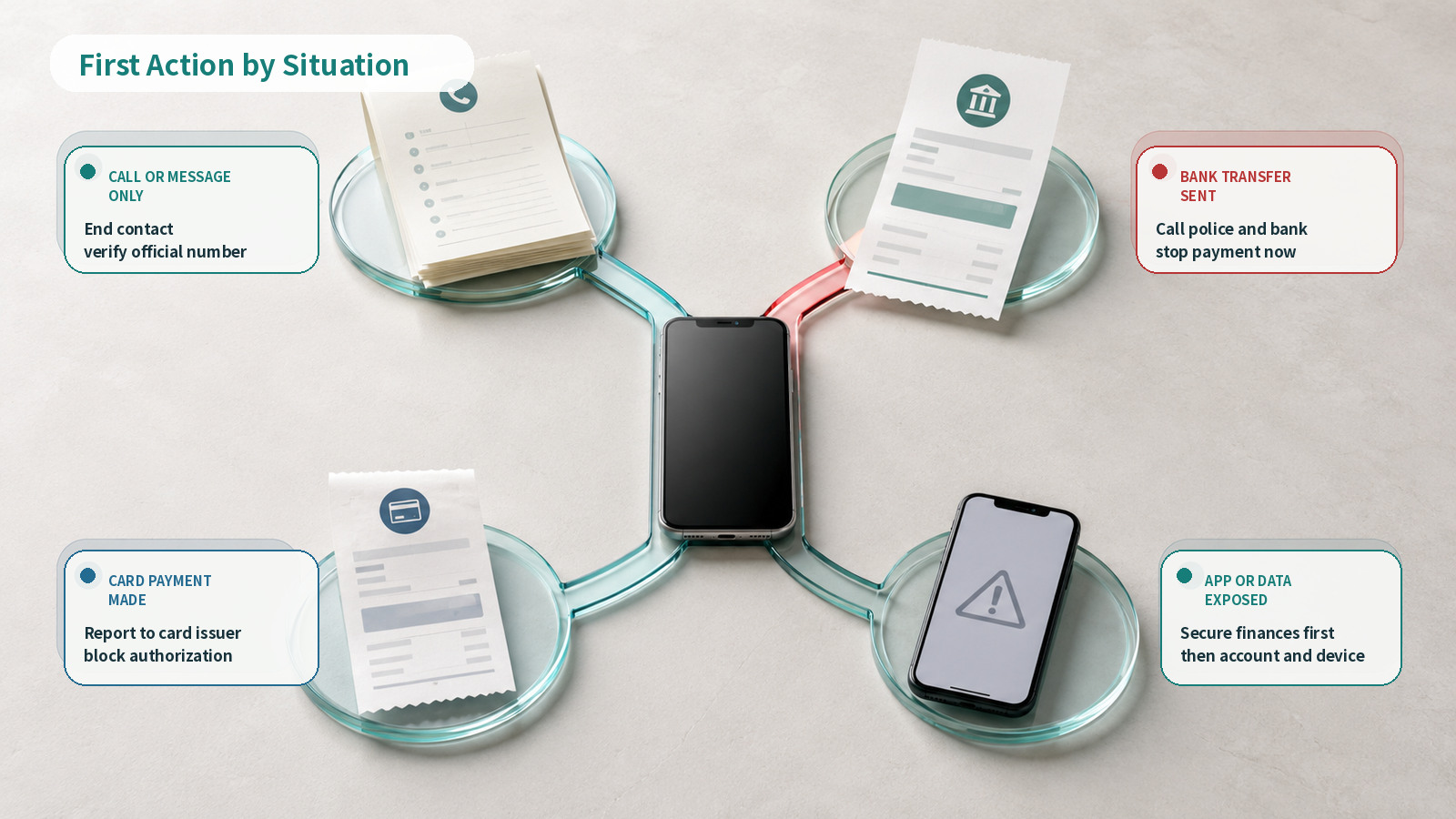
Four situations to separate
- Call or message only: end contact and verify the claimed organization through its official number.
- Bank transfer sent: call 112 and the financial institution immediately to request a payment stop.
- Card payment made: report unauthorized use to the card issuer and ask about blocking the approval and card.
- App installed or credentials shared: secure the money first, then protect the account and device.
Stop the payment first
Korea's police ECRM guidance says a victim may request a stop by phone from the financial institution that manages the account used in the crime. The applicable recovery law also allows a request through the institution that manages the sender's account or the suspected recipient account. Call 112 and the official customer center of the sending institution without spending time deciding which channel is more important.
Prepare the transfer time, amount, sender account, recipient account, account holder name and transfer method. Preserve call logs, messages and the account information used by the scammer. These records help the bank locate the transaction and help police document the loss, but evidence organization should not delay the initial call.
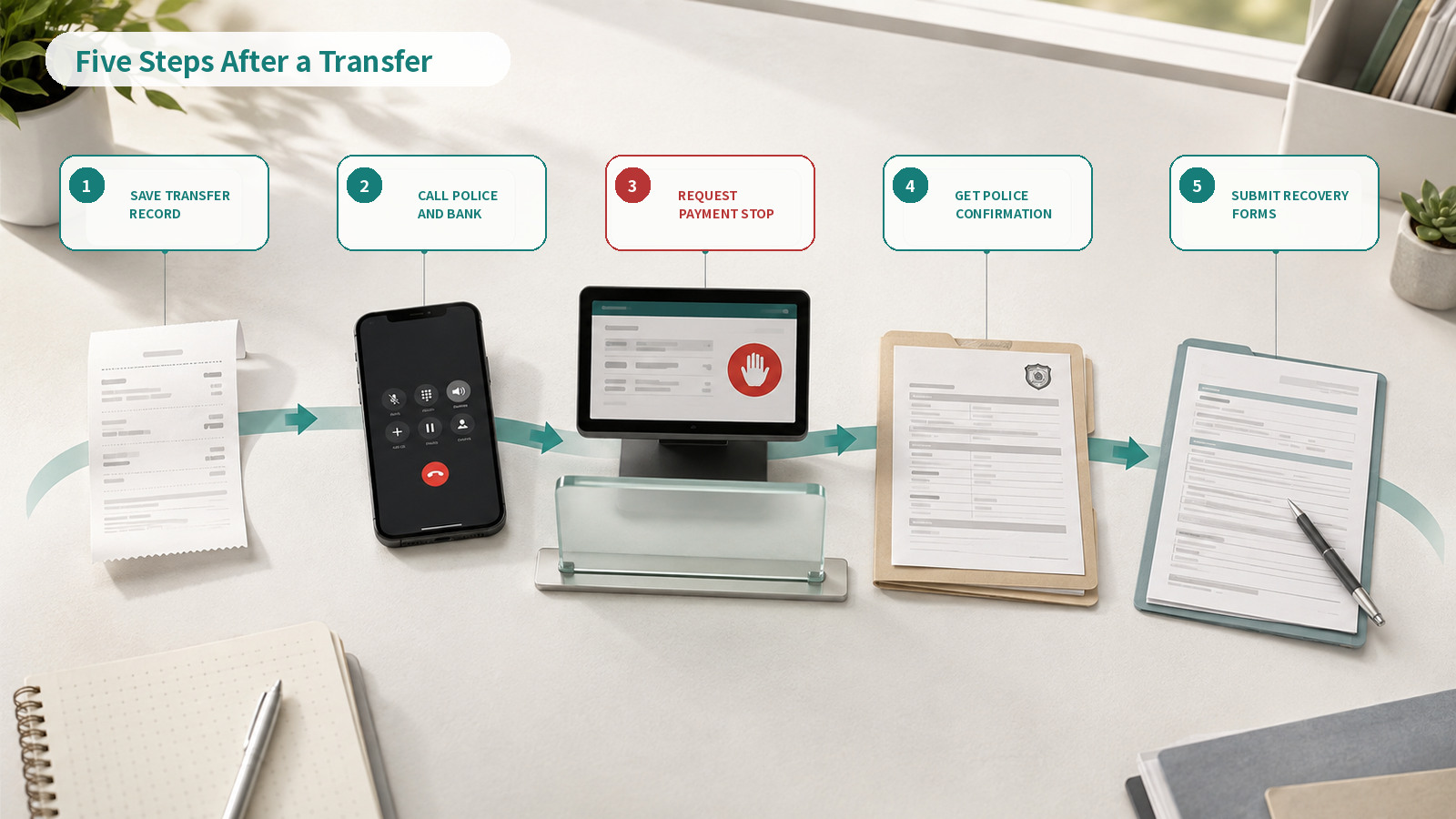
- Save the transfer record and recipient account details.
- Call 112 and the official customer center of the financial institution.
- Request a payment stop and record the reference number and time.
- Report the case at a police station and obtain the incident confirmation document.
- Submit the recovery application and required documents to the financial institution.
What to give the first responder
Provide the time the scam was recognized, contact method, each transfer time and amount, and each recipient account. Separate multiple transfers instead of giving only a total. Before ending the call, confirm that the account and transaction repeated by the agent match the transfer record.
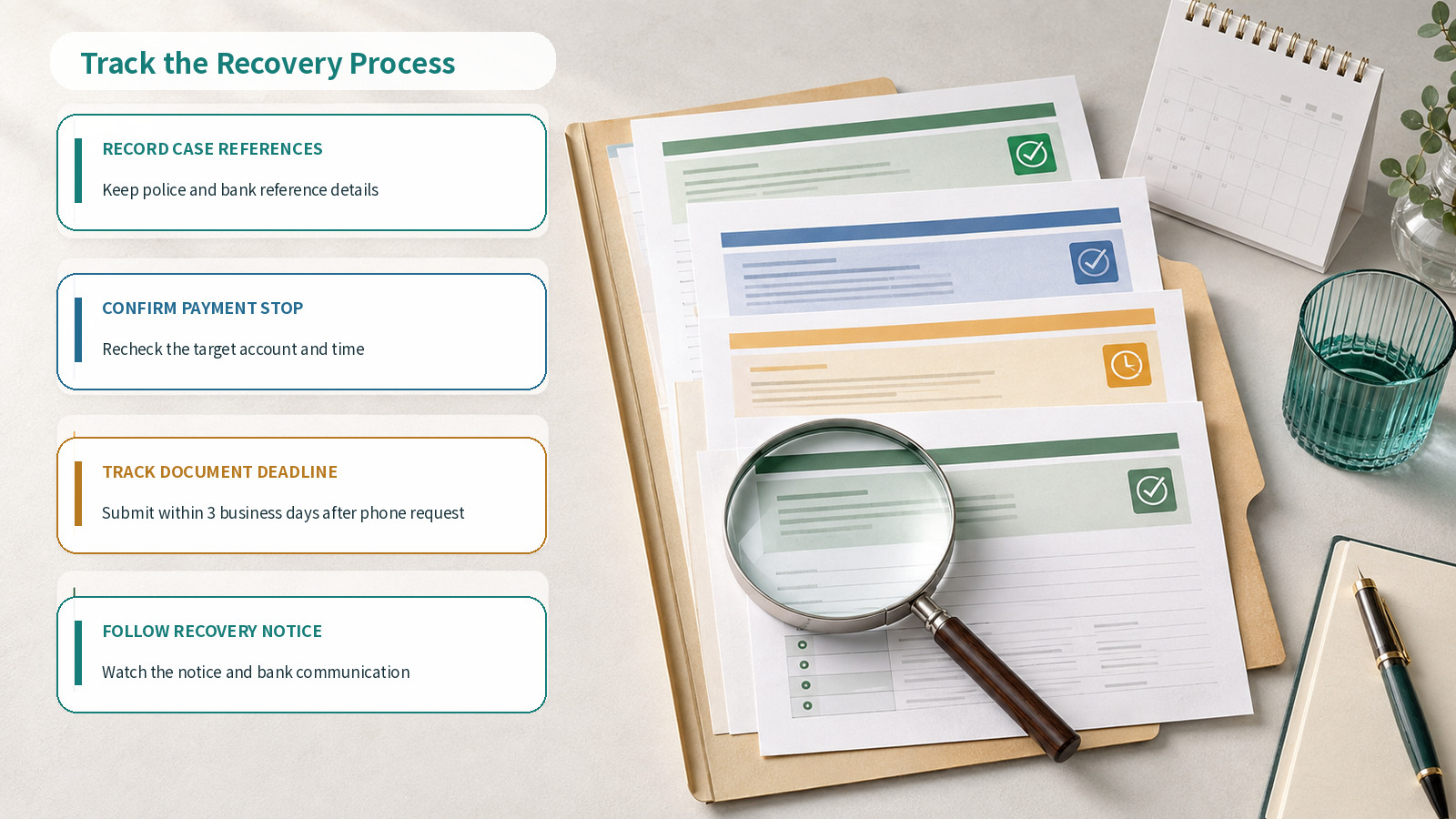
Keep police and financial-institution records in time order. Write down the organization, department, call time, reference number, stopped account and next required action. This makes it easier to connect the police report, bank request and later document submission.
Documents after a phone request
A phone request handles the urgent stop, but it does not finish the process. Police ECRM guidance instructs victims to submit the incident confirmation and recovery application within three business days after a phone request. Record the branch, submission method and deadline given during the call.
Bring the call or message records, transfer details, recipient account information and the story used by the scammer when reporting the case. After police issue the incident confirmation document, submit it with the recovery application to the institution handling the stop. Keep copies of every submitted document and every reference number.
Tracking the recovery process
The stop and the recovery decision are separate stages. After the account is stopped, the institution asks the Financial Supervisory Service to begin the statutory claim-extinguishment notice process. Police ECRM describes a two-month notice period before the refund amount is determined when no objection blocks the process.
Recovery depends on the balance remaining in the recipient account. If the money has already left or several victims share the same remaining balance, the full transferred amount cannot be assumed. Track the stopped account, document acceptance, notice status and communications from the financial institution.
Different paths for cards, cash and compromised devices
For a card payment, report unauthorized use to the card issuer and ask about cancellation, blocking and replacement. For cash handed to a courier or collector, call 112 and preserve the time, location, appearance, vehicle details and receipt. These situations do not use the same recipient-account stop process as a bank transfer.
If remote-control software was installed or authentication details were shared, complete the urgent financial calls first. Then use a trusted device and the service's official recovery channel to secure affected accounts. A work account or work device should also be reported immediately to the organization's security team.
Actions to avoid
- Do not spend reporting time negotiating with the scammer.
- Do not send more money for a claimed safe account, fee or guarantee.
- Do not delete calls, messages or transfer records before reporting.
- Do not trust a number supplied by the scammer; use the institution's official app or website.
- Do not put password changes and phone cleanup ahead of the payment-stop request.
Final checklist
- The 112 report and financial-institution payment-stop request are complete.
- Transfer details, reference numbers and call times are recorded.
- The police incident confirmation document has been issued.
- The three-business-day document deadline has been checked.
- The recovery application and requested records have been submitted.
- Payment-stop status and follow-up notices are being tracked.
Official help channels in Korea
Use 112 for the police report. Request a payment stop through the official customer center of the sender's financial institution or the institution managing the suspected recipient account. Obtain the number from the institution's official app, website, passbook or card rather than from a message sent by the caller.
Sources reviewed
- 전기통신금융사기(피싱) 피해구제 절차경찰청 사이버범죄 신고시스템(ECRM) · Official source
- 전기통신금융사기 피해 방지 및 피해금 환급에 관한 특별법국가법령정보센터 · Official source
- 전기통신금융사기 피해금 환급에 관한 특별법 시행령 제정 추진금융위원회 · Official source
SECUFOCUS NOW reorganized and analyzed the material above. This article does not replace the original sources.
Related SecuNote articles
Entered Card Details on a Phishing Page? Stop the Card and Check for Fraud
A step-by-step guide for anyone who entered card details or a verification code on a phishing page, covering card suspension…

Cloned Car Dealership Websites: How to Verify a Vehicle Before Paying
Scammers are cloning real car dealership websites, listings, photos, reviews, and sales policies to demand upfront wire payments…
Unfamiliar Configuration Profile on iPhone? Check Management and Secure the Device
Configuration profiles can apply work or school accounts, VPN settings, certificates, and other controls to an iPhone. This guide…
Comments
No comments yet.