
Cloned Car Dealership Websites: How to Verify a Vehicle Before Paying
Scammers are cloning real car dealership websites, listings, photos, reviews, and sales policies to demand upfront wire payments for vehicles that do not exist. This guide explains how to verify the dealer and car independently and what to do before or after payment.
Finding the right car online and landing on a polished dealership website can feel like the end of the search. On September 1, 2026, however, the U.S. Federal Trade Commission warned that scammers are cloning real dealership websites to collect upfront payments for vehicles buyers will never receive. Some buyers only discover the fraud after arriving at the real dealership and learning that there is no order, no payment record, and no car waiting for them.
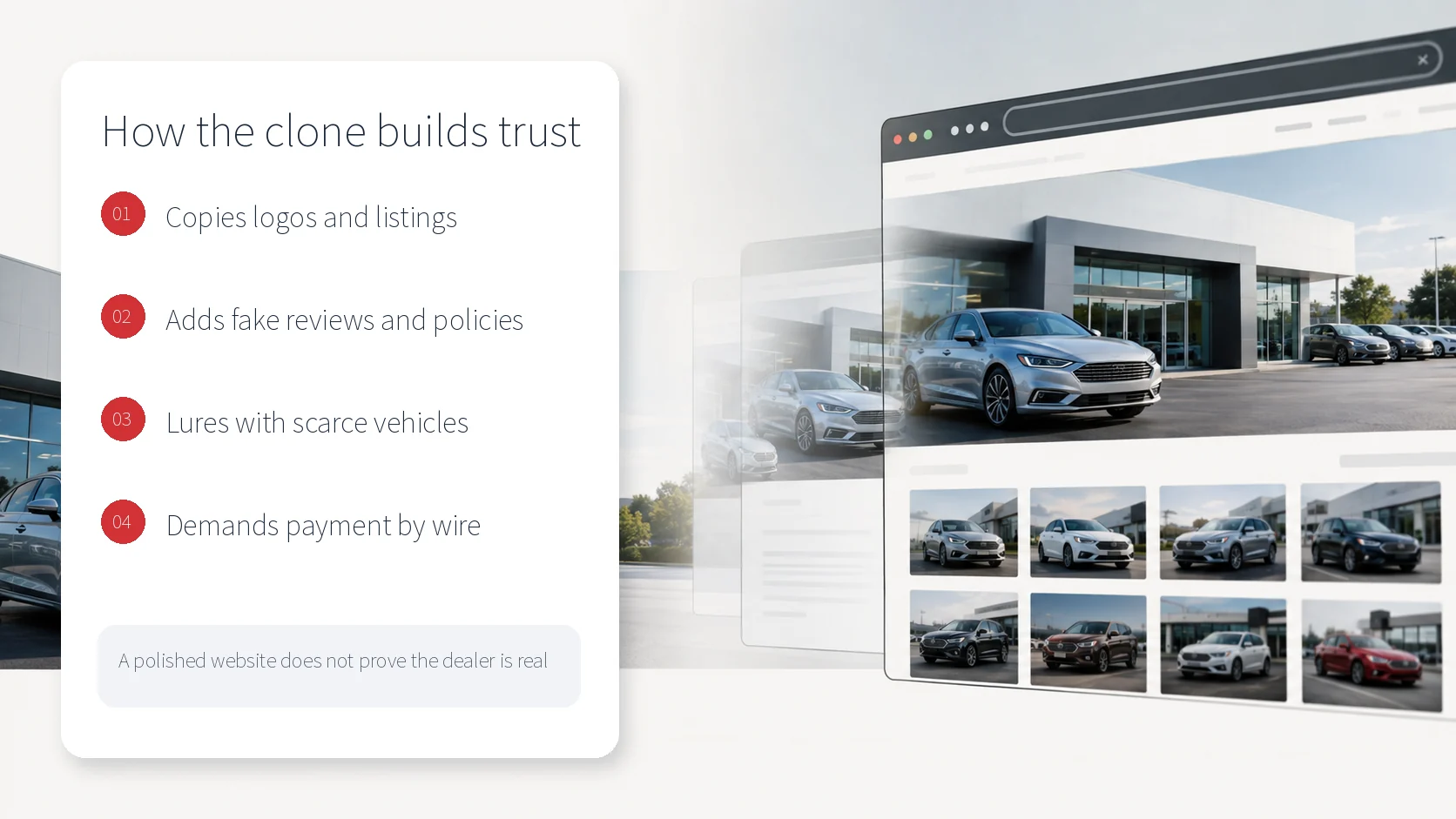
The scam does not rely on an obviously invented business. Fraudsters copy the name, logos, vehicle listings, and photos of a real dealer. They may add fake testimonials, a detailed purchasing process, and flexible return policies. Rare muscle cars and hard-to-find classics create urgency, while a wire payment is presented as the only way to reserve the vehicle. The more complete the website looks, the easier it is to mistake copied information for proof.
A high-value scam built from a real dealer's identity
Traditional bait listings often use an implausibly low price to draw buyers into a showroom. A cloned dealership site borrows the appearance and reputation of a legitimate business as well. The FTC says scammers can use AI to clone a real dealer's site and reproduce brand assets, listings, and photos in detail. Fake customer reviews can make a search of the business name appear reassuring even when the website or contact channel is fraudulent.
That is why reviewing the site only from inside the site is not enough. A copied address may match a real location. Vehicle photos may also appear elsewhere because they were taken from the genuine dealer. Detailed financing steps and a generous return policy can be part of the deception rather than consumer protection. Every important fact has to be checked through a source that the seller does not control.
The decisive moment is the request for money. Stop if the seller insists on wire transfer only, demands a large deposit before inspection, or says the vehicle will disappear unless you pay immediately. Scarcity and a competitive price are not reasons to shorten the verification process. They are reasons to slow down and verify each link between the dealer, salesperson, vehicle, contract, and payee.
Verify independently of the advertisement
Begin by closing the link from the advertisement, social post, text message, or email. Search for the dealer separately and use the relevant licensing authority or official vehicle service to locate its registered name, address, status, and telephone number. A matching business name alone is not enough because the scam may have copied that information from the legitimate dealer.
For a transaction in Korea, Car365 provides Ministry of Land, Infrastructure and Transport dealer information, salesperson lookup, and a quick check for vehicles registered for sale. Compare the salesperson and dealer with the official results. Then call a number obtained from the official record or another trusted channel, not the number supplied in the advertisement. Ask whether the vehicle is in inventory, whether the salesperson works there, and whether the contract and beneficiary account belong to the dealership.
Check the vehicle separately. Car365's quick vehicle lookup uses government and motor-dealer association data to help determine whether a vehicle is registered for sale. Compare the registration number, vehicle details, and inspection report with the advertisement. If a vehicle cannot be verified, do not send money while the question remains unresolved.
Seeing the vehicle is the strongest check. Visit the dealership and compare the car, VIN, odometer, and inspection documents. If distance makes that impractical, choose an independent mobile inspection service or a trusted local representative. The FTC specifically recommends proposing an independent inspection and reconsidering the transaction if the seller refuses. A video or photo selected by the seller is not the same as an inspection chosen by the buyer.
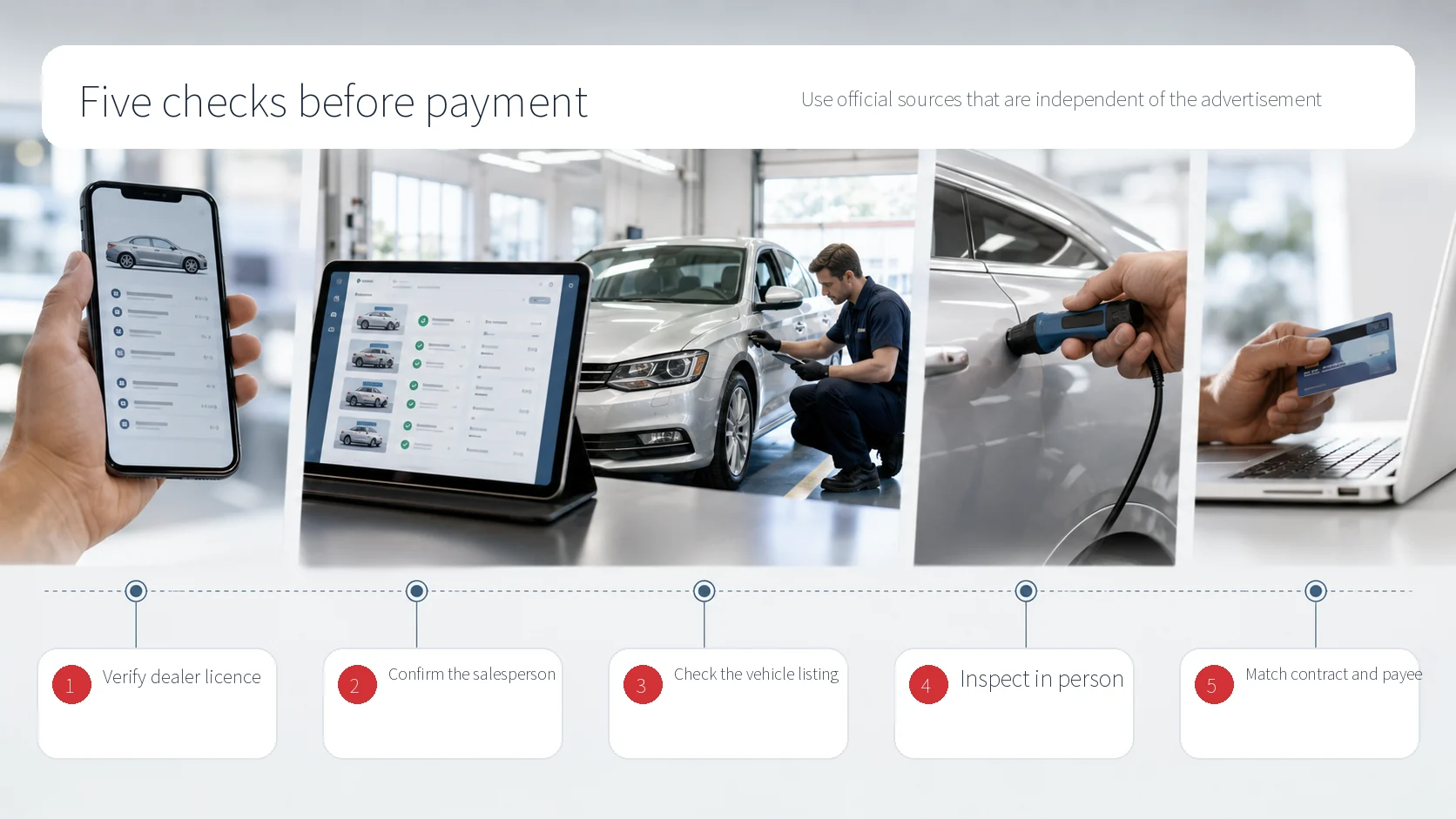
- Check the official dealer record and published phone number
- Confirm the salesperson's affiliation
- Verify the vehicle's registration and sale status
- Inspect the vehicle in person or through an independent service
- Match the contract party, beneficiary account, and payment purpose
Warning signs around the payment request
Price alone is a weak test. A clone can use realistic prices while claiming that another buyer is waiting or that a deposit is due today. The seller may send abundant documents and videos, yet prevent you from verifying them through a channel you selected. Stop if the seller avoids a call to the verified dealership, refuses an in-person or third-party inspection, or asks for payment to a person or account that does not match the contract.
Reviews are also not independent proof. A clone of a real dealership can benefit from the genuine business's reputation. The FTC recommends searching the dealer name with terms such as scam, review, or complaint, but also warns that glowing reviews may belong to the real business being impersonated. Treat searches as a way to find warnings, then verify the licence, phone number, actual vehicle, contract party, and payee separately.
A wire-transfer-only condition deserves extra scrutiny. Wisconsin DMV advises checking an official active-dealer list and independently verifying bank contact information before sending a wire. If the seller offers only a difficult-to-reverse payment method, the concern is not convenience. It is whether the transaction itself can be tied to a verified dealer and a real vehicle.
Actions before and after payment
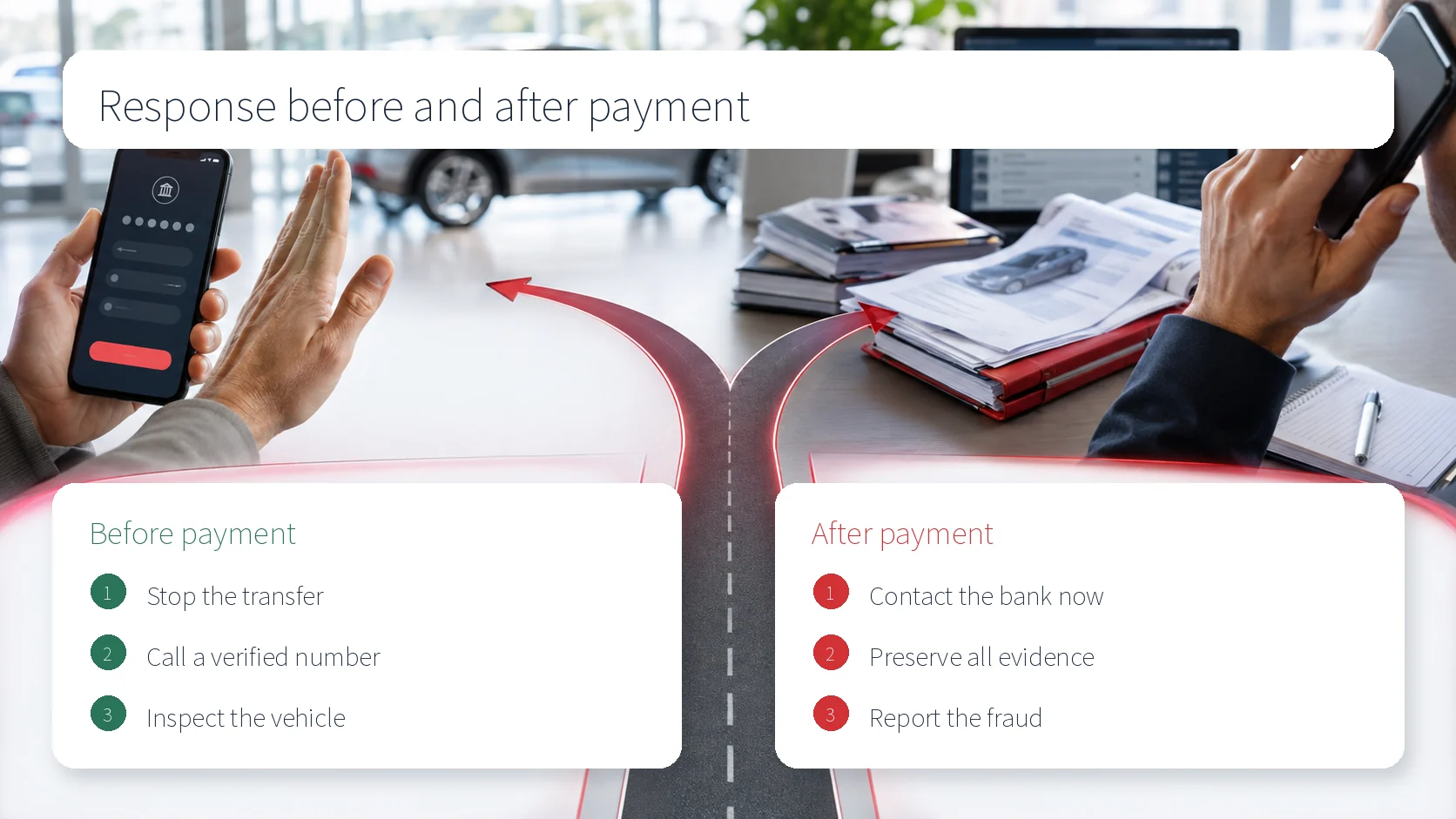
If you have not paid, pause the conversation and preserve the link, phone number, contract, and account details. Contact the dealer through a verified channel, confirm the salesperson and vehicle, and arrange an in-person or independent inspection. Do not send a reservation fee or deposit until those checks are complete, regardless of how urgently the seller pushes.
If you already sent money, contact your financial institution before arguing with the seller. Provide the time, amount, beneficiary account, and reason you suspect fraud, and ask about any available hold or recovery process. Preserve the website address, full-page screenshots, emails, messages, call records, contract files, and transfer receipt in their original form so the sequence of the transaction is clear.
If you also provided an ID copy, card data, or account password, expand the response to match the information exposed. Notify the card issuer or bank and change reused passwords through the official app or a manually entered address. When reporting the scam, distinguish the legitimate dealership from the website and contact channels impersonating it. That helps avoid wrongly identifying the real business as the offender.
Slowing the purchase is the fastest protection
Cloned dealership sites exploit polish, not obvious sloppiness. Correct logos, sharp vehicle photos, positive reviews, and detailed return policies do not establish who controls the website or receives the money. Verification is complete only when official registration data, a real vehicle, the contract party, and the beneficiary account connect outside the advertisement.
For any vehicle found online, keep the sequence: verify the dealer, verify the salesperson, verify the car, match the contract and account, and only then pay. If the seller blocks or asks you to skip a step, walk away. Losing a listing is safer than sending a large payment for an order that does not exist.
Sources reviewed
- Scammers are spoofing car dealership websites: What you need to knowU.S. Federal Trade Commission · Official source
- 중고차 허위매물 점검 및 매매용 차량 신속조회자동차365·국토교통부·한국교통안전공단 · Official source
- Wisconsin DMV warns consumers of rise in online vehicle dealership clone scamsWisconsin Department of Transportation · Official source
SECUFOCUS NOW reorganized and analyzed the material above. This article does not replace the original sources.
Related SecuNote articles
Unfamiliar Configuration Profile on iPhone? Check Management and Secure the Device
Configuration profiles can apply work or school accounts, VPN settings, certificates, and other controls to an iPhone. This guide…
Fake Buyer-Protection Portals: Refund, ID and Bank-Detail Checks
A newly disclosed HKICL impersonation scheme combined refund support, identity verification, bank details, a fake wallet and an…
August 30 Consumer Security Briefing: Fake Interview Apps, GTA 6 Downloads, and Municipal Invoices
Three recent schemes exploit trusted moments—a job interview, a highly anticipated game search, and a municipal invoice. This…
Comments
No comments yet.