
What Is a VPN? Encrypted Tunnels, Traffic Flow, and Connection Scope
A VPN creates a protected communication path over a shared network to connect remote devices or separate private networks. This guide explains tunnel establishment, remote-access and site-to-site placement, traffic routing, and practical operating checks.
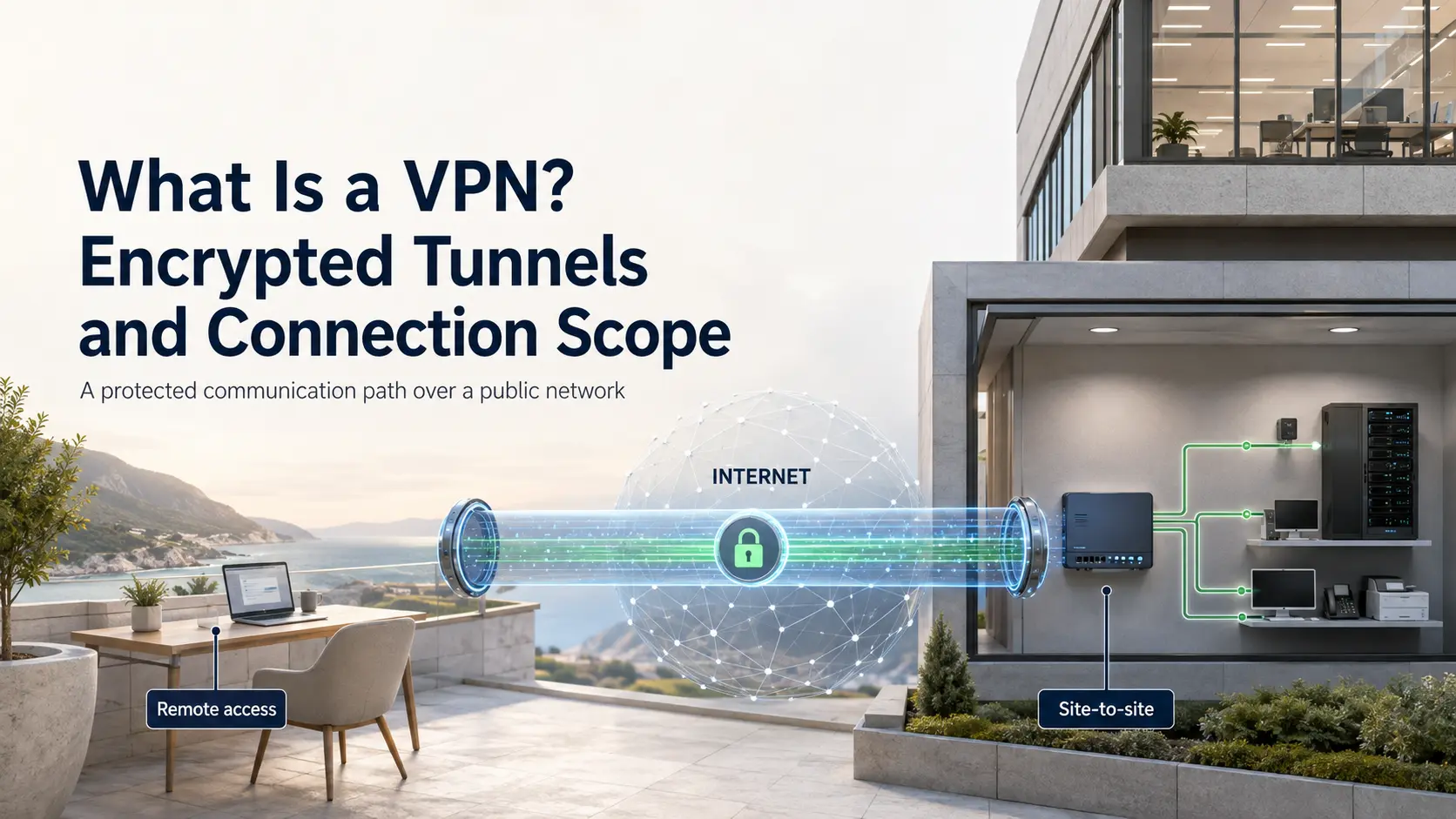
Remote workers and separate offices often need to reach private services across Internet links their organization does not own. A virtual private network creates a logical, policy-controlled path over that shared infrastructure so approved devices or networks can communicate with defined destinations. It does not replace the underlying network; it adds a protected overlay with explicit participants, routes, and security parameters.
VPN definition
NIST defines a VPN as a virtual network built on existing physical networks that can provide secure communications for data and IP information between networks or nodes. A useful analogy is a sealed lane laid across a public road. Intermediate networks still carry the outer packets, while the authorized tunnel endpoints process the protected contents. Encryption supports confidentiality, integrity checks reveal alteration, and peer authentication helps confirm that the endpoint is allowed to establish the connection.
The actual protection depends on the protocol, cryptographic configuration, authentication method, and routing policy. IPsec applies controls at the network layer, allowing many applications to use the same protected path without implementing transport security separately. It can protect the contents carried within the defined tunnel, but its scope ends where the configured tunnel and endpoints end.
Two connection placements
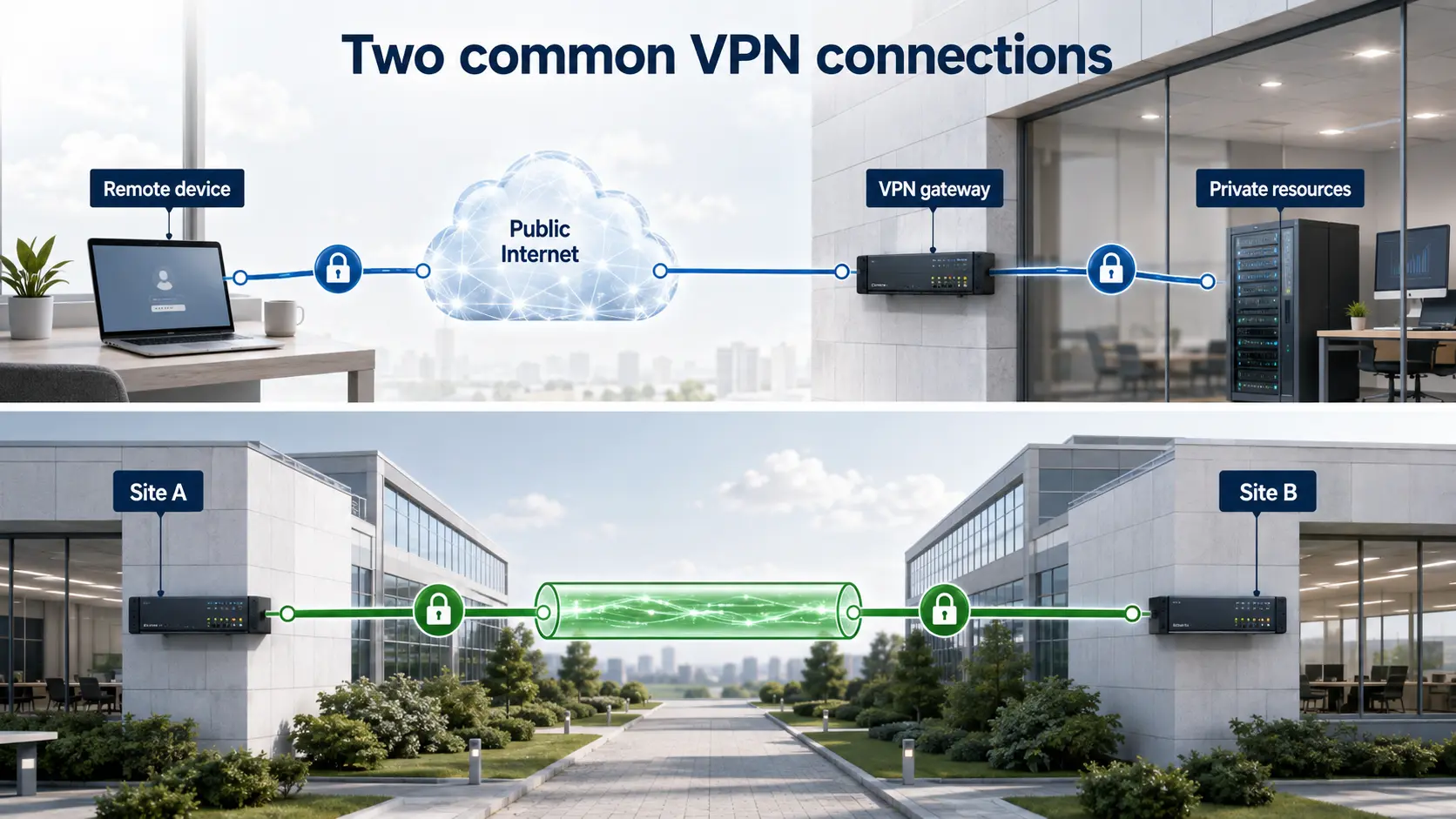
A remote-access VPN connects one user device to an organizational gateway. A laptop or managed endpoint authenticates, receives a virtual address or routes, and reaches only the private destinations permitted by policy. Because users and device locations change, account lifecycle, additional authentication, client support, and session termination are central operating concerns.
A site-to-site VPN connects two network gateways. Headquarters and a branch, or a data center and another private network, exchange traffic for defined address ranges without requiring each user to start a client. Operators must plan the advertised networks, avoid overlapping address space, and test alternate paths. Both placements use the same VPN concept; the difference is whether the tunnel joins an individual endpoint or two networks.
Tunnel establishment and transport
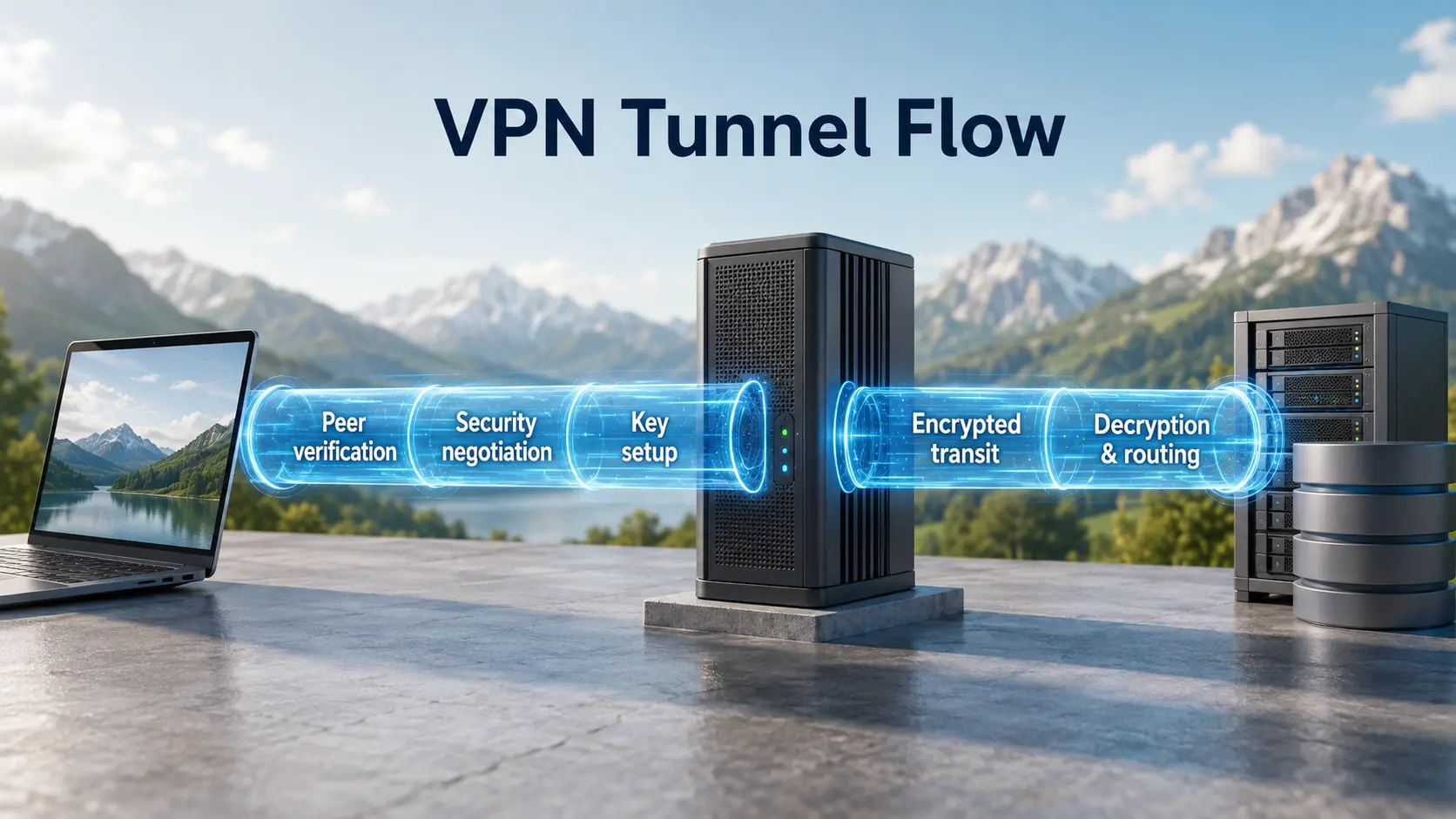
A VPN does not begin by sending application data immediately. The client or gateway first identifies its peer, determines compatible security parameters, and satisfies the required authentication checks. In an IPsec design, IKE negotiates those parameters, performs authentication, and establishes the keys used by the protected connection. Only after both sides agree can traffic enter the tunnel.
When a packet matches a tunnel route, the endpoint encapsulates it and adds encryption and integrity protection. Public-network routers deliver the outer packet to the other VPN endpoint. That endpoint validates the packet, removes the protection, and routes the original packet to its private destination. Replies follow the reverse path. Connection lifetimes and anti-replay handling help maintain a bounded session rather than treating old protected traffic as permanently valid.
- Verify the peer and authentication conditions
- Negotiate compatible security parameters
- Establish keys and a protected session
- Encapsulate and encrypt matching traffic
- Validate, decrypt, and route to the private destination
Traffic routing
A connected VPN does not necessarily carry every packet. Routing rules decide which destinations use the tunnel interface. A full-tunnel design sends ordinary Internet traffic through the organizational gateway as well as private traffic, which can simplify consistent inspection and logging but increases bandwidth and latency demands on the gateway.
A split-tunnel design sends only selected private routes through the VPN while other traffic uses the device's normal Internet path. This reduces load, but the organization must maintain the exact list of protected destinations. New services can miss the tunnel if routes are not updated. DNS selection also affects name resolution and connectivity, so address ranges, routes, and DNS behavior should be reviewed as one operating set.
Access policy and scope
Successful VPN authentication should not imply access to every internal system. Reachable subnets and service ports can be limited by user role, device type, and business purpose. A partner account may need one administration segment, while ordinary users need only application services. Site-to-site policies should likewise specify necessary source and destination combinations instead of automatically permitting an entire remote network.
Address planning matters as deployments grow. A remote-user pool that overlaps a server or branch network can produce ambiguous or incorrect return paths. Operators should manage address pools, concurrent-session capacity, idle timeouts, reauthentication intervals, and credential revocation together. When an account or device is retired, its VPN access should be removed through the same lifecycle rather than remaining as a separate forgotten path.
Operations review
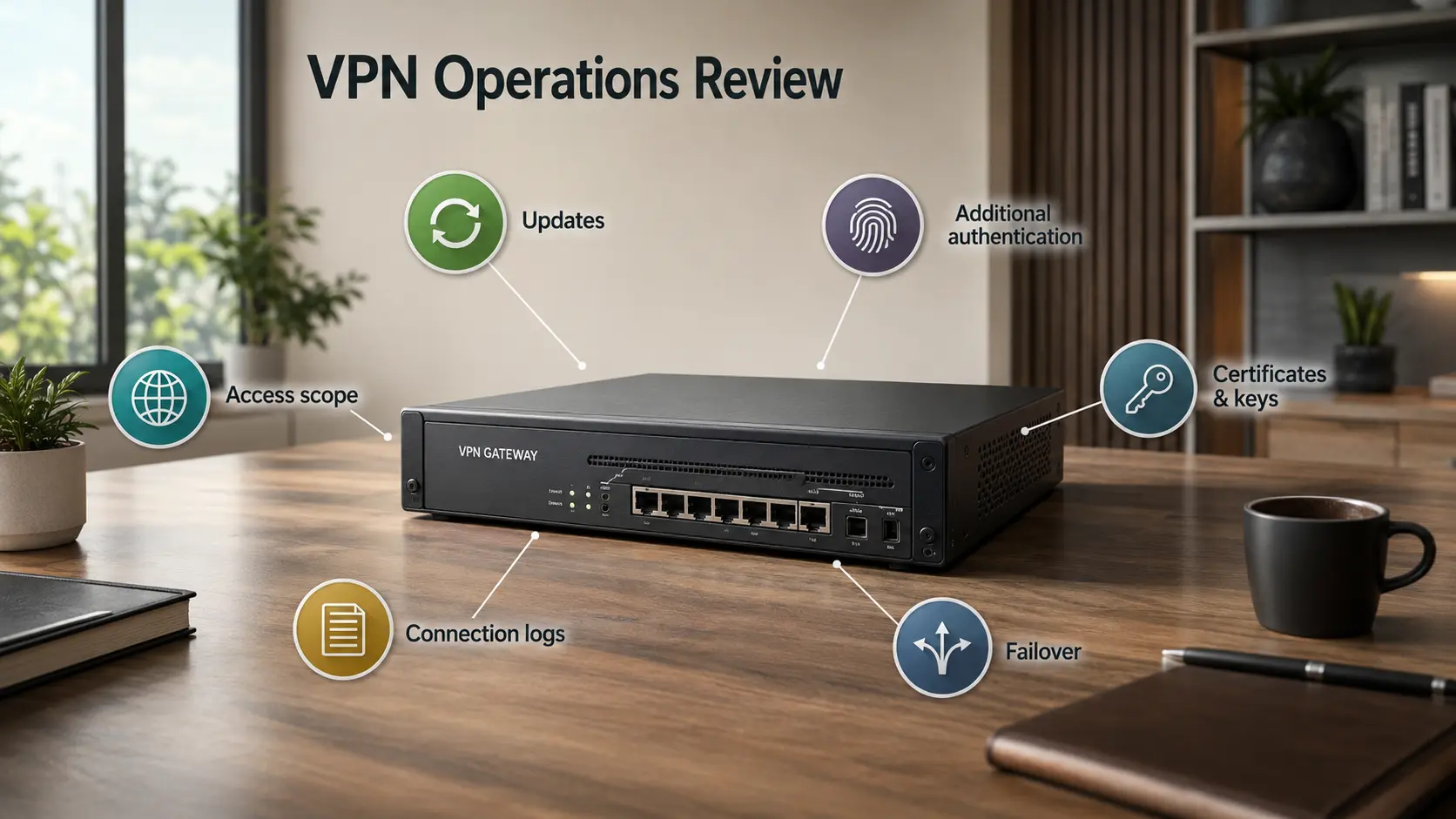
Because VPN gateways face external networks, product updates and security advisories require regular attention. CISA and NSA recommend standards-based solutions, timely updates, reduced exposure of management interfaces, strong authentication, and useful monitoring. Server and client support policies should be aligned so an updated gateway is not paired indefinitely with obsolete endpoint software.
- Supported and updated gateway and client versions
- Additional authentication and separately protected administrator accounts
- Certificate and key issuance, expiration, rotation, and revocation
- Permitted networks and services for each user or site
- Logs for connection identity, time, result, and session context
- Capacity, link failure, and alternate-gateway transition procedures
Useful logs provide more than success and failure counts. Identity, connection time, assigned address, and termination reason create the context needed for operations. Repeated failures from an unusual location, simultaneous use of one account, or frequent tunnel renegotiation can prompt review for misuse or configuration trouble. A standby gateway also needs matching certificates and policies, and failover should be tested before an outage.
Boundaries and misconceptions
A VPN protects traffic within its defined tunnel, not the endpoint or server by itself. A compromised device can send harmful traffic through a correctly functioning connection, and data follows the receiving service's controls after decryption. NIST notes that IPsec does not eliminate every network risk, so endpoint protection and service authorization remain separate responsibilities.
A VPN also does not automatically make a user anonymous. A destination can observe the gateway address, the operator may retain connection records under its policy, and split-tunneled traffic does not use the specified VPN path. The practical objective is a managed communication path between defined parties—not a broad promise that every activity becomes hidden or trusted.
Summary
A VPN builds a logical protected route over shared infrastructure. It can join a remote device to a gateway or connect two networks, using peer verification, security negotiation, key establishment, encrypted transport, and decryption at the destination endpoint. Effective operation depends on knowing which traffic enters the tunnel, limiting access after connection, maintaining credentials and software, and testing logs, capacity, and failover.
Sources reviewed
- Virtual Private Network (VPN) — GlossaryNIST Computer Security Resource Center · Official source
- Guide to IPsec VPNs (NIST SP 800-77 Rev. 1)National Institute of Standards and Technology · Official source
- CISA and NSA Release Guidance on Selecting and Hardening VPNsCybersecurity and Infrastructure Security Agency · Official source
SECUFOCUS NOW reorganized and analyzed the material above. This article does not replace the original sources.
Related SecuNote articles
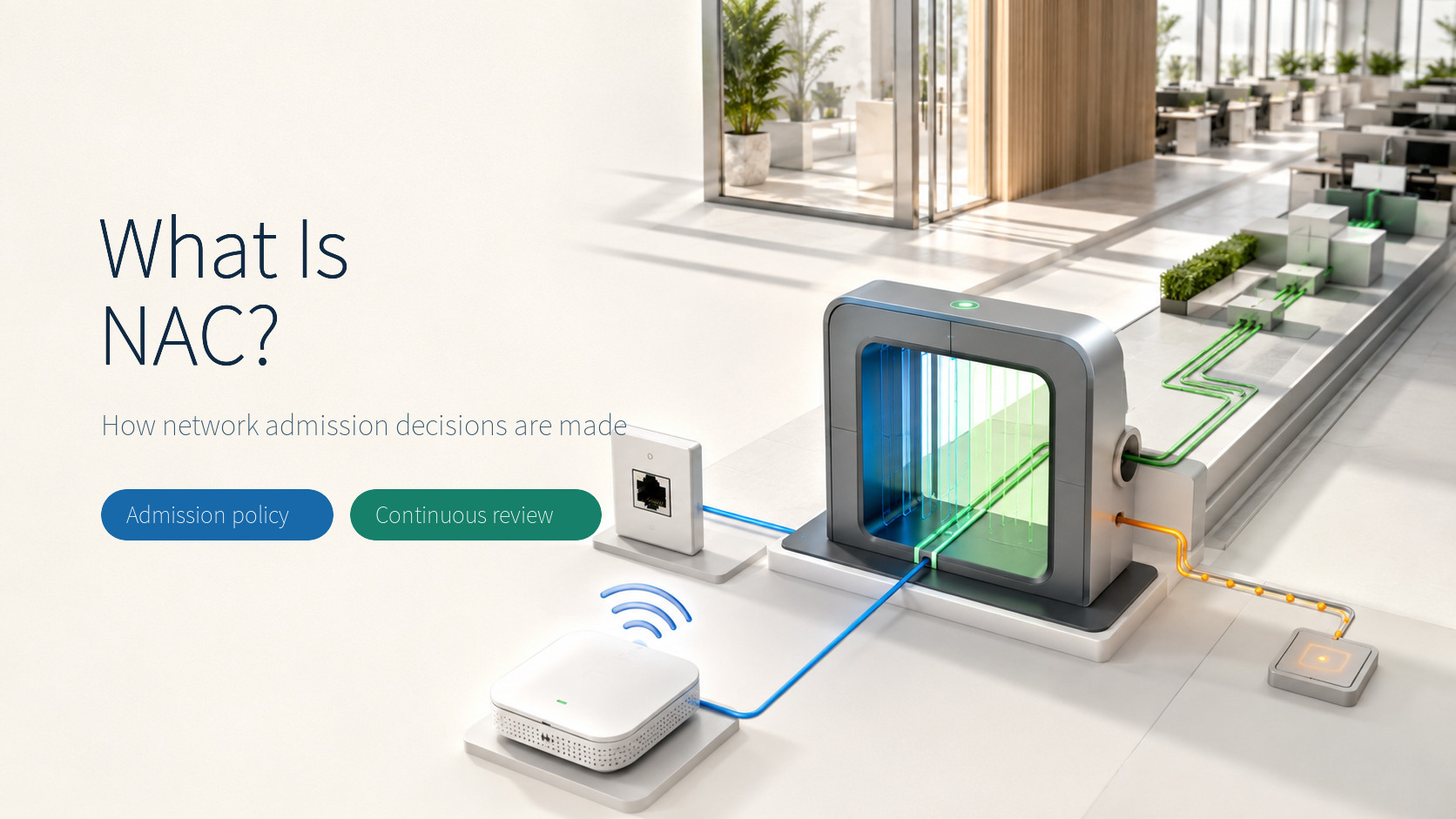
What Is NAC? How Network Admission and Access Decisions Work
Network access control evaluates who and what is connecting, where the request originates, and whether the endpoint meets policy…
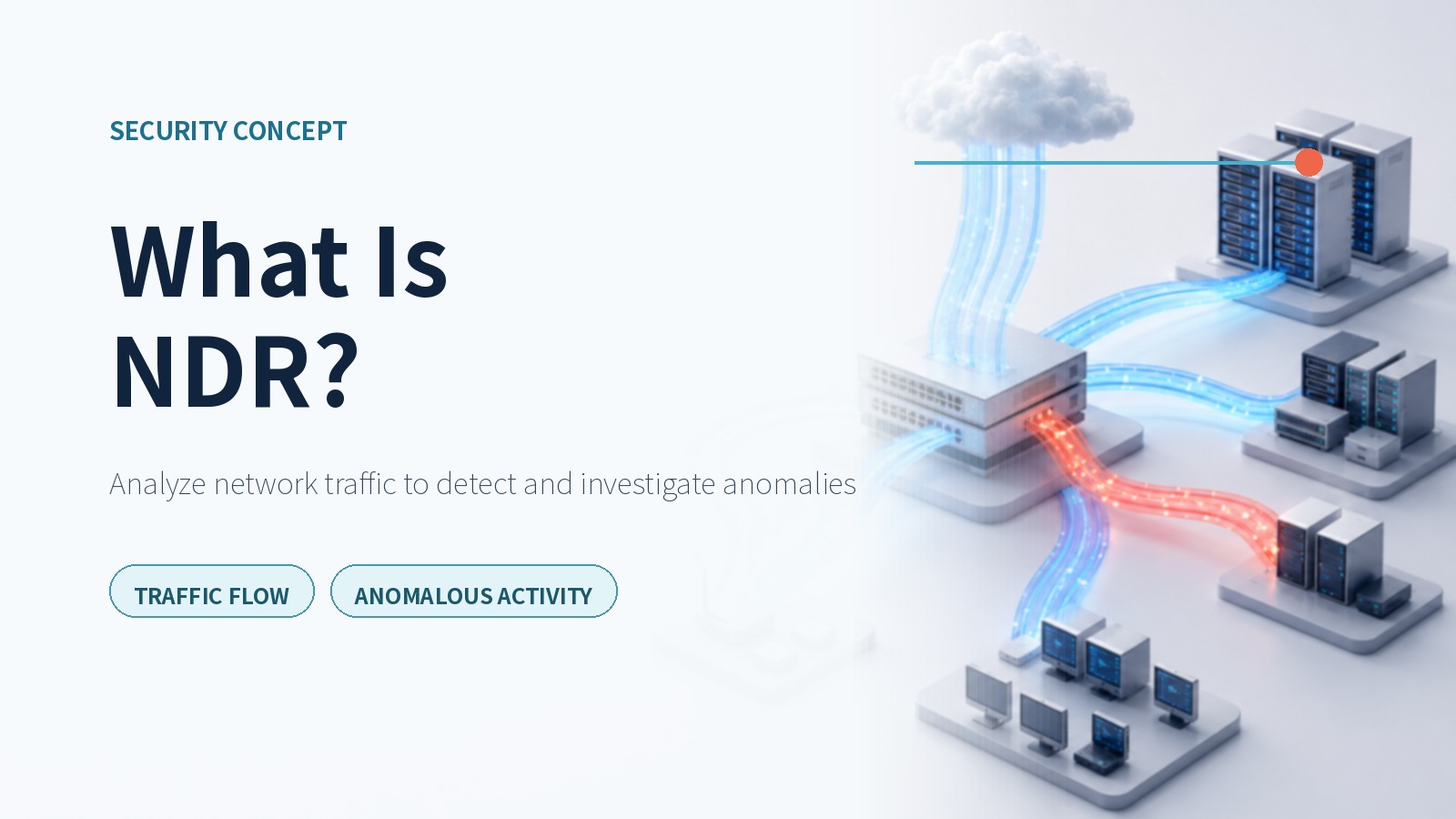
What Is NDR? How Network Detection and Response Analyzes Traffic
A practical explanation of how NDR analyzes north-south and east-west traffic, connects assets and sessions, and turns network…
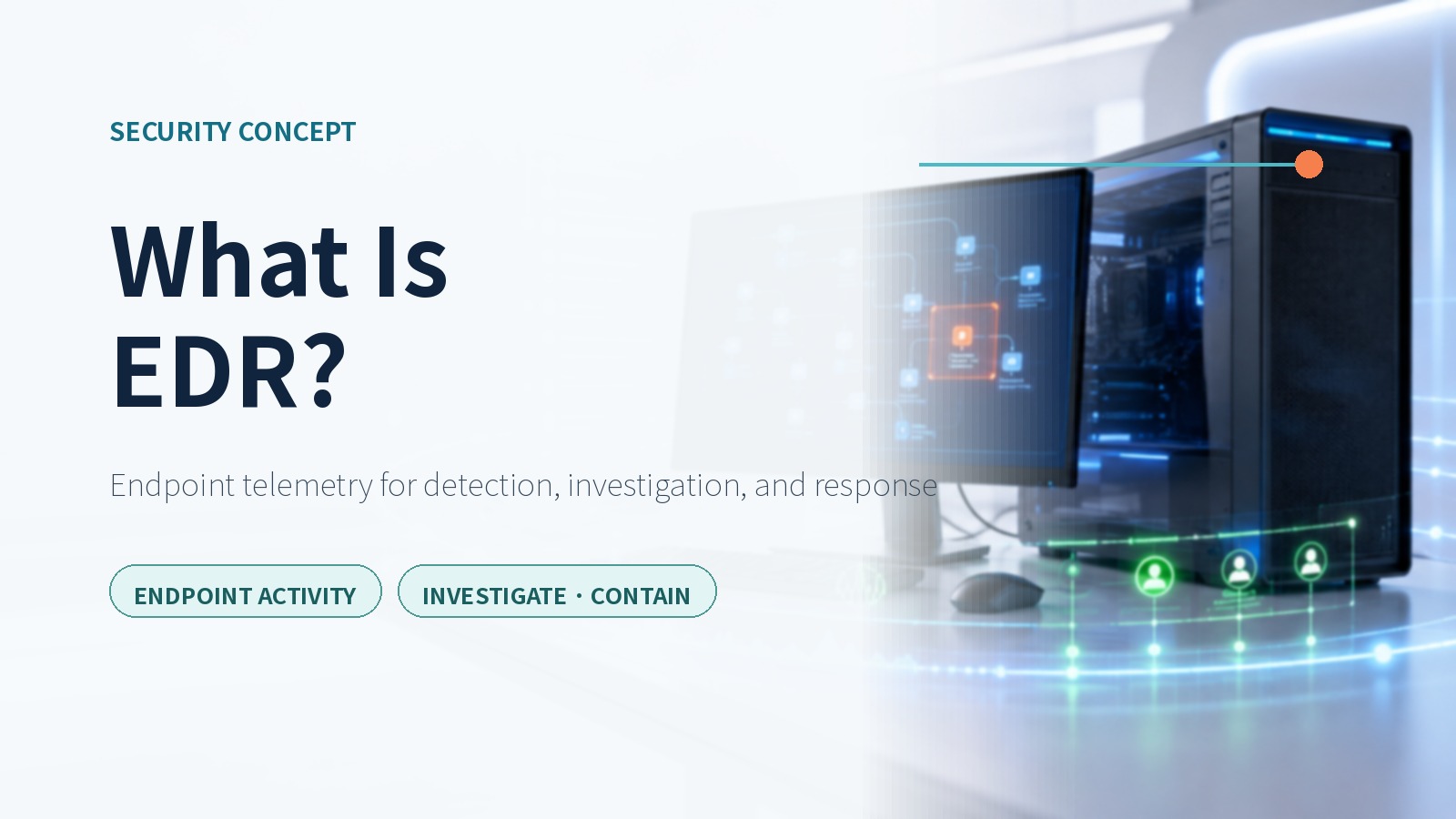
What Is EDR? How Endpoint Detection, Investigation, and Response Work
A practical explanation of how EDR connects endpoint telemetry into alerts, investigations, and controlled response actions.
Comments
No comments yet.