
What Is NAC? How Network Admission and Access Decisions Work
Network access control evaluates who and what is connecting, where the request originates, and whether the endpoint meets policy before granting, restricting, or blocking access. This guide explains the admission decision, enforcement path, and operating cycle.

A laptop plugged into a conference-room port or a phone joining corporate Wi-Fi immediately asks the network for access. A physical link or a correct wireless password should not automatically open the entire internal environment. Network access control, or NAC, evaluates who is connecting, which endpoint is involved, where the request originates, and which policy conditions apply before deciding what the connection may reach.
NAC is best understood as a decision-and-enforcement system rather than a single login prompt or blocking appliance. It collects context at the point of connection, evaluates organizational policy, and applies the result through network infrastructure such as switches, wireless access points, and remote-access gateways. The same employee can receive different access from a managed laptop and a personal phone, and the same endpoint can receive a different decision when its location or posture changes.
The NAC definition
NIST defines network access control as restricting network access according to user credentials and the outcome of client health checks. That definition combines two dimensions: the identity associated with the request and the condition of the endpoint making it. NAC joins those signals with access policy to allow the connection, place it in a restricted segment, or block it.
The decision therefore extends beyond a correct password. Policy may consider whether the endpoint is registered, the switch port or wireless network it uses, the network segment appropriate for its role, and defined posture requirements. Organizations select the conditions that fit their assets and operating model; NAC does not impose one universal checklist.
From connection request to enforcement
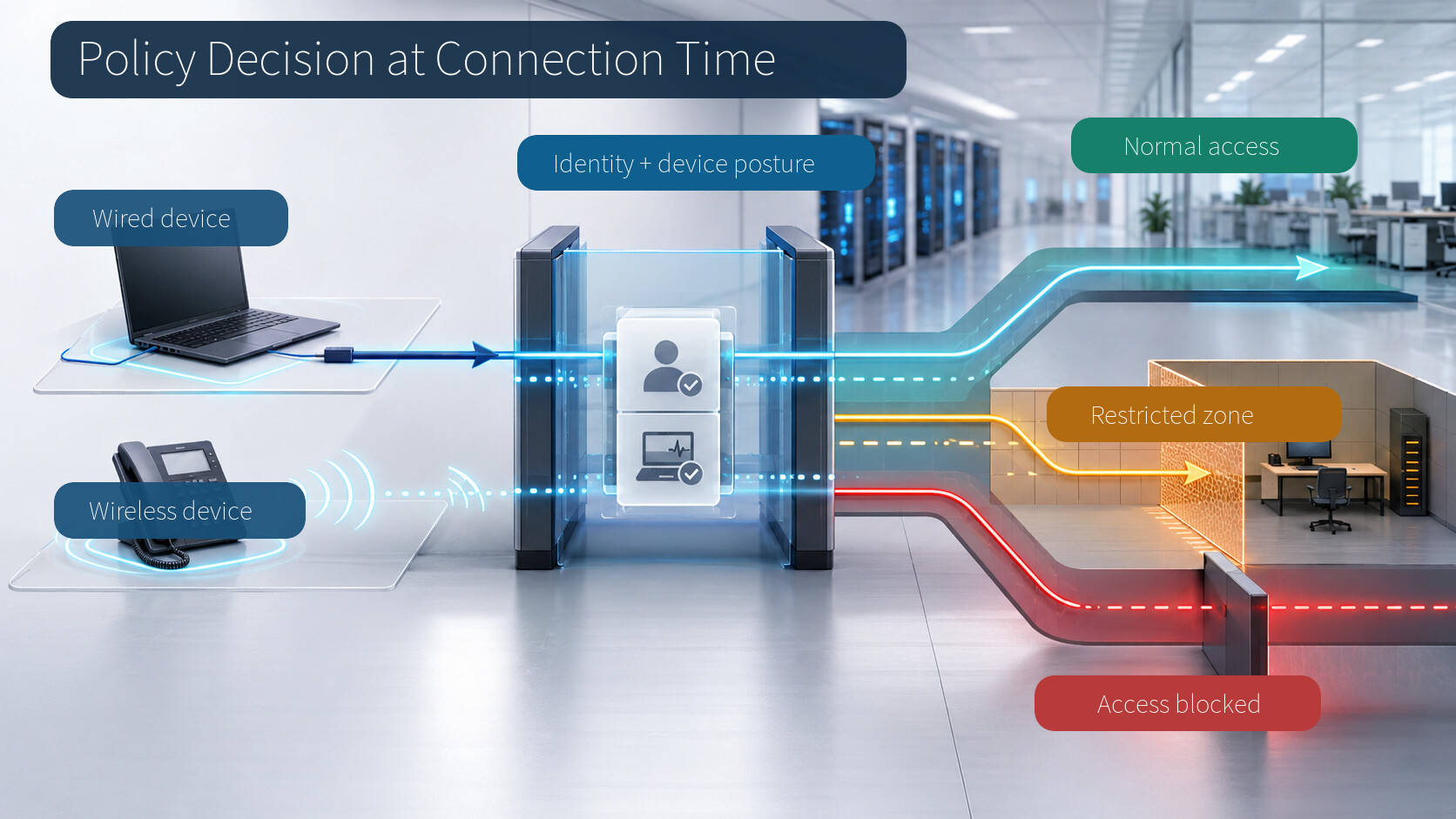
The first step is identifying the request. NAC distinguishes a laptop on a wired port, a phone joining Wi-Fi, or an employee entering through remote access, then gathers the available identity, endpoint, location, and posture context. A policy decision point evaluates that context and returns the appropriate access result.
The result must be enforced on the real traffic path. Compliant requests can be connected to the network resources appropriate for their role. An endpoint that needs registration, an update, or another corrective step can be placed in a restricted segment with only the necessary services. Requests that policy rejects can be denied. Cisco describes NAC in the same practical sequence: verify the user and device, check compliance, then grant, limit, or deny access.
Allow does not have to mean unrestricted access to every internal system. Human-resources staff, developers, guests, printers, and specialized equipment need different network paths. A NAC policy can assign an authenticated subject only the segment or services appropriate to its role and device class.
Inputs behind the decision
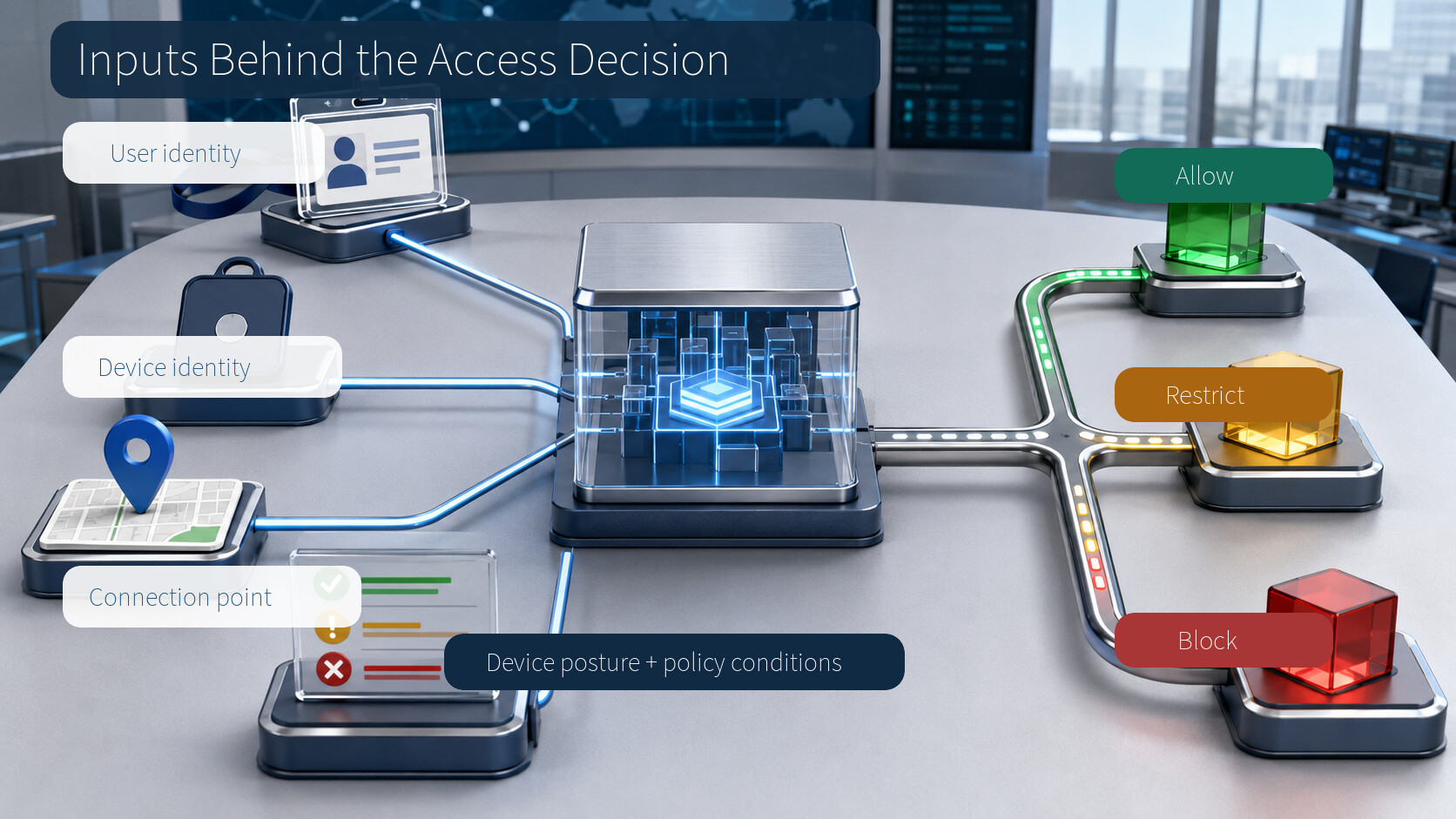
User identity connects the request to a role. Device identity separates managed corporate assets, personal endpoints, printers, phones, and equipment that cannot perform an interactive login. The connection point adds context such as headquarters wired access, branch Wi-Fi, a guest network, or a remote gateway. Device posture evaluates the policy conditions that the organization has defined for that endpoint class.
Posture is not a universal safety score. An organization decides which configuration or management signals matter, how recent the evidence must be, and which outcome follows a failed check. Requirements that are too broad can interrupt legitimate work, while weak requirements reduce the value of enforcement. The decision model should reflect both security needs and the ability to maintain accurate endpoint data.
Where 802.1X and RADIUS fit
802.1X and RADIUS are common building blocks for NAC, but neither is identical to the complete NAC function. 802.1X supports port-based authentication on wired switches and wireless networks. The endpoint requests access, the switch or access point relays the exchange and enforces the result, and an authentication or policy service evaluates the request.
RADIUS centralizes authentication, authorization, and accounting for requests sent by network devices. Microsoft's Network Policy Server documentation describes wireless access points, authenticating switches, and VPN servers as RADIUS clients whose requests can be evaluated and recorded centrally. NAC can use this path to deliver policy decisions, while asset identification, posture evaluation, exception handling, and reassessment still require an operating design around it.
Allow, restrict, and block
- Allow: connect a request that meets identity and endpoint policy to the role-appropriate network or services.
- Restrict: place an endpoint that needs registration, updates, or corrective action in a limited segment.
- Block: deny entry when authentication fails or the request violates admission policy.
These results are not permanent labels. A restricted endpoint may regain normal access after it completes the required step, while an endpoint can be reevaluated when its location, role, or posture changes. Operators should define what each outcome permits, who owns remediation, and when temporary exceptions expire.
Reassessment and decision records
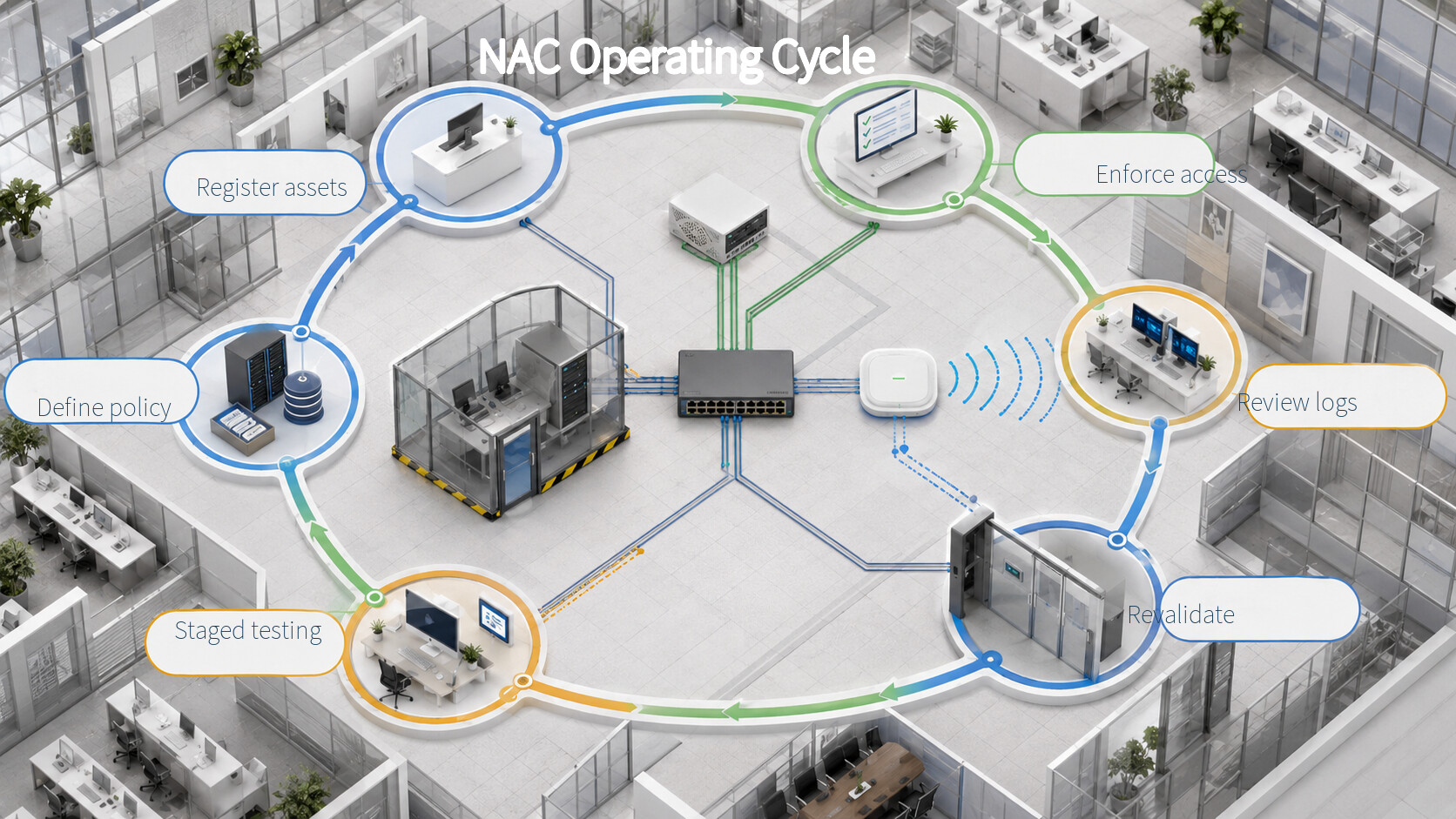
A single approval at the start of a session does not complete the operating cycle. Endpoints reconnect from different locations, user roles change, and policy baselines evolve. NAC operations therefore need current asset data, policy lifecycle management, and reassessment. Cisco includes visibility, device profiling, posture checks, and policy lifecycle capabilities in its NAC overview.
Decision records explain why access was granted or limited. Linking the time, identity, endpoint, connection point, applied policy, and final result makes it easier to investigate false restrictions and recurring exceptions. Microsoft NPS can record RADIUS requests and accounting data in local logs or a database. Those records become useful when teams review concentrated failures, unregistered assets, and long-lived exceptions instead of merely retaining them.
Operational checks
- Maintain the asset inventory: separate managed endpoints, personal devices, guests, printers, and specialized equipment, with an owner for each class.
- Document policy inputs: connect user role, device class, location, posture conditions, and the resulting access scope.
- Test in stages: validate authentication failures, restricted access, business impact, and recovery before broad rollout.
- Expire exceptions: assign an owner and end date to equipment exceptions and urgent business access.
- Review decision records: examine failure reason, applied policy, final access, and repeated exceptions together.
- Revalidate periodically: revisit policies when roles, assets, or network paths change.
A practical rollout starts with well-managed corporate endpoints and a clearly bounded network segment. Teams can then extend coverage to guests, personal devices, and specialized equipment while refining identification and exception workflows. Enforcement points must also sit on the actual connection path. A correct policy decision has no effect if the switch, access point, or remote gateway cannot apply it.
Scope and limitations
NAC governs admission to the network and the access scope assigned to the subject and endpoint. A shared policy model can reduce inconsistent rules across employee, guest, contractor, wired, wireless, and remote connections. It can also classify non-interactive devices such as printers and phones so they receive a narrower, purpose-specific network path.
An admission decision does not guarantee that every later action is safe. Valid credentials and a compliant endpoint can still perform an inappropriate action within their granted scope. Inaccurate asset identity or a path that bypasses enforcement can also weaken the intended control. NAC works as a network admission and authorization foundation when accurate inventory, policy design, enforcement coverage, and decision records are maintained together.
Summary
NAC turns a network connection into a policy decision. It combines user identity, endpoint identity, connection context, and defined posture conditions, then enforces an allow, restrict, or block result on the access path. The sound starting point is an accurate asset model and explicit access scope, followed by staged testing, expiring exceptions, record review, and reassessment. Used this way, NAC connects the right subject and endpoint to the network resources they actually need.
Sources reviewed
- Network Access ControlNIST Computer Security Resource Center · Official source
- What Is Network Access Control (NAC)?Cisco · Official source
- Network Policy Server (NPS) overviewMicrosoft Learn · Official source
SECUFOCUS NOW reorganized and analyzed the material above. This article does not replace the original sources.
Related SecuNote articles

What Is a VPN? Encrypted Tunnels, Traffic Flow, and Connection Scope
A VPN creates a protected communication path over a shared network to connect remote devices or separate private networks. This…
What Is NDR? How Network Detection and Response Analyzes Traffic
A practical explanation of how NDR analyzes north-south and east-west traffic, connects assets and sessions, and turns network…
What Is EDR? How Endpoint Detection, Investigation, and Response Work
A practical explanation of how EDR connects endpoint telemetry into alerts, investigations, and controlled response actions.
Comments
No comments yet.