
UT San Antonio Delays Classes After an Attempted Network Intrusion
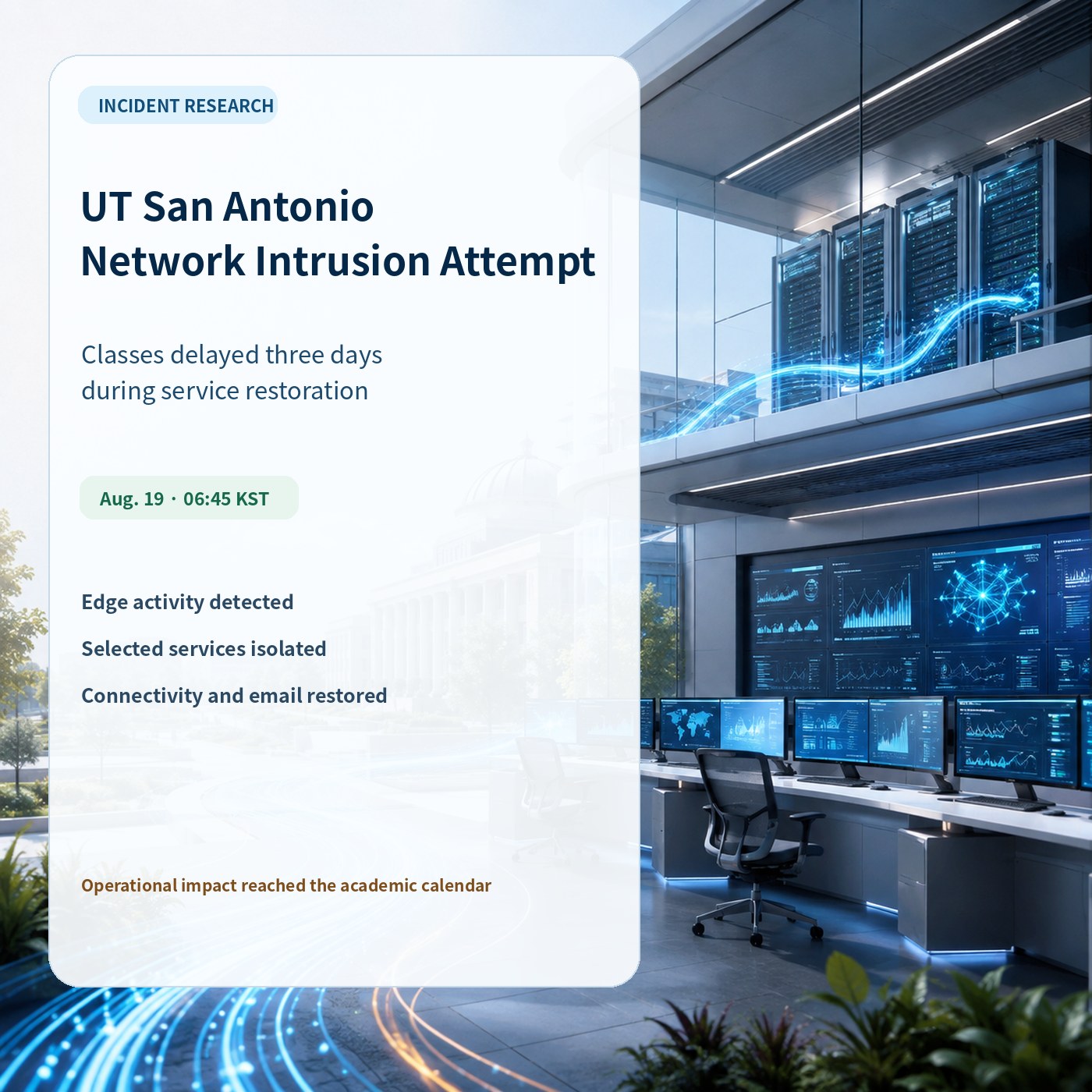
UT San Antonio isolated selected academic-campus services after detecting attempted unauthorized activity at the network edge. As connectivity, email, and other essential services were restored, the university moved the first day of fall classes from August 21 to August 24.
Incident overview
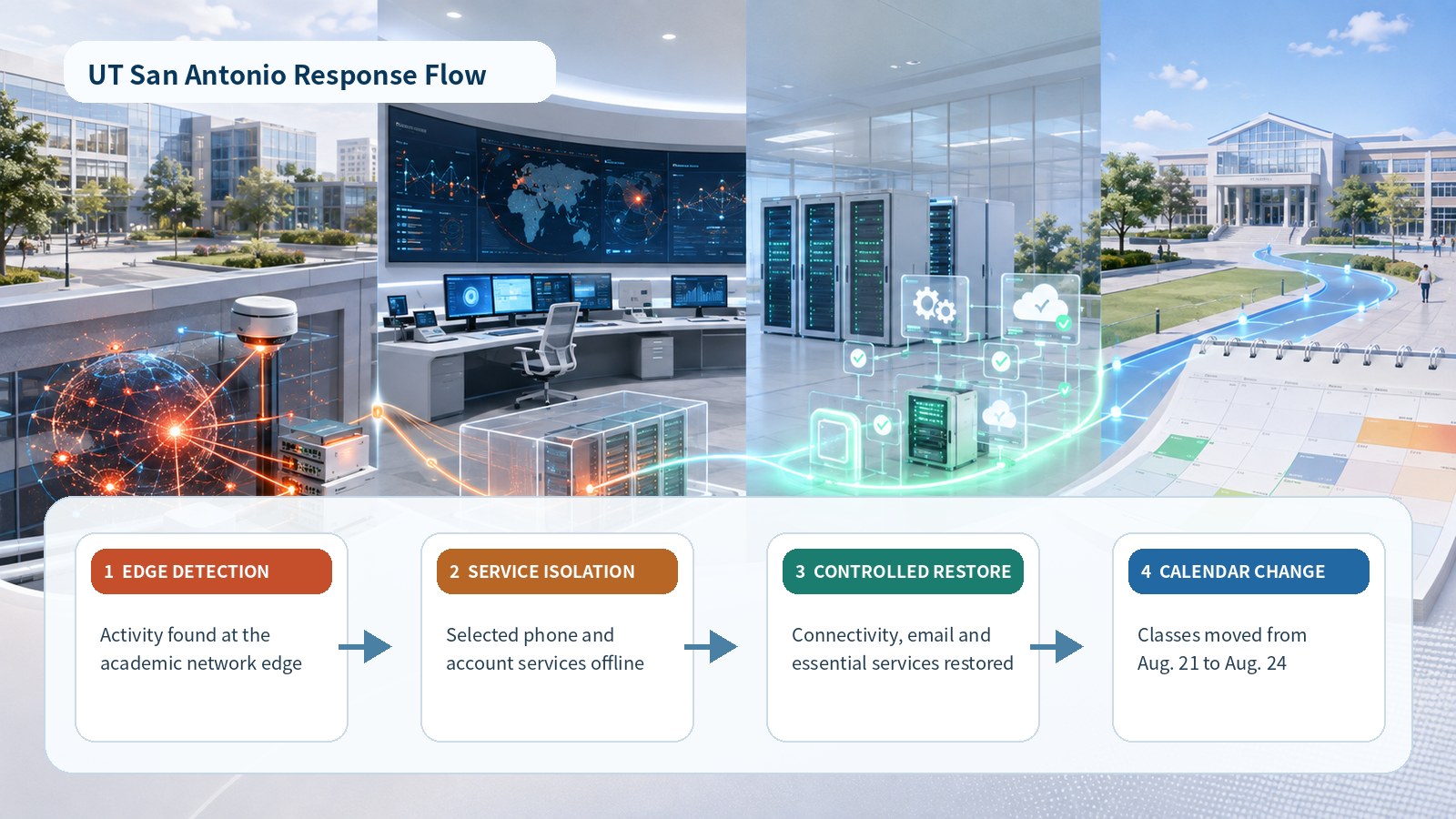
UT San Antonio is responding to attempted unauthorized activity against technology systems on its academic campus. The university said its technology team detected the activity at the edge of the network over the weekend and acted before it reached core systems. Selected systems and services were then taken offline while the environment was evaluated and safeguards were reinforced.
The material update for this reporting window was the expansion of operational impact into the academic calendar. At 4:45 p.m. Central Time on August 18—6:45 a.m. KST on August 19—the university moved the first day of fall classes from August 21 to August 24. The additional time was reserved for careful restoration of connectivity, email, and other essential services.
Detection and containment
The university's first public notice, issued at 6:00 a.m. Central Time on August 17, described attempted unauthorized activity limited to the academic campus. The technology team worked with expert partners to contain the activity and placed selected services offline as a precaution while reviewing the broader environment.
- Aug. 17, 6:00 a.m. CT: attempted activity detected at the academic network edge and contained
- Aug. 17, 12:30 p.m. CT: payment, waitlist, registration, and phone-service changes announced
- Aug. 18, 8:30 a.m. CT: delays reported in the password-reset system
- Aug. 18, 4:45 p.m. CT: classes moved to Aug. 24 to support careful service restoration
The operational effects were visible in phone service, account access, registration, and payment workflows. The university extended the student payment deadline to August 21, preserved waitlist ordering for affected students, and directed users to resume schedule changes when myUTSA access became available. These changes linked technical recovery directly to student-service continuity.
Why the class delay matters
Moving the first day of classes by three days was not simply a calendar adjustment. It gave teams time to stabilize shared infrastructure before thousands of users returned to registration, communications, and learning services. A system that is reachable is not necessarily ready to support peak academic operations, especially when authentication, email, and transaction records depend on one another.
At the start of a semester, account activation, course registration, payment processing, student notices, and learning-platform access all peak within a short period. If identity or network services are unstable, failed requests can multiply and create inconsistent records. UT San Antonio's decision shows why cyber recovery has to be measured against the business process that the technology supports.
Controlled restoration
Recovery after an intrusion attempt requires more than bringing servers back online. Teams need to preserve edge and identity logs, validate administrative paths, restore common dependencies such as DNS and email, and then reconnect business applications in a controlled order. Security telemetry and functional checks should remain active during each stage.
- Preserve network-edge, identity, and policy-change records around the first detection time.
- Revalidate administrator accounts and remote sessions used during restoration.
- Restore common services such as DNS, DHCP, identity, and email before dependent applications.
- Confirm both application function and security logging before and after service reactivation.
- Publish one authoritative status page covering restored functions, approved access paths, and schedule changes.
Large password-reset campaigns also need capacity planning across identity servers, email delivery, help desks, and self-service portals. Staging users into groups and verifying session termination and multi-factor authentication after each wave can reduce secondary failures. The separate notice about password-reset delays illustrates why identity recovery should be treated as its own operational workstream.
Checks for education organizations
Universities should treat the beginning of a term as a distinct risk period. New and dormant accounts change state, third-party learning tools exchange more data, and support requests rise quickly. Network-edge alerts, account provisioning, privilege changes, bulk password resets, and integration failures should be visible together so technical and business teams can make coordinated decisions.
- Service dependency map aligned to the academic calendar
- Independent status channel for phone, email, or portal outages
- Strong authentication and session review for administrators and help desks
- Capacity and failure-rate thresholds for bulk password resets
- Reconciliation procedures for course and payment transactions
- Joint security and business approval for service reactivation
Restoration order should account for user volume, hard deadlines, and the difficulty of replaying transactions—not only technical criticality. Identity and email must be stable before account recovery and student communications can work reliably. Transactional services such as registration and payment can then reopen with reconciliation controls in place.
Checks for students and staff
Members of the university community should use the official update page to confirm restored services and revised dates. Password-reset instructions should begin from the university's established website or portal rather than an unsolicited message. Registration and payment requests submitted during the disruption should be checked against confirmation pages and email receipts.
- Confirm revised class, payment, and waitlist dates
- Verify myUTSA access and password-reset completion
- Reconcile registration and payment status with confirmation messages
- Avoid recovery links that imitate the university domain
- Check the latest official support hours and contact routes
Operational lesson
This case shows that activity stopped at the network edge can still produce substantial availability consequences when precautionary isolation affects identity, email, and support channels. Incident plans should therefore pair containment procedures with alternate communications, help-desk load management, and rules for adjusting business deadlines.
Security and service teams also need a shared definition of recovery. Security teams validate anomalous access, policy changes, and persistence indicators, while service owners test login success, email latency, transaction processing, and user error rates. A service is operational only when both sets of measures are stable enough for the expected workload.
UT San Antonio updated its community in stages: initial detection and containment, student-service adjustments, password-reset delays, and finally the class delay. That sequence is a useful model for status communication during an evolving incident. Even while technical work continues, organizations can provide concrete information about service availability, business deadlines, and the next authoritative update.
Official update
UT San Antonio said the additional three days would support careful restoration of connectivity, email, and essential services. University operations continued, with faculty and staff maintaining their normal work schedules while student-facing systems were prepared for the start of the term.
Sources reviewed
- First day of classes delayed to Monday, Aug. 24UT San Antonio · Official source
- University of Texas forced to take systems offline in San Antonio after cyberattackThe Record from Recorded Future News
SECUFOCUS NOW reorganized and analyzed the material above. This article does not replace the original sources.
Related SecuNote articles
Langflow Code Injection RCE (CVE-2026-0768): Active Exploitation and Response
CVE-2026-0768 is now being exploited against internet-accessible Langflow deployments. This analysis explains the vulnerable…
Sality Botnet Disruption: How the P2P Sinkhole Cut Its Command Path
A multinational operation disrupted Sality's peer-to-peer command path across more than 15,000 infected hosts. This analysis…

Dropbox Account Breach: Lenovo ID Integration and Confirmed Impact
A legacy Lenovo ID integration enabled unauthorized access to about 5,000 Dropbox accounts. This report explains the confirmed…
Comments
No comments yet.