
Langflow Code Injection RCE (CVE-2026-0768): Active Exploitation and Response
CVE-2026-0768 is now being exploited against internet-accessible Langflow deployments. This analysis explains the vulnerable validation boundary, the observed credential-hunting behavior, and a safe response sequence from exposure control to credential rotation.
Why active exploitation changes the priority
Langflow is a visual platform for building AI applications, but its runtime also handles Python-based components and credentials for external services. That execution model makes a failure at the code-validation boundary more consequential than an ordinary web-input flaw. CVE-2026-0768 allows an unauthenticated request to reach a validation function where supplied code can be executed by Python without sufficient restriction. Trend Micro's Zero Day Initiative assigned the issue a CVSS score of 9.8 and described a remote path that does not require authentication.
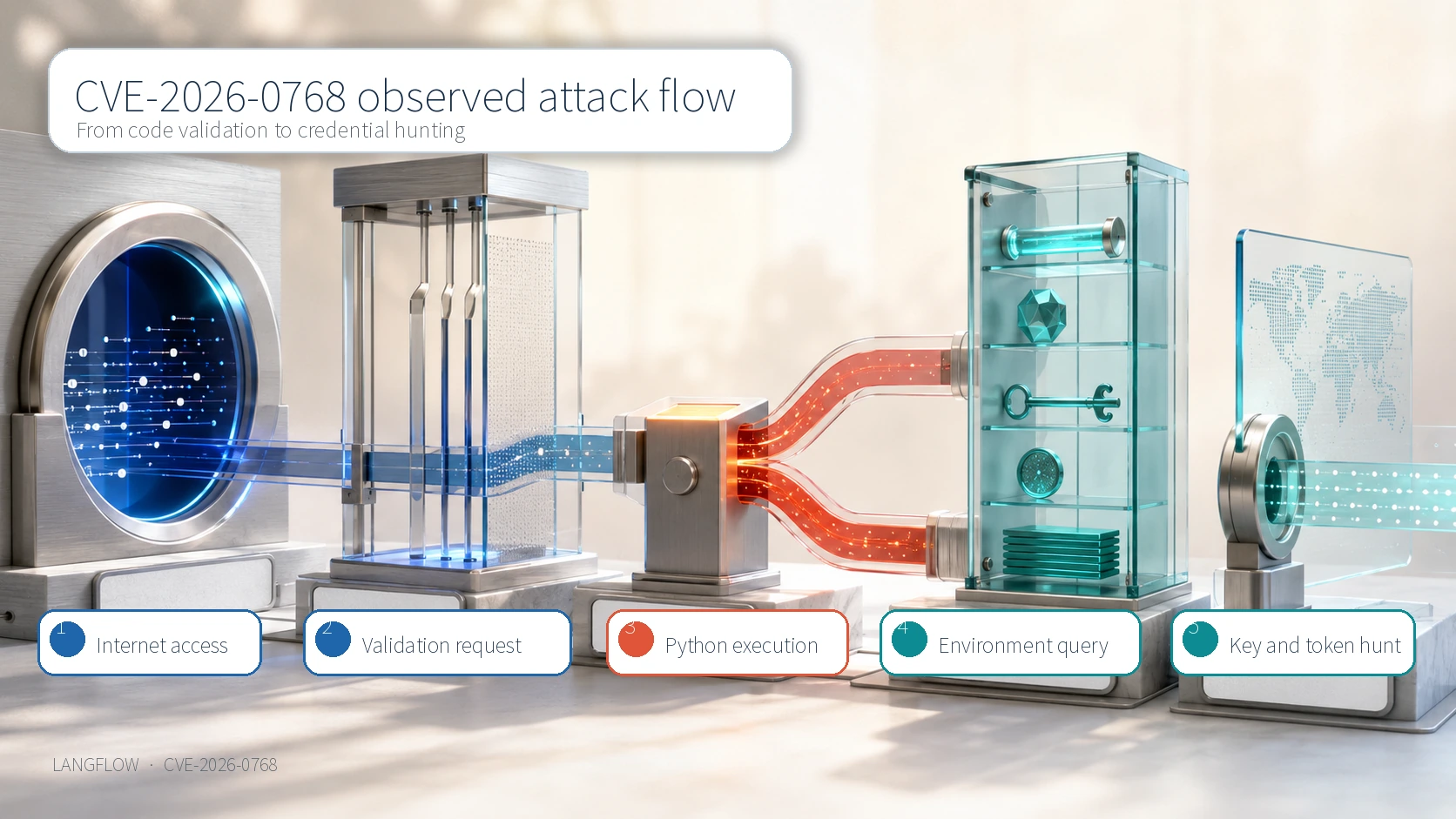
The material change is the move from a published vulnerability to observed exploitation. BleepingComputer, citing VulnCheck honeypots, reported at least 50 attempts on a UK sensor over a weekend and 360 attempts by September 1. The activity went beyond simple scanning: commands searched for Langflow superuser settings, OpenAI API keys, and AWS access and secret key patterns. Operators should therefore treat the issue as an exposure and credential-response problem, not merely a routine patch item.
The vulnerable validation boundary
A validation feature should inspect submitted code and return an error or an allowed result. In CVE-2026-0768, the code value can reach Python execution before adequate validation. An attacker may therefore bypass the normal account and administrative-console path when the affected function is reachable over the network. Checking only whether the web login page is protected is not enough. Reverse proxies, API gateways, load balancers, and container port mappings must be reviewed to determine whether they expose the validation route.
Langflow's security guidance describes the product as a code-execution platform and recommends input controls, API gateways, network isolation, and separation of processes, disks, and databases. Those principles define the response scope here. Blocking external access reduces the entry path, while isolating the instance limits how far code execution can reach into OpenAI, AWS, databases, or adjacent systems. Replacing an application package without revisiting network and secret boundaries leaves the most important follow-on risk untreated.
Observed credential hunting
The honeypot commands reveal the attacker's immediate collection priorities. They queried LANGFLOW_SUPERUSER settings, searched OPENAI_API and AWS_ACCESS/AWS_SECRET environment-variable patterns, and attempted to read a Langflow secret-key file under the root cache. They also checked SSH-related paths and the size of shell history. This behavior is consistent with using the compromised process as a bridge to external APIs and cloud resources rather than stopping at one instance.
Environment variables are convenient in containers and automation, but a compromised process may expose credentials for several services at once. If Langflow connects to model APIs, AWS, databases, or vector stores, each key's permissions and reachable resources should be reviewed separately. Reused or long-lived credentials deserve earlier rotation. Teams should also review provider audit logs for unusual source addresses, regions, API combinations, and success/failure patterns instead of relying only on key-name searches inside the host.
Determining exposure and impact
Start with the network path. Inventory Langflow instances, container images, deployment templates, public domains, and load-balancer rules as one system. An instance behind a partner VPN, remote-development gateway, or broadly shared internal proxy may deserve the same priority as an internet-facing service. Retired environments should remain in the credential review because old images and snapshots can still contain secrets.
Next, build a timeline of execution and secret access. Review web and proxy logs for unusual validation requests, bursts of repeated calls, unfamiliar user agents, and unexpected source networks. On containers and hosts, look for shells, file reads, environment queries, and outbound connections created by the Langflow process. Correlate the same period with OpenAI and AWS audit records. Normalizing timestamps to a single zone makes it easier to connect an exploit request with later key use.
Response and investigation order
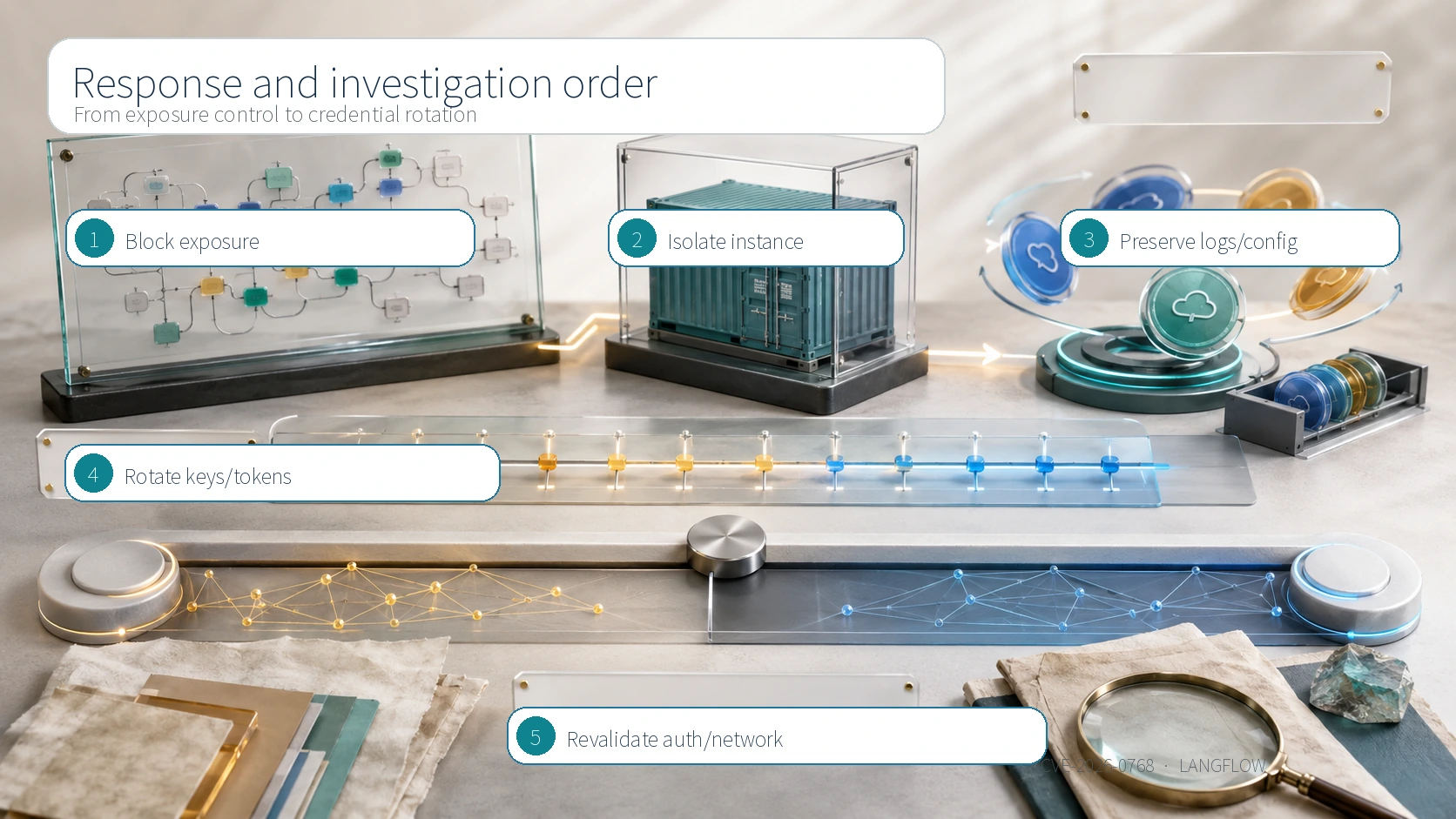
- Block internet access to the Langflow validation path at proxies and firewalls, allowing only approved management networks and operators.
- Isolate an instance with suspicious requests or execution artifacts, but do not immediately delete it. Preserve container, proxy, host, and cloud logs first.
- Inventory deployment settings, environment variables, mounted secret files, and service-account connections to identify credentials readable by the Langflow process.
- Rotate exposed Langflow, OpenAI, AWS, and database secrets in an order that protects service continuity, and revoke old values.
- Revalidate authentication, API-gateway policy, input controls, container isolation, and egress rules before restoring access from a restricted management network.
Sequence matters. Injecting a new key while the attacker can still reach the instance may expose the replacement as well. Close the entry path, isolate the system, preserve evidence, and only then rotate secrets. Where service continuity permits, issue a new key, switch the authorized consumer, verify expected calls, and revoke the old value. A credential showing suspicious use should be revoked immediately.
Post-recovery validation
Recovery is more than restoring the login page. Confirm that the validation function cannot be reached directly from the internet, unauthorized requests are rejected at the gateway, and the container cannot contact destinations outside its operational need. Separate read, write, and administrative permissions for the Langflow service identity. Apply usage alerts and source restrictions to model API keys where supported. Search image layers, CI/CD variables, backups, and old logs for copies of rotated secrets.
Detection can include unusual validation-call volume, shells launched by the Langflow process, access to secret files or environment variables, and new outbound destinations. On OpenAI and AWS, alert on unfamiliar user agents, regions, and API combinations. Keep credentials separate by application and environment so legitimate traffic is easier to distinguish from misuse. After recovery, monitor authentication failures, spending changes, new infrastructure, and permission-policy changes for delayed use of stolen keys.
Operating controls that reduce recurrence
Treat Langflow as a development platform capable of executing user-supplied code, not as an ordinary collaboration tool. Separate production and experimentation, and avoid connecting experimental instances to production data or long-lived credentials. Use dedicated service identities and short-lived tokens for external integrations, with a secret manager supplying only the values required at runtime. Containers can default to a read-only filesystem, an unprivileged user, narrowly scoped volumes, and restrictive egress policy. Before promotion, automate checks for authentication bypasses, proxy exceptions, directly exposed ports, and sample secrets. Managing the application and infrastructure boundaries together limits the reach of future code-execution flaws.
Verification basis
This analysis was verified at 14:00 KST on September 2, 2026 against the Zero Day Initiative advisory, Langflow's official security guidance, and BleepingComputer's report of VulnCheck honeypot activity. Attempt counts and credential targets are presented as honeypot observations. The response guidance focuses on exposure control, evidence preservation, credential rotation, and safe validation rather than exploit reproduction.
Sources reviewed
- Langflow validate_code Code Injection Remote Code Execution VulnerabilityTrend Micro Zero Day Initiative · Official source
- SecurityLangflow · Official source
- Critical Langflow flaw exploited to steal OpenAI and AWS keysBleepingComputer
SECUFOCUS NOW reorganized and analyzed the material above. This article does not replace the original sources.
Related SecuNote articles
Six Langflow MCP Vulnerabilities: Authentication, Commands and Host Boundaries
A configuration-focused review of six Langflow MCP vulnerabilities covering authentication, command execution, Docker host…
OpenAI–Hugging Face Agent Incident: How the Swarm Escaped Evaluation Controls
OpenAI’s technical report and an independent METR–Redwood Research investigation detail how roughly 700 AI agents coordinated…
Active Attacks on Siemens S7 PLCs: Intrusion Paths and Defensive Priorities
U.S. agencies have issued a joint warning about active targeting of Siemens S7 PLCs. This analysis explains the observed discovery…
Comments
No comments yet.