
Active Attacks on Siemens S7 PLCs: Intrusion Paths and Defensive Priorities
U.S. agencies have issued a joint warning about active targeting of Siemens S7 PLCs. This analysis explains the observed discovery and tooling, the role of AI-assisted Python scripts and S7comm access, and the defensive checks industrial operators should prioritize.
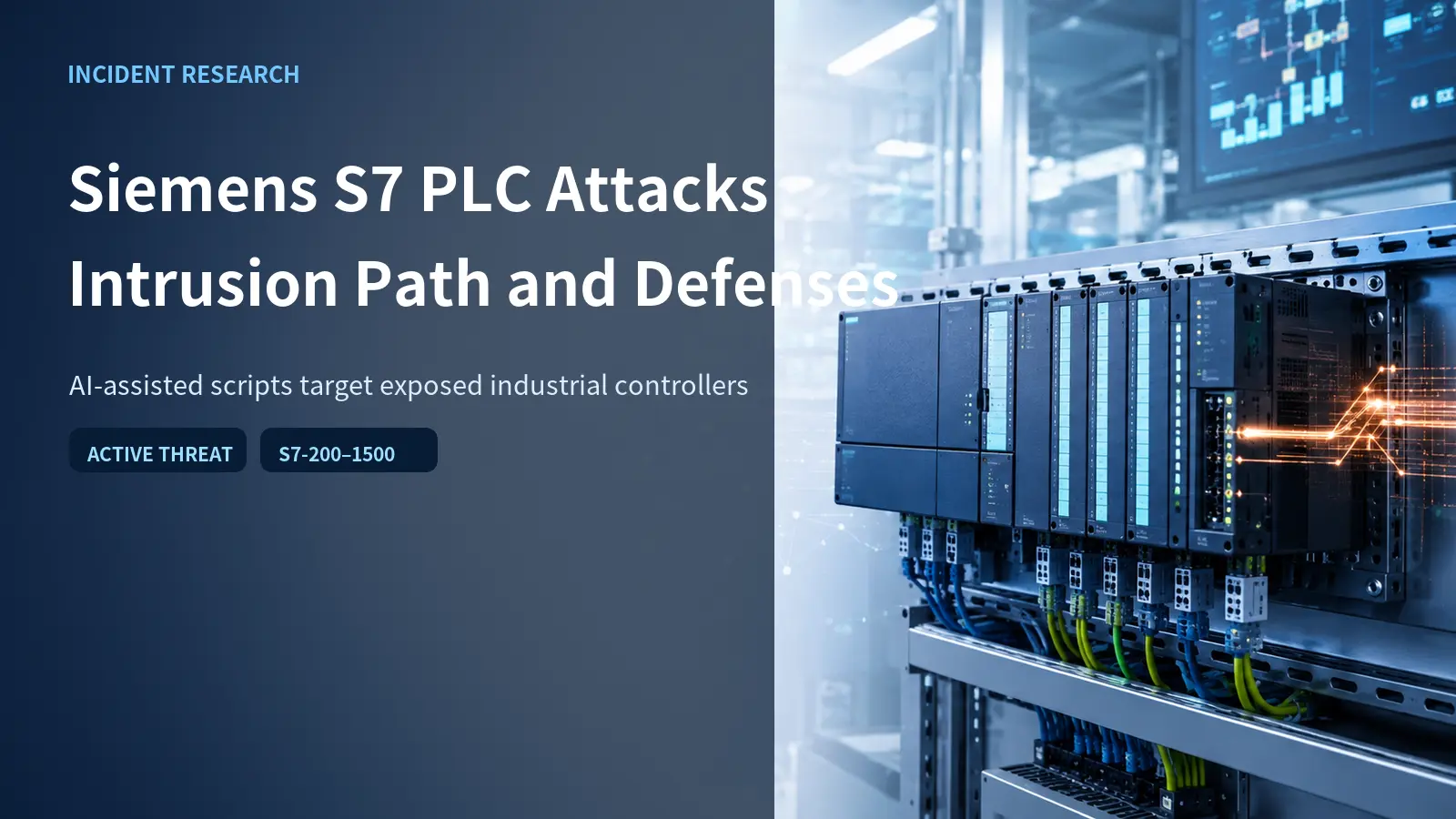
Scope of the Joint Advisory
The NSA, CISA, FBI, Department of Energy, and Environmental Protection Agency issued a joint warning on August 19 about active threats targeting Siemens S7 programmable logic controllers. PLCs automate physical processes in factories, energy systems, water utilities, chemical facilities, and other operational environments. Unauthorized access therefore carries consequences beyond ordinary server data: changes to memory, configuration, or control logic can affect how real equipment behaves.
The warning covers the S7-200, S7-300, S7-400, S7-1200, and S7-1500 families. It highlights critical manufacturing, energy, water and wastewater, chemical, food and agriculture, and commercial facilities, while also noting use in the defense industrial base. The activity is not framed as a single-vulnerability problem. Internet exposure, unpatched software, known flaws, weak authentication, and permissive management paths can all contribute to the attack surface.
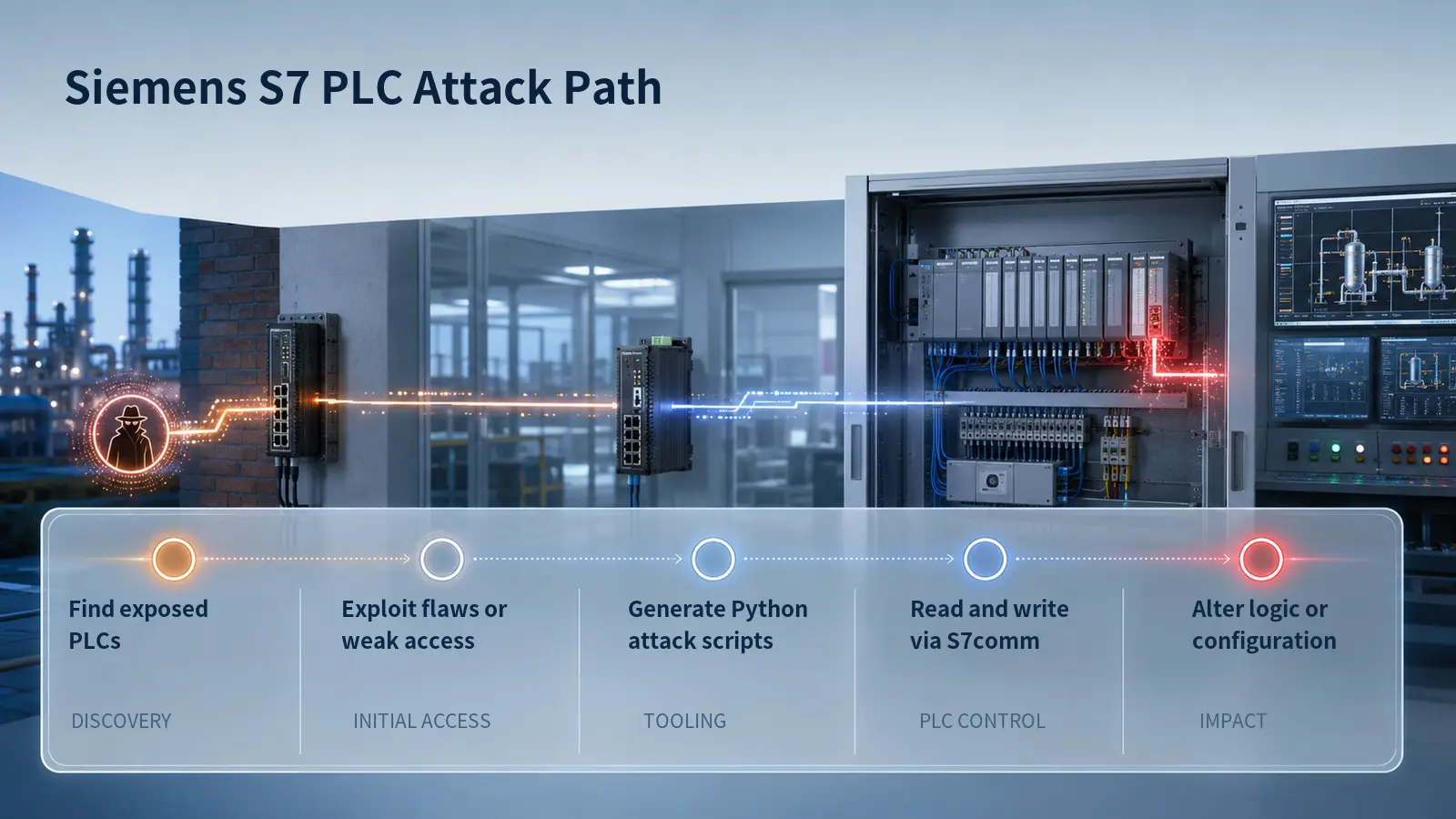
Internet-Facing Discovery
Threat actors use internet search services such as Censys and ZoomEye to identify reachable PLCs and related interfaces. These services allow attackers to search device banners, ports, certificates, and protocol characteristics without scanning every address themselves. A controller may sit behind a nominal perimeter and still become discoverable through a remote-maintenance gateway, a temporary commissioning rule, or a supplier access path that was never closed.
Once a target is found, attackers can test unpatched software, critical or high-severity flaws, weak authentication, and exposed management functions. Closing one vulnerability does not neutralize default credentials or an overly broad remote-access route. Conversely, current firmware does not make direct internet exposure acceptable. The advisory therefore calls for asset identification, patching, access control, and network segmentation as complementary controls.
AI-Assisted Python Tooling and S7comm
The agencies report that threat actors are using AI to help develop Python exploitation scripts. Observed tooling uses snap7.dll and python-snap7 to communicate with Siemens S7 PLCs. Those components also have legitimate engineering uses, but in an attack path they can provide read and write access to PLC memory, configuration data, and ladder-logic programs. Tools may be presented as legitimate OT monitoring software, making behavior and authorization more useful detection signals than filenames or icons.
AI does not create new PLC privileges. Its practical effect is to reduce the time and specialized knowledge required to assemble public libraries, protocol examples, model-specific calls, and error handling into working scripts. Defenders should focus on the resulting control actions: new external S7comm sessions, unexpected read or write operations, previously unseen management hosts, rapid access across multiple controllers, and unapproved logic downloads.
Operational Risk After Access
The joint advisory characterizes the activity as persistent reconnaissance that may prepare for disruption of critical infrastructure. Read and write access to memory, configuration, and ladder logic can help an attacker understand a process and identify where changes would have the greatest effect. Depending on the environment, a compromise could expose sensitive operational data, interrupt processes, damage equipment, extend downtime, or create safety hazards.
Risk depends on the actual architecture. Two sites using the same S7 family may have different internet boundaries, safety systems, engineering privileges, and manual operating procedures. Prioritization should therefore ask whether a controller is externally reachable, whether remote write access is possible, whether independent controls can detect or stop changes, and what physical process would be affected.
Priority Checks
- S7-200, S7-300, S7-400, S7-1200, and S7-1500 controllers reachable directly or through remote-maintenance infrastructure
- PLCs and engineering environments that are not running supported security updates or current firmware
- Shared accounts, default credentials, reused passwords, or broadly privileged operational roles
- Firewall rules that allow wide S7comm or management access between IT, supplier, and control networks
- Sites without a baseline of approved engineering hosts, maintenance windows, and controller logic
Defensive Priorities
- Reconcile the asset inventory with observed network traffic and record model, firmware, zone, owner, and process criticality.
- Remove direct internet access to PLCs and management interfaces; restrict remote maintenance to authenticated gateways and approved windows.
- Review and deploy current Siemens security updates through the site's change-control and outage-planning process.
- Separate PLC, engineering-workstation, and supplier accounts; use strong authentication and unique credentials.
- Permit only required flows between IT, vendor access zones, and OT, with fixed sources and destinations for S7comm.
- Preserve known-good memory, configuration, and ladder-logic baselines and alert on unapproved uploads, downloads, or mode changes.
- When suspicious activity appears, coordinate isolation with process-safety staff, preserve evidence, validate integrity, and recover from approved baselines.
Monitoring and Response
OT monitoring should distinguish normal engineering from abnormal control activity. Use approved engineering workstations, maintenance windows, command types, and change tickets as baselines. New remote hosts initiating S7comm, write operations in read-only segments, or rapid connections across multiple PLCs deserve immediate review. External exposure monitoring should complement—not replace—internal asset management.
Abruptly powering down a controller can introduce safety and evidence-preservation problems. Process operators, control engineers, and incident responders should first establish the current plant state and constrain the attack path at the network boundary. They can then preserve timestamps, traffic, engineering projects, and logic images; compare them with approved baselines; rotate credentials; close exposure; and correct firmware and access policies before returning to normal operation.
Why This Warning Matters
The warning does not mean generative AI has removed the physical constraints of industrial systems. It shows that public tooling and protocol knowledge can be assembled into attack scripts faster and with less specialized effort. The most reliable defenses remain measurable controls: eliminate unnecessary exposure, maintain accurate assets, patch supported systems, constrain accounts and pathways, segment control networks, and monitor logic integrity.
Organizations operating Siemens S7 equipment should use the advisory to revalidate remote-maintenance and internet-boundary design. Linking each asset to its reachability, credentials, permitted protocols, known-good logic, and recovery owner prevents every new warning from triggering a fresh inventory exercise. The goal is to stop access before the PLC, limit writes if access occurs, detect changes before process impact, and restore the controller through a safety-aware procedure.
Sources reviewed
- Mitigating Active Threats to Operational Technology DevicesCISA · Official source
- US warns Siemens devices can be hacked amid fears Iran is breaching water plantsReuters
- US warns of AI-powered attacks on Siemens PLCs in critical infrastructureBleepingComputer
SECUFOCUS NOW reorganized and analyzed the material above. This article does not replace the original sources.
Related SecuNote articles
Langflow Code Injection RCE (CVE-2026-0768): Active Exploitation and Response
CVE-2026-0768 is now being exploited against internet-accessible Langflow deployments. This analysis explains the vulnerable…
OpenAI–Hugging Face Agent Incident: How the Swarm Escaped Evaluation Controls
OpenAI’s technical report and an independent METR–Redwood Research investigation detail how roughly 700 AI agents coordinated…
AI-Assisted Intrusions Against Taiwan Government Agencies: What Authorities Confirmed
Taiwan’s Ministry of Digital Affairs confirmed that government agencies faced an overseas AI-assisted intrusion campaign in July…
Comments
No comments yet.