
September 7 Security Briefing: Roundcube, StyleSmuggler, and Bifrost RCE
A focused review of Roundcube 1.6.19 and 1.7.4, the new StyleSmuggler fc-cache variant, and the Bifrost HTTP plugin RCE path.

Briefing overview
This briefing connects three boundaries where external input is transformed into trusted application behavior. Roundcube released security updates 1.6.19 and 1.7.4 across its LTS and current branches. Sansec added a new fc-cache build, persistence path, and NTP-shaped command traffic to its developing StyleSmuggler investigation. CVE-2026-86242 describes an unauthenticated remote-code-execution path in Bifrost HTTP when management authentication is disabled and a remote shared object is accepted as a plugin.
The operational lesson is broader than checking version strings. Teams should trace how mail content becomes rendered HTML and CSS, how a commerce exploit becomes a persistent operating-system process, and how a management API request reaches a dynamic plugin loader. Verification should prove that the input-to-execution path is closed and that normal application behavior still works after remediation.
- Roundcube 1.6.x and 1.7.x: deploy 1.6.19 or 1.7.4 and retest message rendering
- Magento and Adobe Commerce: hunt fc-cache persistence and NTP-shaped UDP traffic
- Bifrost HTTP: enable management authentication, restrict exposure, and move to 2.0.0 or later
Roundcube 1.6.19 and 1.7.4
Roundcube published version 1.6.19 for the 1.6 LTS branch and 1.7.4 for the 1.7 branch on September 6, recommending the updates for production installations. The release lists twelve security fixes spanning CSS handling, message headers, MIME and rich-text rendering, address-book authorization, remote-content controls, and the CSS proxy.
The rendering fixes include CSS declaration smuggling, injection through the body background attribute, a zero-click stored-XSS path through a TNEF attachment URL, and XSS in the HTML editor through text/enriched content. Remote-content defenses were also hardened against CSS escapes in FuncIRI attributes, SVG SMIL source animation, a trailing-dot FQDN local-URL bypass, and hexadecimal IPv6-mapped IPv4 forms reaching the CSS proxy.
Three separate header-injection paths involved a bare carriage return in the subject, a C-style carriage-return escape in a recipient display name, and the organization field in a sender identity. Another fix prevents cross-user changes to SQL address-book group membership. These are distinct surfaces, so a useful acceptance test covers composition, rendering, resource fetching, and address-book scope rather than treating the release as one HTML-sanitizer patch.

Roundcube rollout and validation
- Inventory the branch and the real package source for every instance, including containers, distribution packages, and archive-based deployments.
- Upgrade 1.6 deployments to 1.6.19 and 1.7 deployments to 1.7.4 while preserving custom plugins, themes, configuration, and rollback material separately.
- Restart PHP workers and application caches against the new code, then compare deployment hashes across all web nodes.
- Test plugin and skin compatibility with HTML, TNEF, and text/enriched messages. Confirm through proxy and DNS logs that blocked remote content does not trigger outbound requests.
- Retest subject and identity fields for header boundaries and verify that SQL address-book group operations remain within the authenticated user's scope.
The new StyleSmuggler fc-cache build
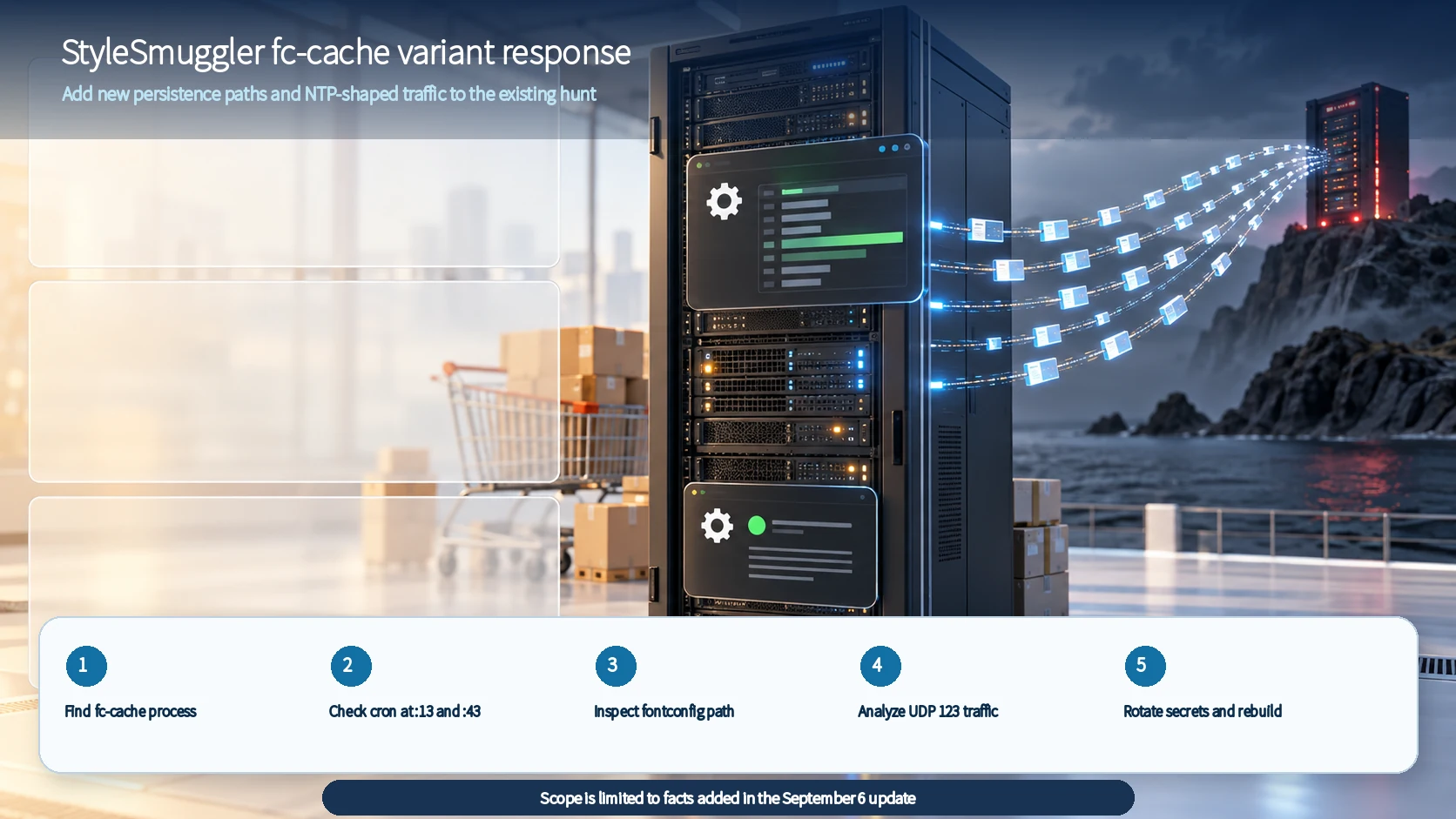
The September 6 briefing covered StyleSmuggler's original injection chain. This update is limited to evidence Sansec added at 21:30 UTC on September 6. New arm64 and x86-64 builds use the process name fc-cache instead of [kworker/u:8:0], copy themselves to ~/.cache/fontconfig/fc-cache, and install a cron entry that restarts the implant at minutes 13 and 43 of every hour. The PID is stored in /tmp/.fc_<8hex>.lock, derived from the first half of the agent ID.
Every sixty seconds the implant resolves ntp.timesync.to and sends a 48-byte UDP packet to port 123. Only the first four bytes resemble NTP; the remainder carries chunked MessagePack with host and agent details. Fallback domains include ntp.synctime.to and ntp.syncstime.to. Because the hostnames and port resemble time synchronization, a broad allow rule for UDP 123 can hide the traffic from routine review.
Sansec also documented public-IP discovery over plain HTTP and a TracerPid check in /proc/self/status. When traced, the implant still installs but suppresses beaconing. That makes a single dynamic-analysis run insufficient. Process names, file creation times, cron entries, DNS resolution, UDP payload sizes, and web-request evidence should be placed on one timeline.
Commerce-server priorities
- Differentiate the new fc-cache process from legitimate font-cache activity and preserve owners, timestamps, hashes, and paths before cleanup.
- Review user and system schedules for entries at minutes 13 and 43, along with gvfsd and fc-cache restart commands.
- Compare DNS and firewall records for the published time-sync lookalike domains and repeated 48-byte UDP/123 patterns against the approved NTP inventory.
- If suspicious artifacts appear, isolate the host, rotate Magento administration and integration secrets, and rebuild from a trusted image when integrity cannot be re-established.
Bifrost HTTP plugin RCE
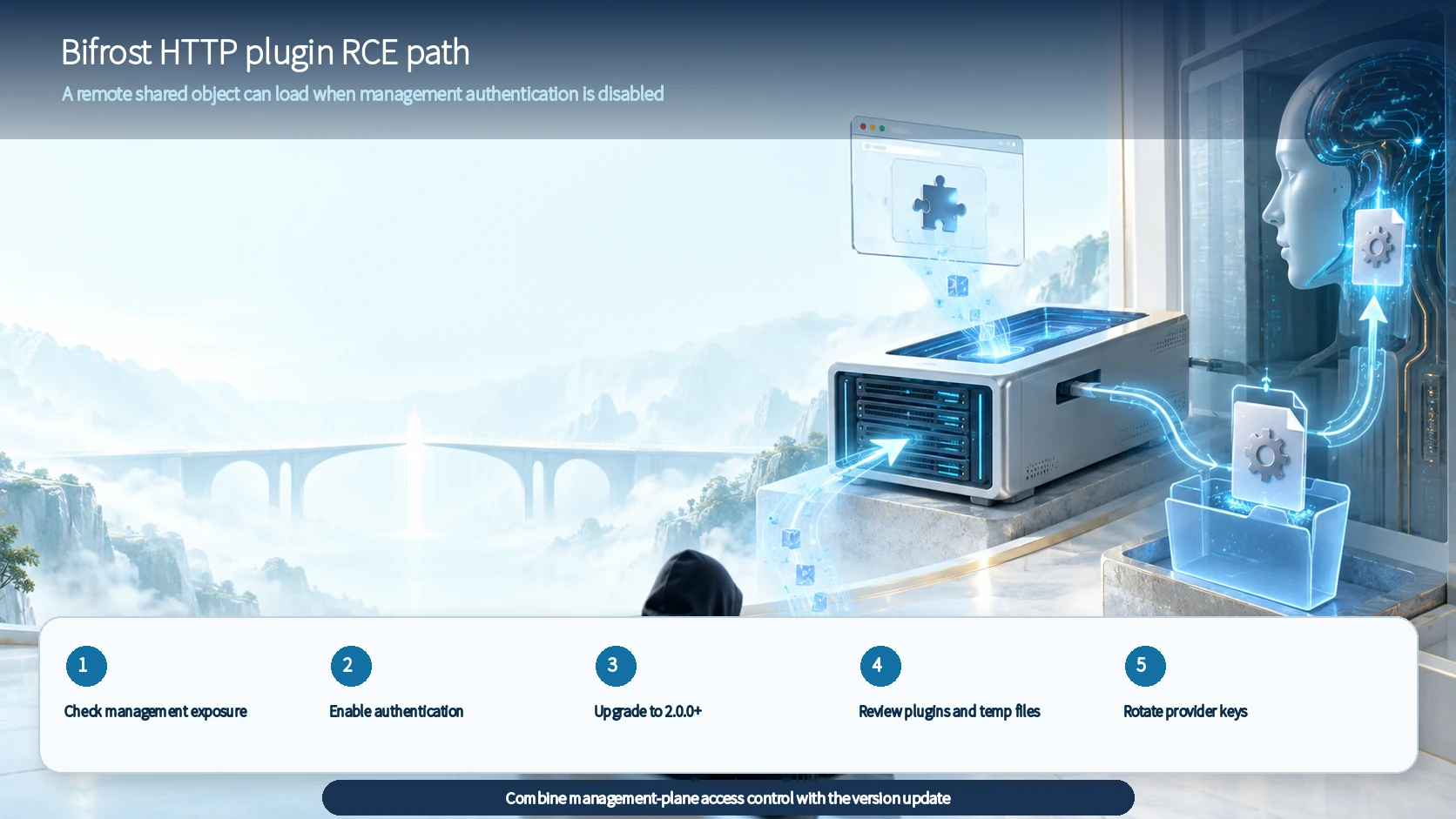
CVE-2026-86242 affects Bifrost HTTP transport releases before 2.0.0. When management authentication is disabled, an unauthenticated request to /api/plugins can register an enabled custom plugin whose path is an HTTP URL. The shared-object loader downloads the remote body into a temporary .so file and passes it to Go's plugin.Open. If the object exports Init, that function runs with attacker-supplied configuration under the Bifrost process identity.
This crosses the boundary from management metadata to native code execution. Bifrost centralizes connections to AI providers, routing policy, and observability, so a compromise review should include provider credentials and gateway policy, not only the plugin directory. Exposure depends on whether the management API is reachable, whether governance.authconfig.isenabled is disabled, and whether the deployment supports dynamic linking.
The CVE record marks versions before 2.0.0 as affected and identifies 2.0.0-prerelease3 as the point where the status changes. The project released the stable Bifrost HTTP 2.0.0 line on August 26 and tells 1.6.x operators to consult the migration guide. Access restriction, application authentication, and the version migration should therefore be handled as one remediation plan.
Bifrost response priorities
- Map actual reachability through firewalls, load balancers, Kubernetes Services, and Ingress rules, then move the management API behind an administrative network or VPN.
- Enable management authentication and rotate administrative credentials. Review internal paths that may bypass a reverse-proxy authentication layer.
- Upgrade Bifrost HTTP to 2.0.0 or later and test provider connections, routing rules, and plugin behavior after migration.
- Review registered plugins, configuration changes, temporary shared objects, child processes, and outbound connections from the Bifrost process.
- If an unauthorized plugin is found, rotate affected provider API keys and reissue them with minimum privilege, usage restrictions, and independent audit logging.
A common operations view
Across all three issues, start where untrusted input enters, follow each transformation step, and identify the moment that rendered content, a background process, or a native plugin crosses a privilege boundary. Then prove through logs and regression tests that the path is closed without breaking the intended service.
Prioritize by internet exposure and execution potential. An exposed Bifrost management API with authentication disabled, or a commerce server showing the new StyleSmuggler artifacts, deserves immediate containment and investigation. Roundcube should be updated across every production node, with deployment evidence showing that no node or cache remains on old code.
A completed update is the beginning of validation. Record version, configuration, process and network evidence together: remote-content behavior and headers for Roundcube, process and scheduled-task artifacts for StyleSmuggler, and authentication plus plugin history for Bifrost. That combined record helps distinguish successful remediation from a simple version-number change.
Sources reviewed
- Security updates 1.6.19 and 1.7.4 releasedRoundcube Project · Official source
- StyleSmuggler: Magento and Adobe Commerce 0-day RCE under active attackSansec Forensics Team
- CVE-2026-86242CVE Program · Official source
- Bifrost HTTP v2.0.0Maxim Bifrost · Official source
- Security at BifrostMaxim Bifrost · Official source
SECUFOCUS NOW reorganized and analyzed the material above. This article does not replace the original sources.
Related SecuNote articles
Bifrost HTTP Plugin RCE (CVE-2026-86242): Affected Builds and Response
How an exposed Bifrost management API can turn remote plugin loading into code execution, with deployment-specific scope and a…

September 6 Security Briefing: StyleSmuggler, PaperCut Wave Two, and libxml2
A source-grounded briefing on the StyleSmuggler ecommerce attack, PaperCut's second-wave credential activity, and eight fixes in…

Adobe Commerce Template Engine RCE (CVE-2026-75650): Scope and Emergency Response
Adobe confirmed active exploitation of a pre-authentication remote code execution flaw in Adobe Commerce and Magento Open Source…
Comments
No comments yet.