
September 6 Security Briefing: StyleSmuggler, PaperCut Wave Two, and libxml2
A source-grounded briefing on the StyleSmuggler ecommerce attack, PaperCut's second-wave credential activity, and eight fixes in libxml2 2.15.4.

Today's Security Priorities
This briefing connects three different operational boundaries: public ecommerce applications, internet-facing print-management servers, and XML parsing libraries embedded throughout software stacks. Sansec disclosed the StyleSmuggler chain against Magento and Adobe Commerce. PaperCut exploitation progressed into host discovery, privileged-account attempts, and credential collection. libxml2 2.15.4 fixed eight flaws spanning memory handling, I/O callbacks, and XInclude policy propagation.
The response differs by issue. StyleSmuggler requires temporary exposure reduction and compromise assessment while the vendor fix is pending. PaperCut requires Release 3, log preservation, and hunting beyond the application process. libxml2 requires dependency tracing across packages, containers, bindings, and statically linked software.
Issues at a Glance
- StyleSmuggler: GraphQL style-property injection followed by code execution during failed-payment email rendering
- PaperCut wave two: host discovery, configuration searches, registry-hive collection, and attempted privileged-account creation
- libxml2 2.15.4: eight fixes for out-of-bounds access, integer and buffer overflows, callback length handling, and XInclude flags
- Shared priority: reduce exposure, preserve evidence, deploy fixes, rotate relevant secrets, and verify application behavior
Magento and Adobe Commerce StyleSmuggler
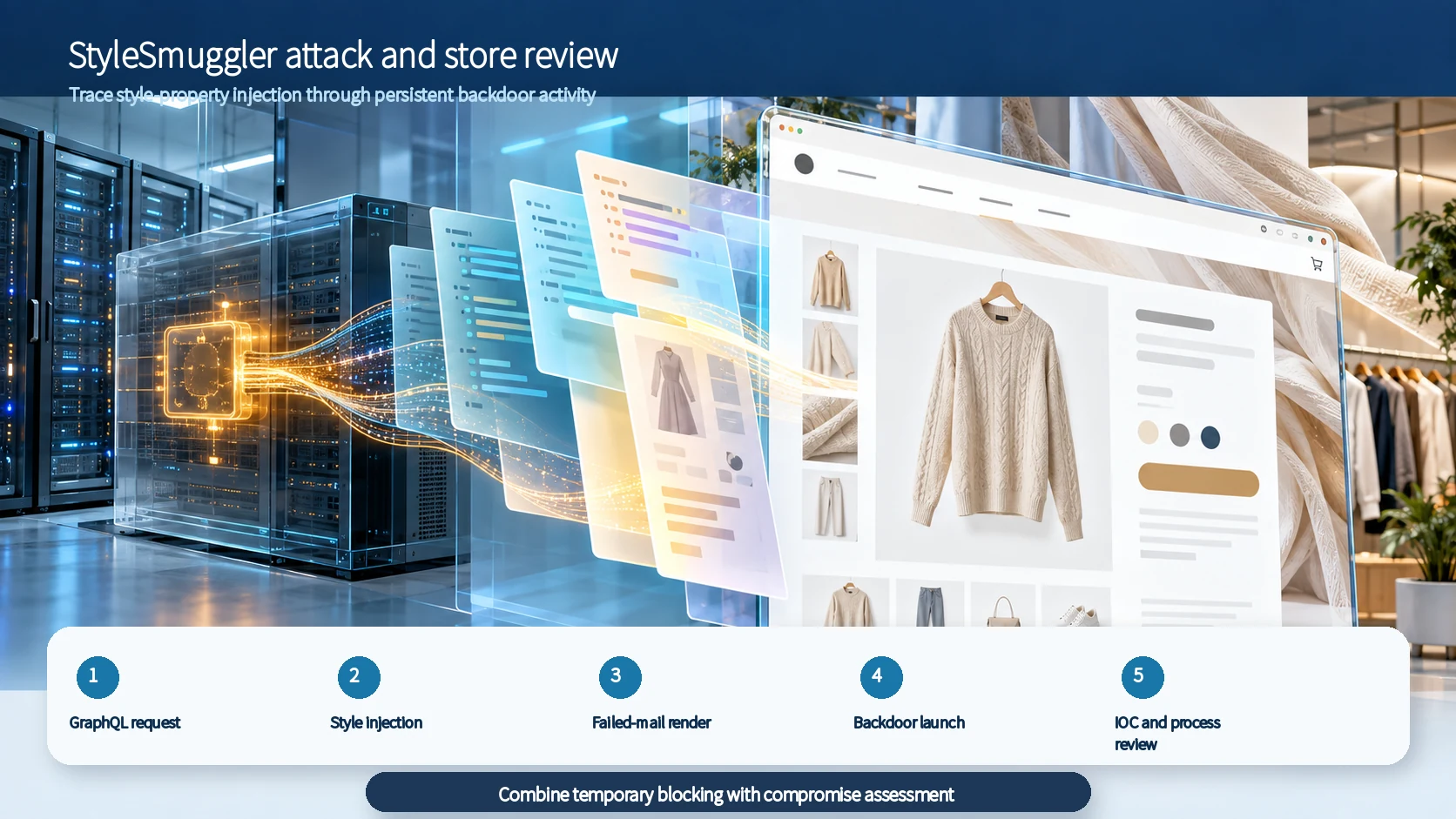
StyleSmuggler targets Magento's template-processing boundary. The chain described by Sansec first poisons PHP code through the GraphQL styles property and then causes the normal failed-payment email renderer to execute the poisoned content. A recipient does not need to open the message, and a failed delivery does not prevent the rendering step. This makes the activity easy to miss if monitoring focuses only on uploads and administrator logins.
Sansec reproduced the unauthenticated chain on clean Magento Open Source 2.4.7, 2.4.8, and 2.4.9 systems. Its first observed victim ran 2.4.6-p15 with the available security patches applied. Successful attacks launched a small Rust backdoor that connected to 99.84.67.186 and waited for commands. Process names and temporary paths were chosen to resemble system activity, so defenders need to correlate the executable path, parent process, persistence, and outbound traffic.
Start by identifying internet-reachable Magento and Adobe Commerce instances and whether GraphQL is exposed. Evaluate Sansec's temporary recommendation to disable GraphQL against service requirements, and search access logs for unusual styles parameters, report-generation activity, cron changes, and unexpected processes. A burst of failed-payment reminders should be correlated with GraphQL and server evidence rather than closed as a payment-only issue.
When suspicious evidence appears, move from patch management to incident response. Isolate the server, preserve memory, processes, cron entries, and web logs, compare files with an approved deployment, and rebuild from a trusted image if compromise is established. Scope rotation for Magento administrator accounts, deployment keys, payment-integration secrets, and database credentials according to observed access.
PaperCut Second-Wave Credential Activity
PaperCut exploitation involves CVE-2026-81578 and CVE-2026-82078. The former can allow unauthenticated requests to trigger administrative actions before access validation completes under specific conditions. The latter lets configuration-controlled database driver names select Java classes without an approved allowlist. Chained conditions can progress from configuration changes to code execution in the PaperCut server process.
Observed follow-on behavior included uname, whoami, ver, and tasklist for host discovery, attempts to create an Administrator17 account, and command shells launched beneath pc-app.exe. Attackers searched configuration files for password, secret, ldap, bind, and token, delivered registry-hive collection tools, and retrieved Meterpreter-related Java payloads. The response boundary therefore extends beyond the print application to operating-system and directory credentials.
PaperCut directs customers to remove direct internet access to the application server's web interfaces and apply Emergency Patch Release 3. Release 3 supersedes earlier emergency patches, corrects SAML and legacy Microsoft SQL Server driver regressions, and adds further hardening. Primary, Site, Secondary, and Print Servers must be checked together; patching only the primary application server leaves an incomplete inventory.
Preserve server.log before investigation and review unexpected truncation or deletion. Search for the vendor's JDBC-related strings, short randomly named class and command files, pc-app.exe spawning command interpreters, pcp_ files under custom paths, and privileged-account events. If compromise is established, preserve current backups and evidence, rebuild the application server, restore a clean pre-incident backup, and rotate exposed operating-system, service, LDAP, database, and API credentials.

Eight libxml2 2.15.4 Fixes
libxml2 2.15.4 addresses CVE-2026-86137 through CVE-2026-86144. The set includes an out-of-bounds read, integer overflows, stack- and heap-based buffer overflows, a NULL-pointer dereference, negative lengths reaching output callbacks, and XInclude routines that failed to propagate parser flags.
These findings should not be treated as one uniform risk. Several affect memory safety when applications process unusual XML, URI, regular-expression, DTD, or XPointer inputs. CVE-2026-86144 concerns enforcement boundaries: flags such as XML_PARSE_NONET may not reach the XInclude path, allowing a custom resource loader to contact external resources and creating XXE, SSRF, or denial-of-service risk depending on the application.
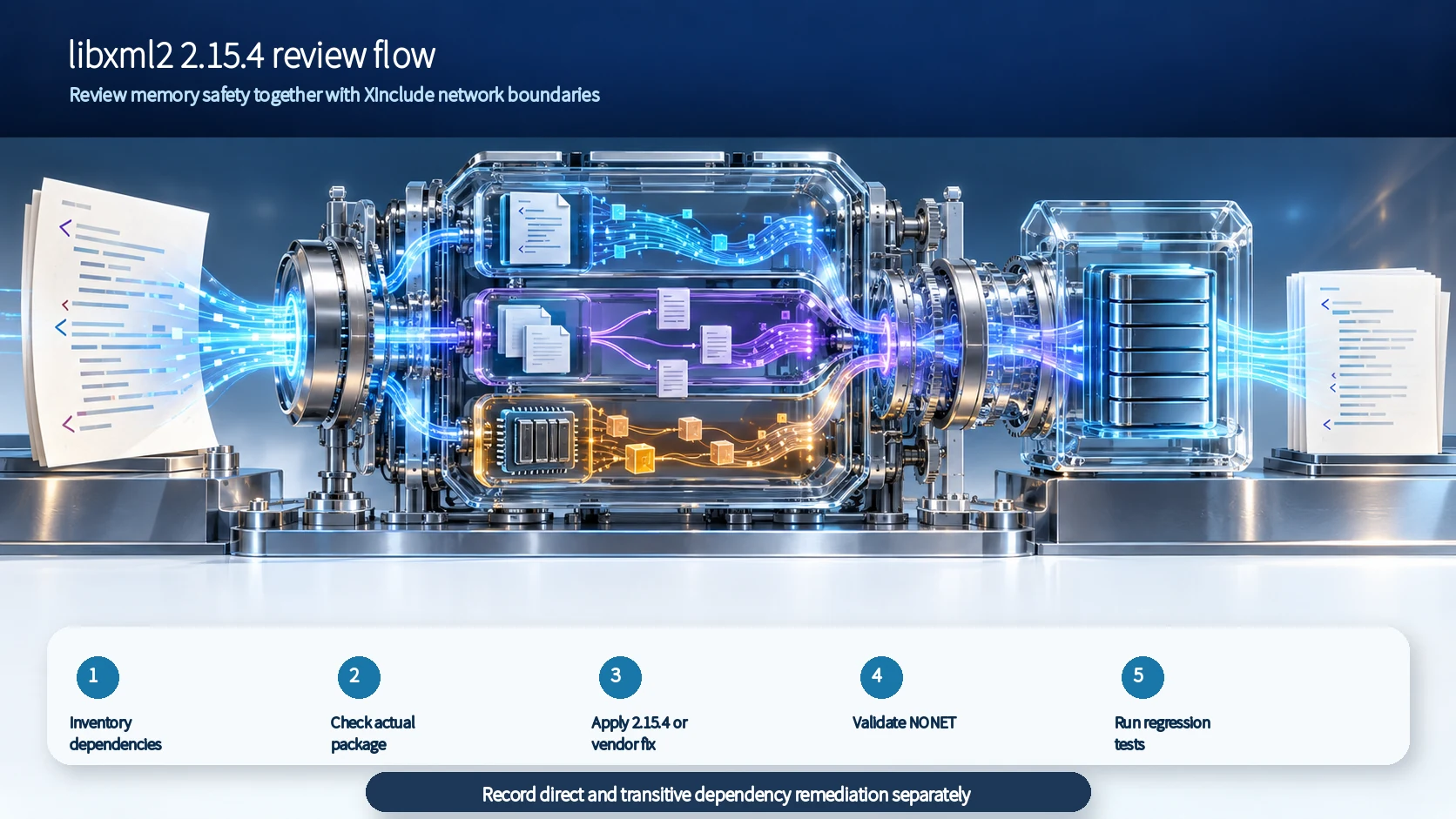
Inventory operating-system packages, container images, language bindings, document converters, upload processors, security scanners, and statically linked copies. Package-manager records, SBOM data, lock files, and container digests are more reliable than filename searches alone. Direct upstream users should move to 2.15.4 or later; distributions and commercial products should follow their vendor's patched package or backport.
After deployment, test normal parsing plus large URIs, complex regular expressions, XPointer and XInclude behavior, custom I/O callbacks, and network-disabled policy. Record direct and transitive dependencies separately, connect rebuilt image digests to running workloads, and verify that a source declaration change actually reached production.
Operational Sequence
Prioritize public Magento, Adobe Commerce, and PaperCut servers first. StyleSmuggler needs exposure reduction and compromise checks while a fix is pending. PaperCut needs both Release 3 and credential-focused hunting. Group libxml2 assets by untrusted input paths and packaging model so updates can be validated without overlooking embedded copies.
- Confirm every internet-reachable Magento, Adobe Commerce, and PaperCut interface
- Correlate StyleSmuggler GraphQL, report, cron, process, and network evidence
- Verify PaperCut Release 3 across primary, site, secondary, and print servers
- Hunt pc-app.exe child processes, configuration searches, account creation, and hive collection
- Patch direct and transitive libxml2 copies and test XInclude, NONET, I/O, and regressions
Keep evidence with the completion record: asset, exposure path, observation time, fixed build, reviewed log range, restart or redeployment result, and functional validation. Systems with compromise evidence require separate tracking for preservation, isolation, rebuild, and secret rotation. Validate ecommerce payment and mail rendering, print authentication and card lookup, and XML processing after security changes.
Sources reviewed
- StyleSmuggler: Magento and Adobe Commerce 0-day RCE under active attackSansec · Official source
- URGENT Security Advisory: PaperCut NG/MF Security BulletinPaperCut · Official source
- libxml2 2.15.4 releaseGNOME libxml2 · Official source
SECUFOCUS NOW reorganized and analyzed the material above. This article does not replace the original sources.
Related SecuNote articles
September 1 Security Briefing: PaperCut KEV, Rails Exploitation, and Fraudulent Hiring
This briefing covers the new KEV priority for two PaperCut flaws, observed exploitation of Ruby on Rails CVE-2026-66066, and…
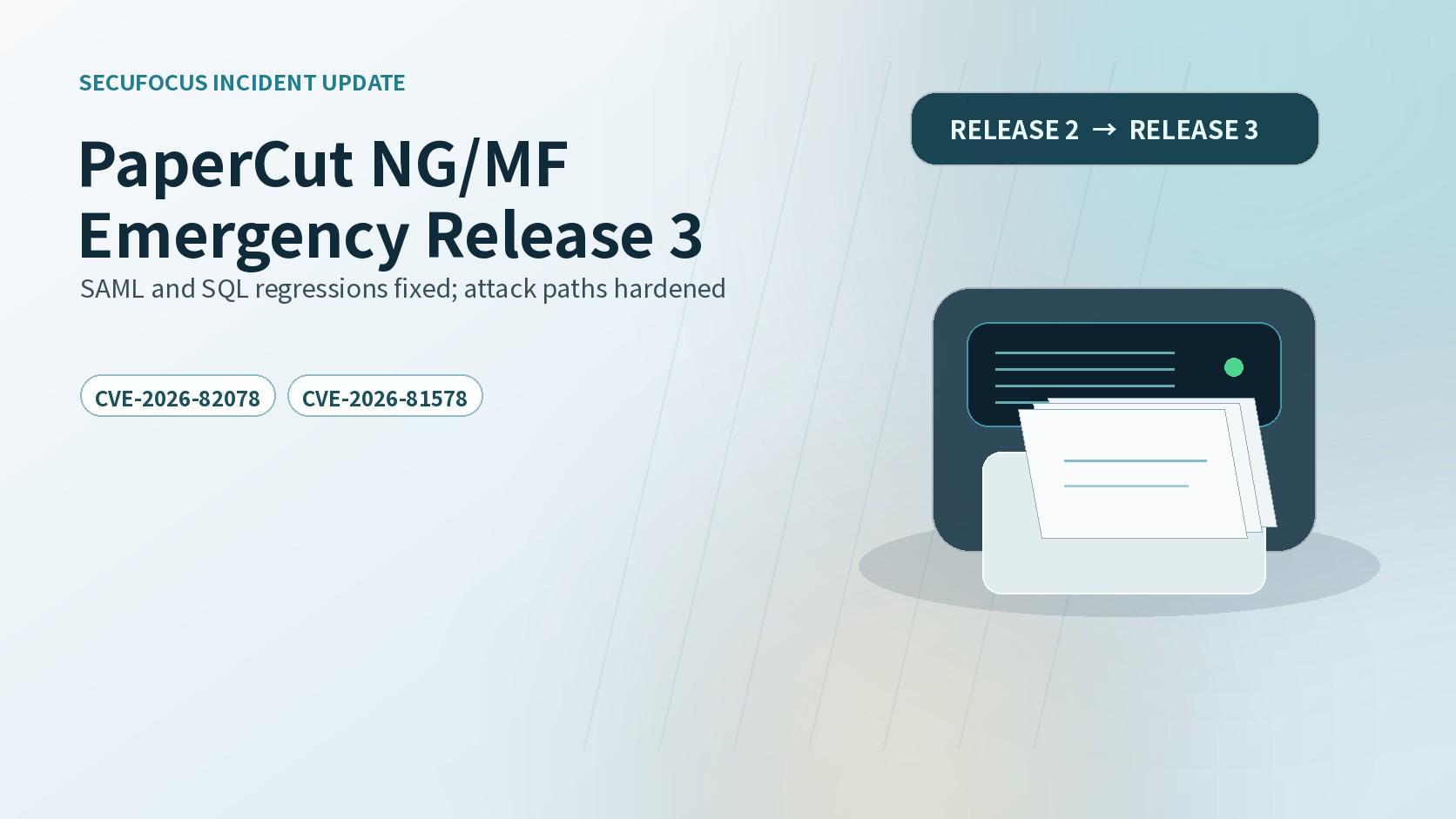
PaperCut NG/MF Exploitation: Second-Wave Activity and Response
Observed PaperCut NG/MF exploitation progressed to privileged-account attempts, registry-hive collection, Java Meterpreter…

September 7 Security Briefing: Roundcube, StyleSmuggler, and Bifrost RCE
A focused review of Roundcube 1.6.19 and 1.7.4, the new StyleSmuggler fc-cache variant, and the Bifrost HTTP plugin RCE path.
Comments
No comments yet.