
Oz Hair and Beauty Data Breach: Exposed Data and Customer Response
An unauthorized party accessed customer contact and order data at the Australian beauty retailer. This report explains the confirmed scope and a practical response to delivery and refund impersonation risks.
Incident summary and disclosure time
Australian beauty retailer Oz Hair and Beauty notified customers that an unauthorized third party accessed its systems and that the investigation identified customer information that had been viewed. The report quoting the notice was published at 21:41 UTC on August 19, 2026, or 06:41 KST on August 20.
The confirmed scope centers on contact and order context: names, email addresses, phone numbers, locations and postcodes, and details of earlier purchases, including items bought. The retailer said the records related to purchases made before August 2026. It distinguished credit card details, payment information, and invoice details from the exposed data.
What the exposed fields mean together
Each field may look routine in isolation, but the combination can make a follow-up message more persuasive. A name and email identify the recipient, a phone number creates another contact channel, location data adds delivery context, and purchase history gives a scammer realistic product names and transaction themes to imitate.
- Names and email addresses can support personalized email lures.
- Phone numbers can be used for delivery or customer-service impersonation.
- Location and postcode data can make a fake delivery update look locally relevant.
- Past products and order history can make refund, replacement, or restock messages sound credible.
The statement that card and payment data were outside the exposed scope remains important. It does not remove the need to watch for messages that try to collect new payment details. The practical risk is a message that uses real order context to persuade a customer to enter card information, a password, or an authentication code on a fraudulent page.
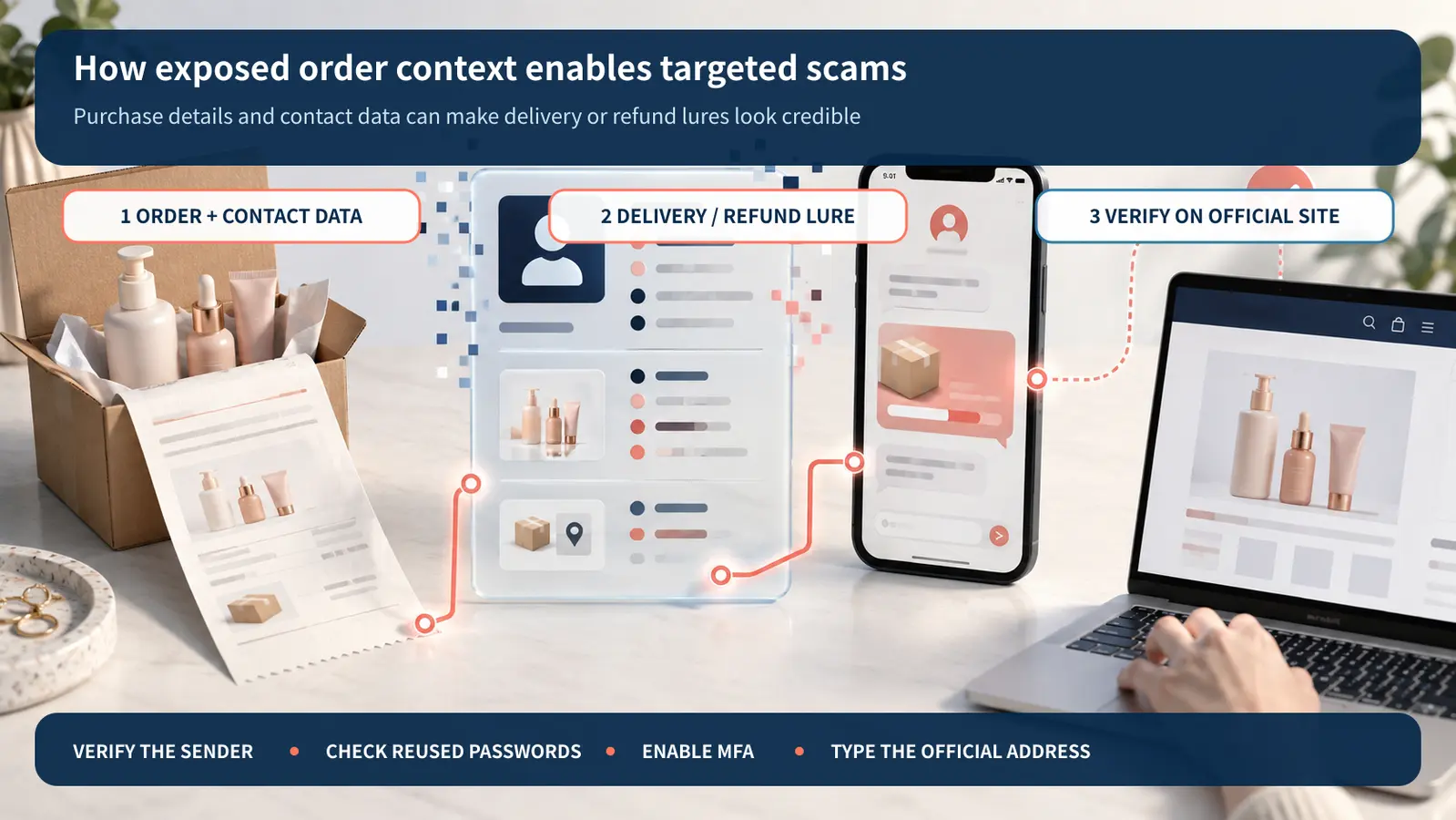
Why order history changes the phishing test
Generic phishing often fails because it refers to an unfamiliar order or uses vague shipping language. A lure built around a real product, region, or earlier purchase can instead resemble routine customer service. Beauty products are often repurchased, so a message about a restock, replacement, exchange, or recurring promotion can appear plausible.
Visual polish, a familiar logo, or a correct product name cannot establish legitimacy. Move verification outside the message. Open the retailer's website by typing the address or using a previously installed official app, check the order there, and use contact details published on the official site.
Accurate order details should not be treated as authentication when those details are among the exposed fields. A legitimate business should not need a full password, a multi-factor authentication code, a remote-access application, or a transfer to a separate bank account to resolve a shipment or refund.
First checks for notified customers
Keep a copy of the notification and compare the listed data types with the information used on the account. Reach the account through the official site rather than a link in the notice. Review recent orders, saved addresses, and contact details, and confirm that they match your own activity.
- Open the official website directly and review recent orders, delivery addresses, and saved contact details.
- Replace reused or similar passwords on email, shopping, and payment accounts with unique ones.
- Enable multi-factor authentication on email and other high-value accounts.
- Independently verify any request for a delivery fee, refund charge, or address correction.
- Contact the relevant bank or service through its official support channel if an alert looks suspicious.
Passwords were not listed among the exposed fields, but email addresses and phone numbers can still support account-recovery or impersonation attempts. Securing the email account first is useful because password-reset links for many other services arrive there. A unique password plus multi-factor authentication makes a stolen identifier less useful.
How to verify messages and payment requests
Delivery and refund scams often create urgency: a parcel will be returned today, an address must be corrected immediately, or a small fee is required to complete a refund. Do not rely only on the sender name or the visible shape of a link. Check whether the same order status appears inside the independently opened official account.
- Open the official site or app instead of following the message link.
- Treat a correct order number or product name as context, not proof of identity.
- Stop if a message asks for card data, banking credentials, or authentication codes.
- Verify attachment or remote-support requests through the official customer-service number.
- If money has moved, contact the financial institution immediately through a trusted channel.
Australia's privacy regulator advises people who receive a breach notification to keep records of the actions they take and to tailor their response to the type of data involved. Its guidance for exposed contact information includes changing email passwords, enabling multi-factor authentication, and being cautious with calls and messages.
Response disclosed by Oz Hair and Beauty
Oz Hair and Beauty said it started a forensic investigation and containment work with senior technical specialists from its cloud e-commerce platform provider. It also reported the incident to the Australian Cyber Security Centre, the Office of the Australian Information Commissioner, and New Zealand's Office of the Privacy Commissioner.
The company said it is reviewing and strengthening its cybersecurity posture and data-retention policies. For online retailers, reducing retention periods and deleting or de-identifying records that no longer serve a business purpose can reduce both the volume and richness of data available in a future incident.
Operational reviews should also cover who can access customer and order systems, whether external platform accounts use multi-factor authentication, and whether bulk viewing or export activity is logged and alerted. Clear notices should separate the exposed data types from the immediate actions customers can take.
A durable rule for international shoppers
The incident was disclosed by an Australian retailer, but the verification rule travels well. A message that knows the product you bought, the area where you live, or the channel you used can still be fraudulent. Familiar transaction details should trigger a second-channel check, not automatic trust.
Verify the order on the official site, remove password reuse, enable multi-factor authentication, and compare payment requests with records held by your bank or payment provider. If an account or payment is compromised, switch immediately to the official recovery channels of the service and financial institution.
Sources reviewed
- Oz Hair and Beauty cyber attack may hit 2 million customersNews.com.au
- Act quickly if you're affected by a data breachOffice of the Australian Information Commissioner · Official source
- Multi-factor authenticationAustralian Signals Directorate · Official source
SECUFOCUS NOW reorganized and analyzed the material above. This article does not replace the original sources.
Related SecuNote articles

Sality Botnet Disruption: How the P2P Sinkhole Cut Its Command Path
A multinational operation disrupted Sality's peer-to-peer command path across more than 15,000 infected hosts. This analysis…

Dropbox Account Breach: Lenovo ID Integration and Confirmed Impact
A legacy Lenovo ID integration enabled unauthorized access to about 5,000 Dropbox accounts. This report explains the confirmed…
Novocure Cyber Incident Exposed Patient and Contact Records
Unauthorized access to a Novocure subsidiary exposed internal patient IDs and a smaller set of identifying and contact records in…
Comments
No comments yet.