
Novocure Cyber Incident Exposed Patient and Contact Records
Unauthorized access to a Novocure subsidiary exposed internal patient IDs and a smaller set of identifying and contact records in the United States. This report separates the affected corporate systems from treatment devices and outlines evidence-based response priorities.
Incident overview
Novocure disclosed unauthorized access to information systems at one of its subsidiaries in a Form 8-K filed with the U.S. Securities and Exchange Commission on September 1, 2026. The subsidiary became aware of the access in mid-August. Novocure activated its cybersecurity incident response plan, contained the incident, opened an internal investigation, and engaged independent forensic experts.
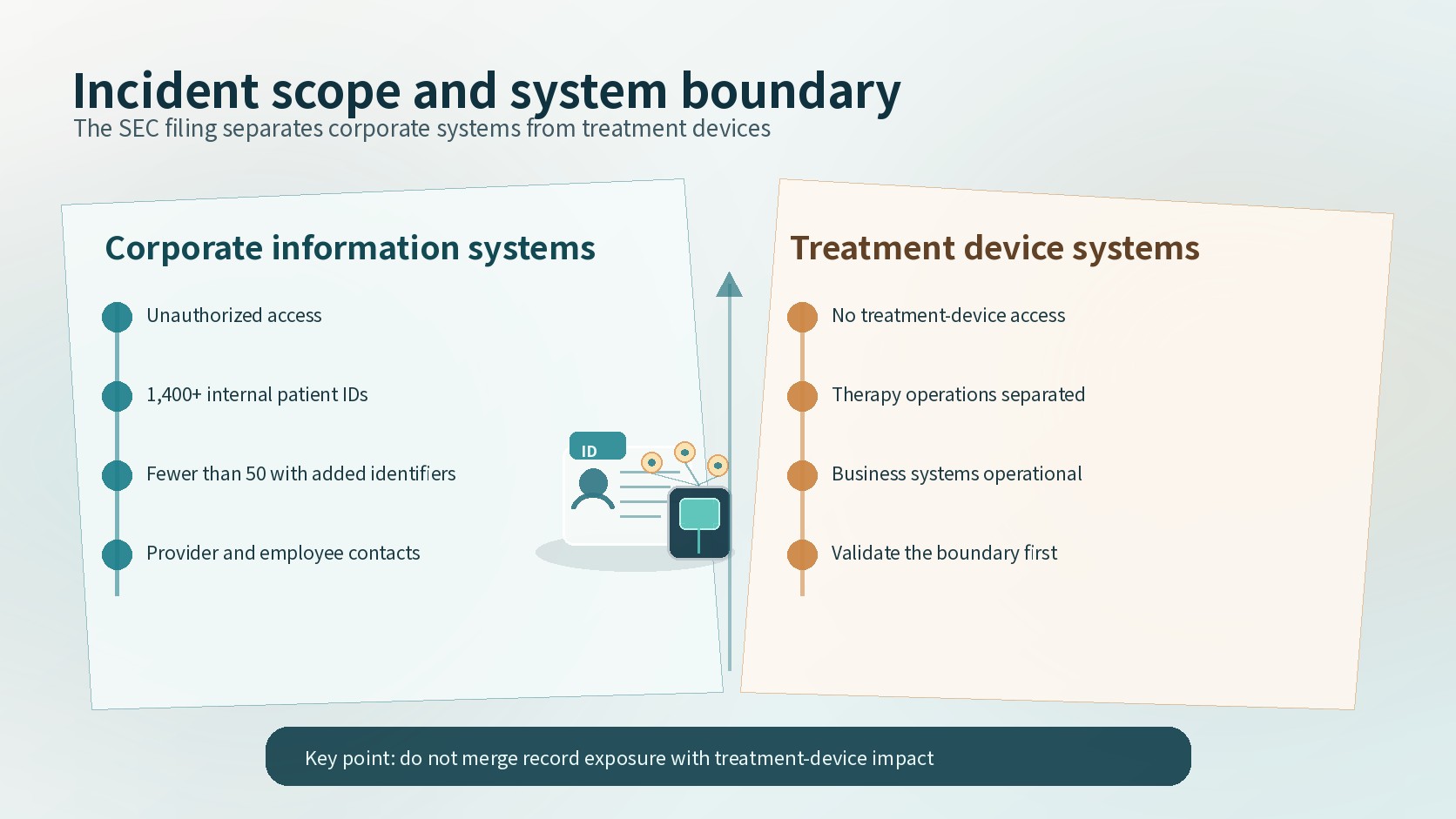
The filing draws a critical boundary between corporate information systems that held patient-related records and the medical treatment devices used in care. Some records were exposed, but Novocure said there was no access to medical treatment devices and that operations were not compromised. That distinction keeps record confidentiality, service availability, and device integrity from being treated as the same impact.
The SEC accepted the filing at 7:00:43 a.m. Eastern time on September 1, or 8:00:43 p.m. in Korea. Reuters reported the disclosure later that day. This analysis relies on the company’s regulatory filing and corroborating reporting rather than claims from a leak site or an unidentified actor.
Response timeline
After detecting the access, Novocure activated its response plan and contained the incident. The independent forensic review adds a separate evidentiary layer to the company’s internal investigation. The practical task is to align account activity, affected hosts, repository access, and record-level evidence into one reliable timeline.
Novocure said all systems were fully functional and normal operations continued. It is reviewing notification requirements and plans to notify patients where required. The response therefore extends beyond containment into forensic review, record classification, and notification decisions tied to the data involved.
Records in scope
The largest group consists of more than 1,400 U.S. patient records containing only internal Novocure patient identification numbers. The filing says those records did not include patient names or other identifying information. An internal identifier has a different risk profile from a name, address, or direct contact field.
A second group includes fewer than 50 patients in the western United States whose records contained additional identifying information. General contact information for healthcare providers was also exposed, along with general employee contact details such as job titles and phone numbers. These categories should remain separate: the filing does not say that every patient in the larger group had the same data exposed.
The field-level distinction informs defense. Internal patient IDs should be checked for reuse across portals, support workflows, or billing systems. Provider and employee contacts can make a message appear credible when combined with public organizational details. That is a defensive implication of the exposed fields, not evidence that the incident included follow-on phishing.
Treatment-device boundary
Novocure explicitly stated that the incident did not involve access to medical treatment devices. The statement separates affected business information systems from systems that operate therapy equipment. The disclosure should not be expanded into a claim about device control, treatment delivery, or device safety.
Healthcare organizations can apply the same boundary analysis internally. Start with corporate identities, business storage, customer support tools, and patient-management records, then independently validate the authentication and management paths that connect to treatment-device environments. If a privileged identity or management service spans both zones, review its sign-ins, token issuance, and permission changes first.
Normal operations and record exposure are also separate findings. Systems can remain available while an investigation examines whether records were viewed or removed. Conversely, exposure of a patient-related record does not by itself establish an impact on treatment equipment. Availability, confidentiality, and device integrity each require their own evidence.
Data-specific priorities
For internal patient identifiers, determine where each value is created, stored, and reused. If the same identifier is accepted as a lookup or verification factor in an external workflow, strengthen that workflow so the identifier alone cannot reveal patient details. Logs can be reviewed for bulk queries, sequential access, and activity from unusual accounts or times.
Records containing additional identifying information require a field-by-field review so notices and protections match the actual exposure. Provider and employee contact data call for renewed verification of unusual email and phone requests, especially when a message uses a real title, team name, or internal identifier to build trust.
Response sequence
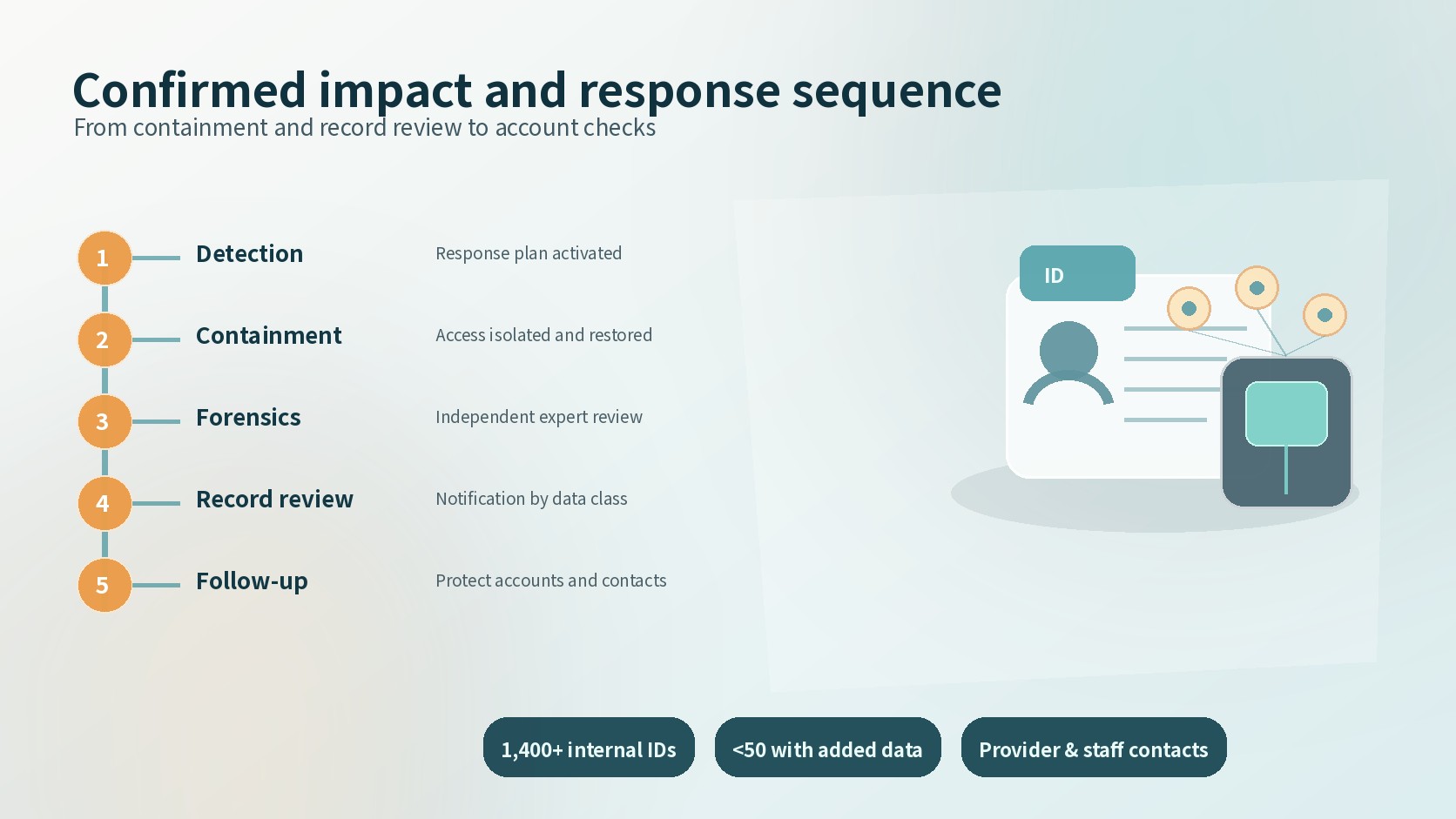
A disciplined sequence connects detection, containment, forensic review, record classification, and follow-up checks. End affected sessions and rotate relevant credentials, preserve authentication and repository logs, then classify impacted records by data type and person. Notification language, support scripts, and protective actions should use the same verified scope.
Priority checks
- End sessions and rotate credentials for affected subsidiary accounts, hosts, and repositories.
- Preserve authentication, permission-change, bulk-query, and download logs in one aligned timeline.
- Map reuse of internal patient IDs across patient management, support, and billing workflows.
- Validate identity and management boundaries between corporate systems and treatment-device environments.
- Classify the added identifiers, provider contacts, and employee contacts by exposed field.
- Reinforce independent verification for unusual requests sent to providers and staff.
- Keep patient notices, official contact channels, and support responses consistent with the verified scope.
Anyone receiving a notice in Novocure’s name should verify it through a known official channel instead of relying on a link or phone number inside the message. A real internal patient ID or job title can make a request look convincing, but it does not authenticate the sender. Requests for passwords, one-time codes, or payment details fall outside the data fields described in the filing and warrant independent verification.
Impact assessment
The incident involves sensitive patient-related records, but the disclosed impact differs by group. More than 1,400 records contained internal patient IDs only; fewer than 50 patients had additional identifying information exposed. Provider and employee contact details formed separate categories. Novocure reported no access to treatment devices and no operational disruption.
The response priority is therefore the affected business-information environment: preserve access evidence, classify records, notify the right people, and protect accounts and communication channels. Healthcare operators should also use the event to test the boundary between record systems and treatment technology. The filing demonstrates why a precise, record-level and system-level scope is essential in healthcare incident response.
Sources reviewed
- Novocure Ltd. Form 8-K, Item 8.01 — Cybersecurity IncidentU.S. Securities and Exchange Commission · Official source
- Oncology firm Novocure says cyberattack exposed US patient recordsReuters
SECUFOCUS NOW reorganized and analyzed the material above. This article does not replace the original sources.
Related SecuNote articles
Langflow Code Injection RCE (CVE-2026-0768): Active Exploitation and Response
CVE-2026-0768 is now being exploited against internet-accessible Langflow deployments. This analysis explains the vulnerable…
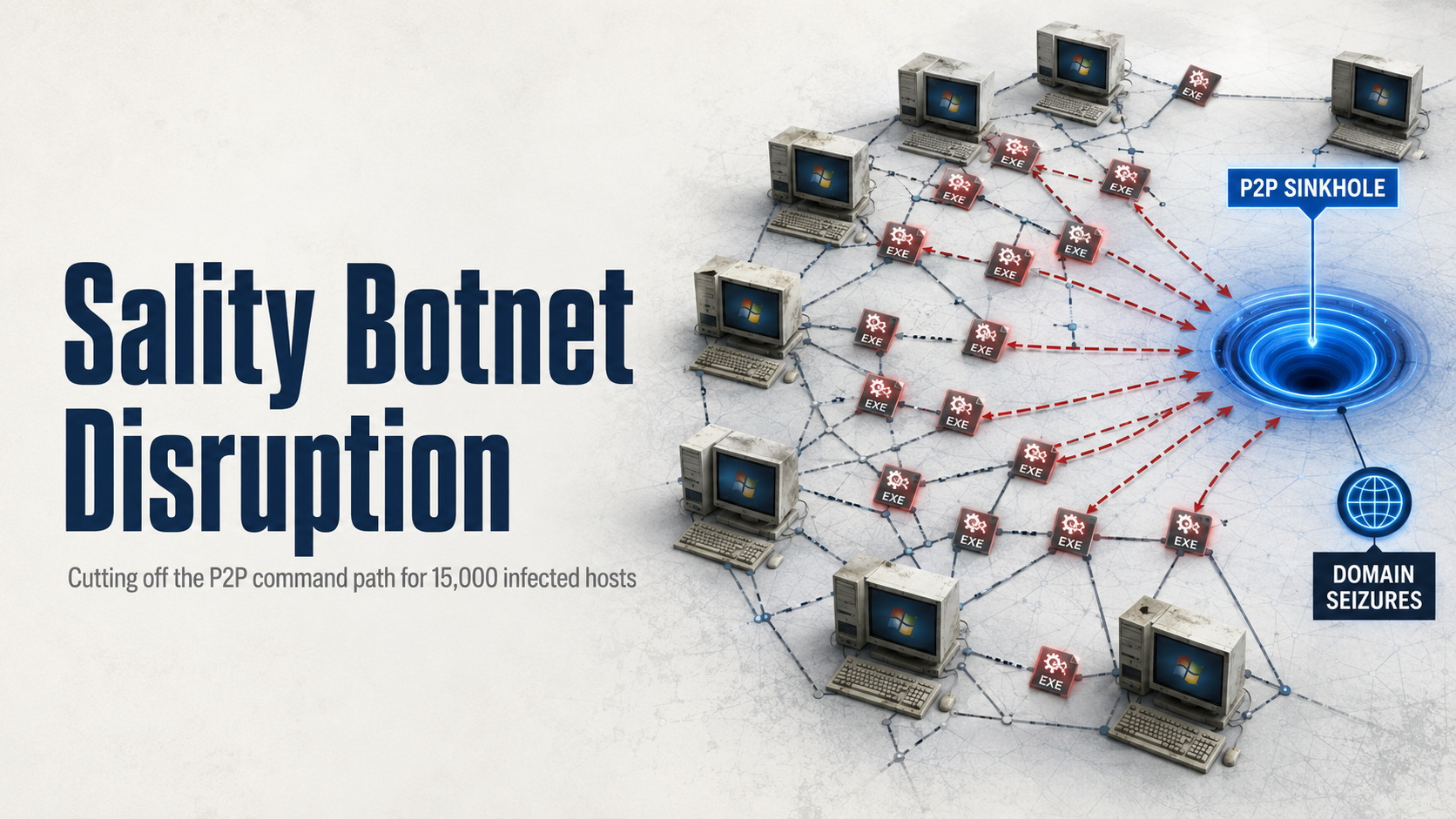
Sality Botnet Disruption: How the P2P Sinkhole Cut Its Command Path
A multinational operation disrupted Sality's peer-to-peer command path across more than 15,000 infected hosts. This analysis…

Dropbox Account Breach: Lenovo ID Integration and Confirmed Impact
A legacy Lenovo ID integration enabled unauthorized access to about 5,000 Dropbox accounts. This report explains the confirmed…
Comments
No comments yet.