
August 20 Consumer Security Briefing: Money-Doubling Offers, Card-Reward Texts, and Jury-Duty Threats
This briefing compares money-doubling offers, card-benefit text links, and jury-duty payment threats. It explains how to pause, verify the sender through an independent official channel, and respond according to whether you only received the message, clicked, entered data, or paid.
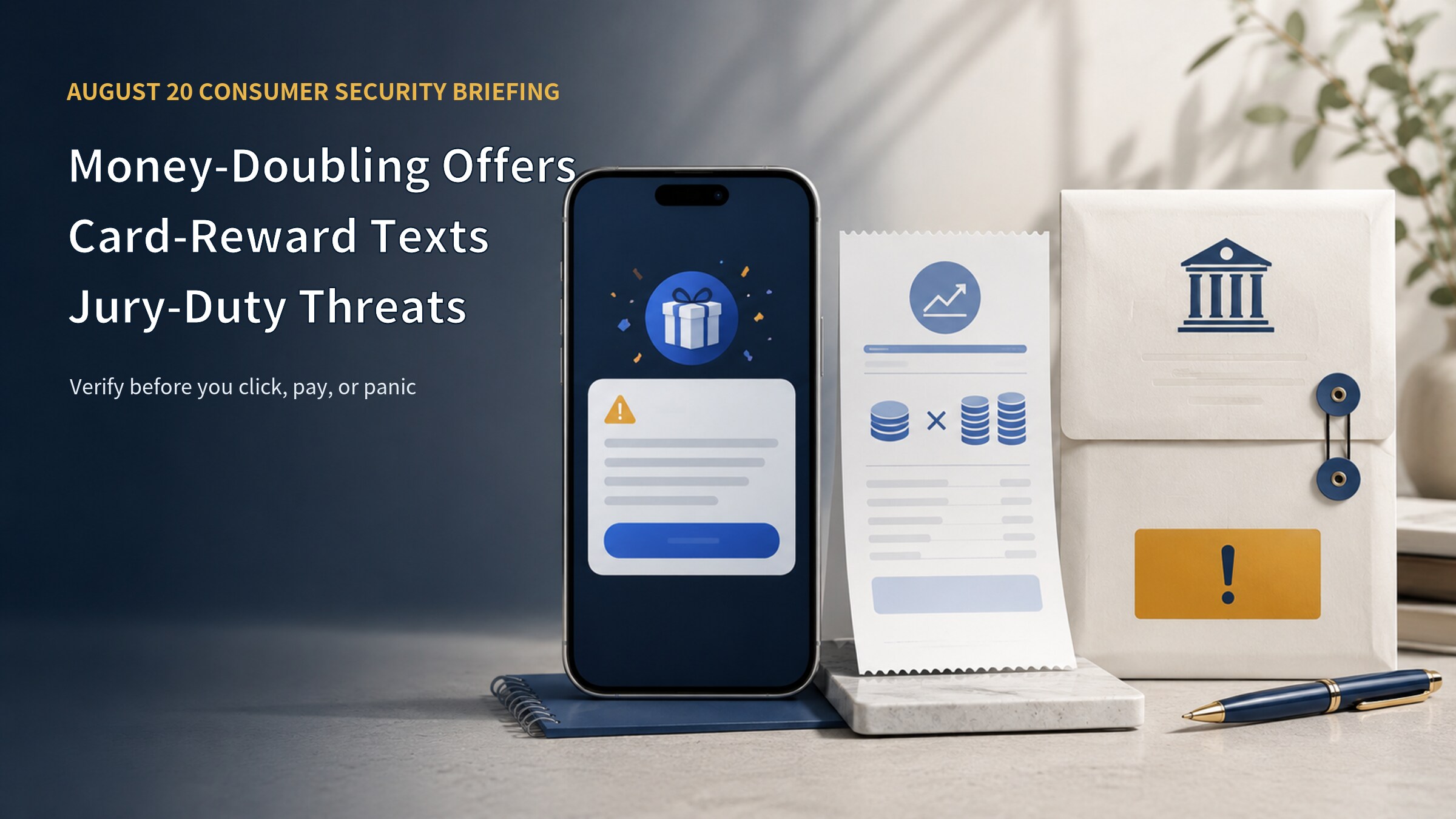
Three public warnings issued during the last seven days show how consumer scams use very different stories to push the same sequence of actions. The Bank of Ghana warned about a money-doubling operation using the look-alike name “Worldremit.” Bank of China Macau described text messages advertising credit-card spending rewards or annual-fee waivers. In Florida, the Nassau County Clerk warned residents about callers claiming that missed jury duty required an immediate payment to reschedule or avoid arrest. The themes differ, but each message tries to move the recipient away from an independently verifiable official channel.
A practical test is not simply whether the story sounds plausible. Ask where the sender wants the next step to happen. A messaging account, an embedded text link, a caller-controlled transfer, or an immediate payment request gives the sender control over both the claim and the supposed verification. Close that path and open a separate one: the financial institution’s normal app, a regulator’s licensing register, or a phone number found on the agency’s official website.
Money-Doubling Impersonation
The Bank of Ghana’s August 17 notice identifies a fraudulent money-doubling operation using the pseudo name “Worldremit.” The notice distinguishes the operation from WorldRemit, the legitimate remittance provider. A familiar-looking name or logo is therefore not enough to establish who is receiving the money. Before treating an offer as an investment, compare the exact legal entity, authorization status, receiving-account name, and withdrawal terms against an official register.
A promise to return a fixed multiple of a deposit does not explain how revenue is produced, who bears losses, or how withdrawals work. A legitimate product should identify the operator, risks, fees, and exit conditions in a document that can be checked outside the sales conversation. Do not proceed when a contact reduces the decision to a package amount, urges an immediate transfer, or asks you to recruit others, install remote-control software, share a screen, or disclose a one-time code. A precise payout figure does not compensate for an unverifiable operator or opaque money flow.
Card-Reward and Fee-Waiver Texts
Bank of China Macau’s August 14 warning describes fraudulent messages about “BOC Credit Card Consumption Awards” and “BOC Credit Card Annual Fee Waivers.” The embedded links lead recipients toward the theft of personal and card information. The bank states that it does not send SMS or email containing hyperlinks that direct customers to log in, conduct transactions, or provide sensitive personal or card information. A bank name in the sender field should not override that rule.
Reward messages often add a deadline: points are about to expire, a refund is waiting, or a fee waiver must be claimed today. Instead of using the link, open the card issuer’s app yourself and look for the same promotion in its notices or benefits area. If assistance is needed, use the number printed on the card or shown in the official app. This prevents the message sender from supplying both the alarming claim and a counterfeit support channel.
Response depends on what happened. If you only opened the page, close it and check recent downloads, newly installed apps, and browser notification permissions. If you entered card details or a one-time code, contact the card issuer through its official service line to block and replace the card and review authorizations. If you entered an online-banking password, change it on the real site, terminate other sessions, and replace reused passwords. Preserve the message, URL, transaction time, amount, and merchant name if a charge occurred.
Jury-Duty Payment Threats
The Nassau County Clerk’s August 14 alert says residents received calls from people impersonating the Nassau County Sheriff’s Office. The callers claimed that the recipient had missed jury duty and demanded payment to reschedule or avoid arrest. The Clerk explains that the Sheriff’s Office, Clerk’s Office, and judicial employees do not call to demand money for missing jury duty or to avoid arrest. A detailed title, case number, or official-sounding vocabulary does not make an immediate payment request legitimate.
Authority impersonators try to keep the call active. They may say that hanging up will trigger a warrant or that discussing the call with a bank, relative, or police officer will interfere with an investigation. That pressure is designed to remove verification time. End the call, find the agency’s published number independently, and ask whether a real notice exists. Do not call back the displayed number or accept a transfer arranged by the caller.
Requests for gift-card numbers, cryptocurrency, payment apps, or transfers to an individual are especially strong stop signals because recovery can be difficult. The same verification method applies when any court, police, prosecutor, tax office, or other public body is invoked: the contact path used to verify the claim must be independent of the person making it. Only after verification should you consider any separate official process.
The Shared Fraud Sequence
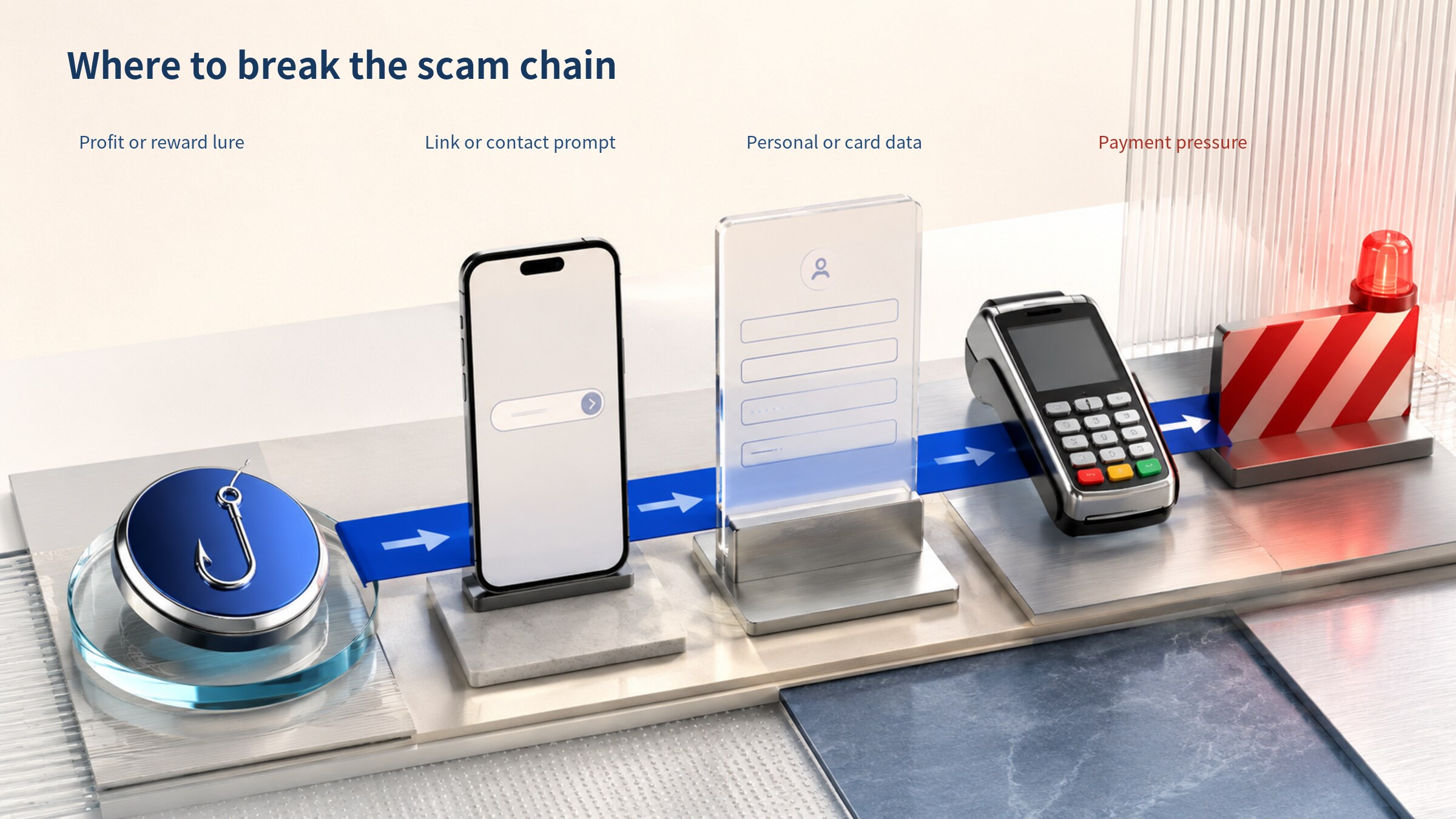
The first stage is emotional: a large return, a benefit that will disappear, or an arrest threat. The second stage moves the recipient to a channel controlled by the sender. The third collects card data, credentials, identity details, or one-time codes. The last stage requests an immediate transfer and renews the deadline whenever the recipient hesitates. Recognizing this sequence is more reusable than memorizing one brand name or script.
Separate the contact channel from the verification channel. For a text, open the normal app instead of the embedded link. For a call, hang up and find the published number. For an investment pitch, check the regulator’s licensing register and the exact legal entity. This moves the decision outside the story and infrastructure prepared by the sender.
Response by Exposure Stage
- If you only received the contact, do not reply or call the displayed number. Capture the evidence, block the sender, and verify through an independently found official channel.
- If you opened a link without entering data, close it and review downloads, newly installed apps, and browser notification permissions. Prioritize a device security check if you ran an installer.
- If you entered a username and password, change the password on the official site, sign out other sessions, and replace the password anywhere it was reused.
- If you entered card data or a one-time code, call the issuer immediately to block and replace the card and review authorizations. Ask the bank about protective measures if account details were disclosed.
- If you paid, contact the bank or card issuer first. Preserve the conversation, caller ID, receiving account, URL, time, and amount, then submit them through the appropriate official reporting route.
This Week’s Check Order
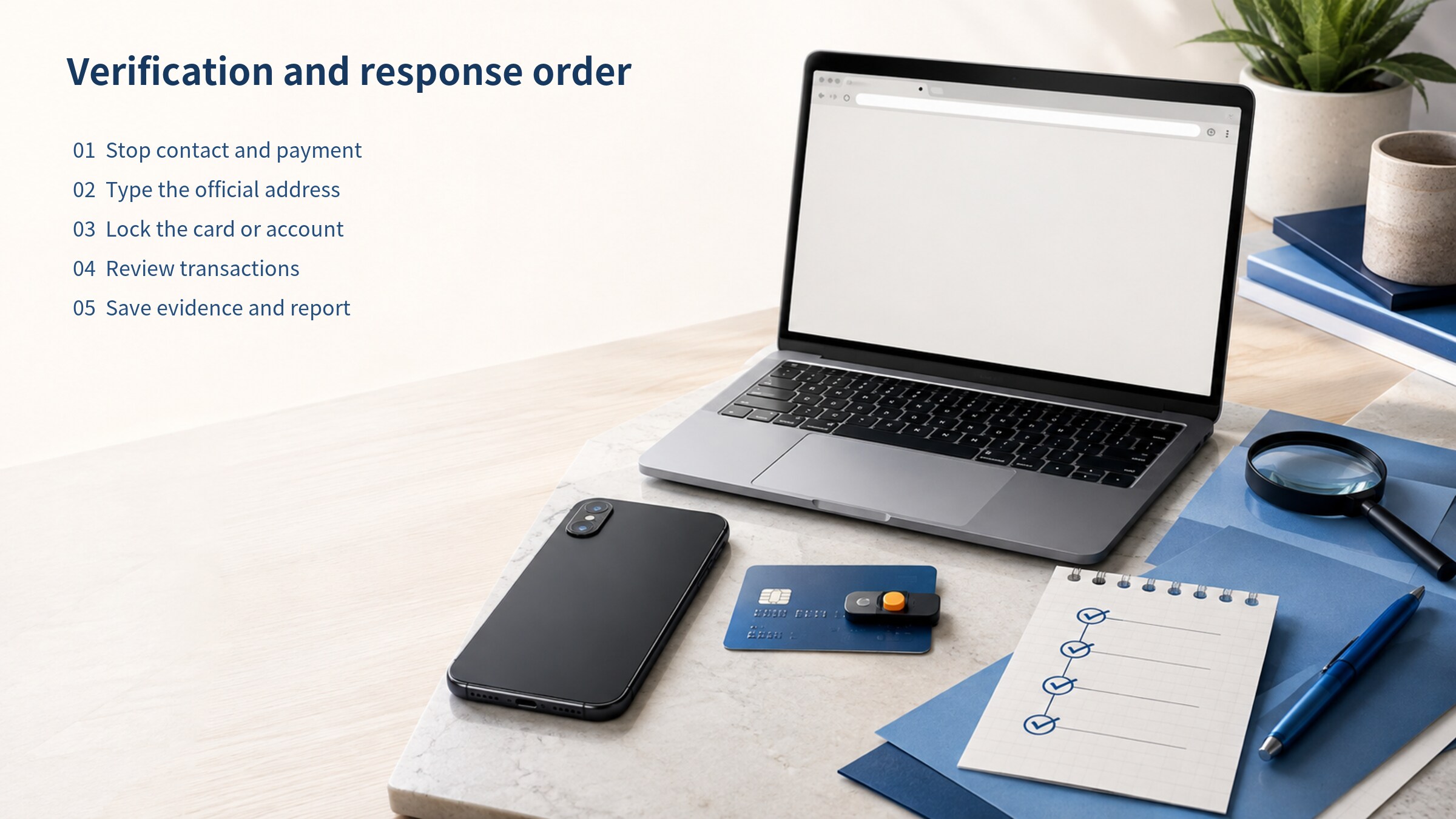
- Check the exact legal entity and regulator authorization before sending money to any guaranteed-return or money-multiplication offer.
- Verify card rewards, points, and fee waivers inside the issuer’s app, not through an embedded text link.
- Stop when a supposed bank or agency requests a one-time code, card security code, screen sharing, or remote-control software.
- End calls that threaten fines, arrest, or account suspension, then use the agency’s published main number.
- Do not pay through gift cards, cryptocurrency, or personal accounts simply because the caller says the deadline is immediate.
- After data entry or payment, contact the financial institution, secure accounts, preserve evidence, and use the official reporting process.
Review Scope
This briefing was prepared for 4:00 p.m. Korea Standard Time on August 20, 2026. The review window ran from 4:00 p.m. on August 13 through 3:59 p.m. on August 20, KST. We selected public alerts from financial and government institutions that gave consumers a concrete action. Administrative and reporting processes differ by location, so use the official routes provided by the financial institution and authorities where you live.
Sources reviewed
- SCAM ALERT – ‘WORLD REMIT’ MONEY DOUBLING SCHEMEBank of Ghana · Official source
- Bank of China (Macau) Fraud AlertBank of China (Macau) · Official source
- Jury Duty Scam AlertNassau County Clerk of the Circuit Court and Comptroller · Official source
SECUFOCUS NOW reorganized and analyzed the material above. This article does not replace the original sources.
Related SecuNote articles

Cloned Car Dealership Websites: How to Verify a Vehicle Before Paying
Scammers are cloning real car dealership websites, listings, photos, reviews, and sales policies to demand upfront wire payments…
Unfamiliar Configuration Profile on iPhone? Check Management and Secure the Device
Configuration profiles can apply work or school accounts, VPN settings, certificates, and other controls to an iPhone. This guide…
Fake Buyer-Protection Portals: Refund, ID and Bank-Detail Checks
A newly disclosed HKICL impersonation scheme combined refund support, identity verification, bank details, a fake wallet and an…
Comments
No comments yet.