
GS Retail Data Breach: Credential Stuffing, Missed Signals, and User Actions
A regulator investigation established how credential stuffing affected GS SHOP and GS25, why 327 shared IPs mattered, and how exposure continued after the first detection. Here are the confirmed findings and priority actions.
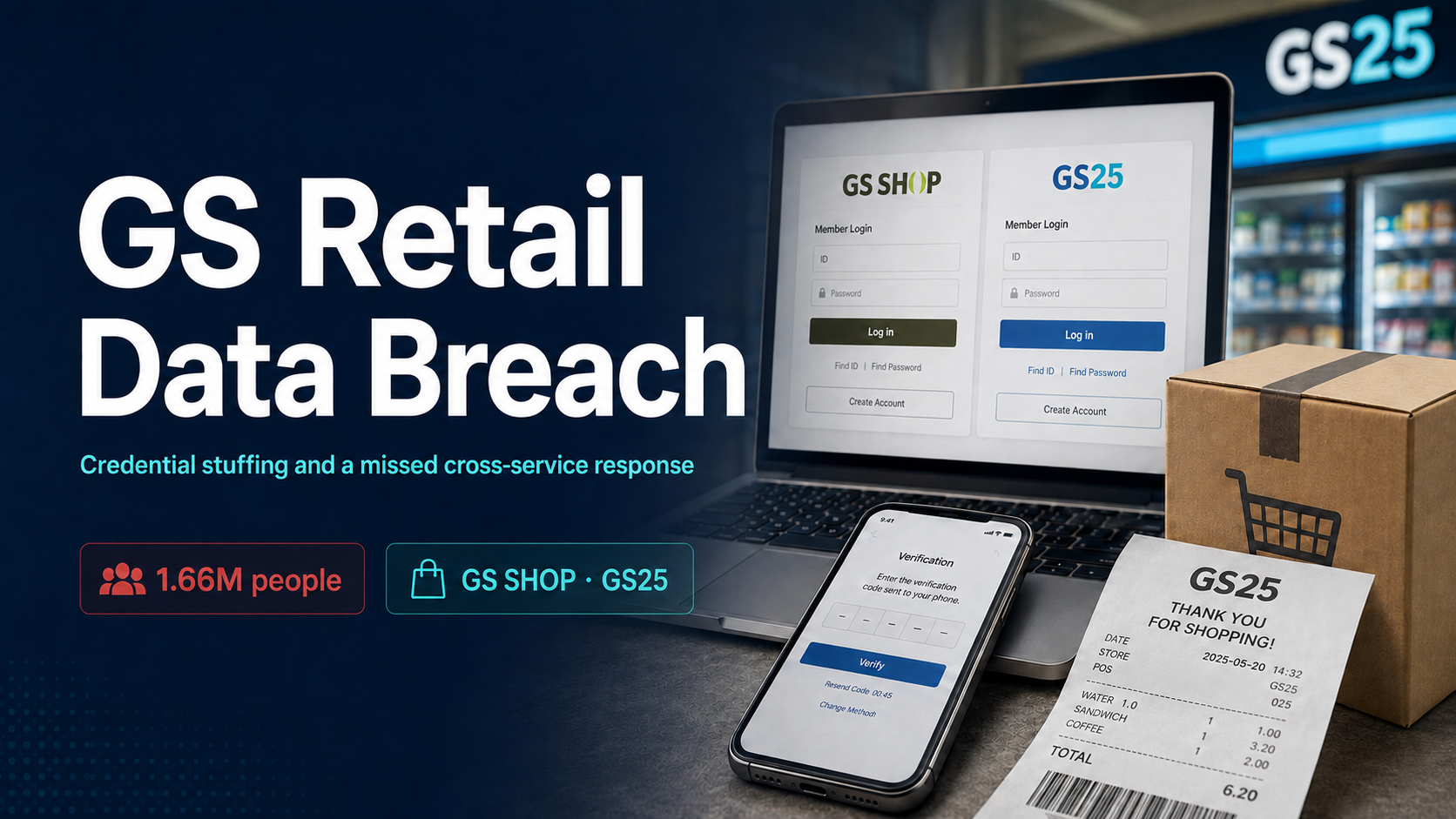
What the new investigation established
A Personal Information Protection Commission investigation published on August 31, 2026 added important findings to the GS Retail breach first disclosed in early 2025. It explained how credential-stuffing activity crossed GS SHOP and GS25, why the second service was not identified promptly after the first breach was detected, and which abnormal login signals were missed. The regulator imposed a KRW 12.836 billion administrative penalty and a KRW 3 million fine, and ordered corrective measures covering breach prevention, privacy governance, and publication of the decision.
The confirmed scope covers 1,581,025 GS SHOP members and 79,128 GS25 members. Attackers used credentials obtained from other sites, attempted logins at scale, and accessed member-profile pages after successful authentication. Confirmed data categories included names, gender, birth dates, contact details, addresses, and email addresses. Earlier company notices for GS SHOP also listed user IDs, marital status, wedding anniversaries, and personal customs-clearance codes. People who received a notice should therefore review reused credentials and remain cautious about messages that exploit order or delivery context.
Timeline and the missed cross-service response
The GS SHOP activity ran from June 21, 2024 through February 13, 2025, while the GS25 activity ran from December 27, 2024 through January 4, 2025. GS Retail detected the GS25 exposure on January 4, but did not identify the same activity affecting GS SHOP until February. Personal-data exposure on GS SHOP therefore continued after the first service-level detection.
The two services shared a concrete investigative link: 327 IP addresses used against GS25 were also used against GS SHOP. Once one service had detected a breach, those indicators could have been searched across other consumer services. The material new fact is not merely the number of affected accounts; it is the regulator's finding that evidence from one service was not connected quickly enough to stop continued exposure in another.
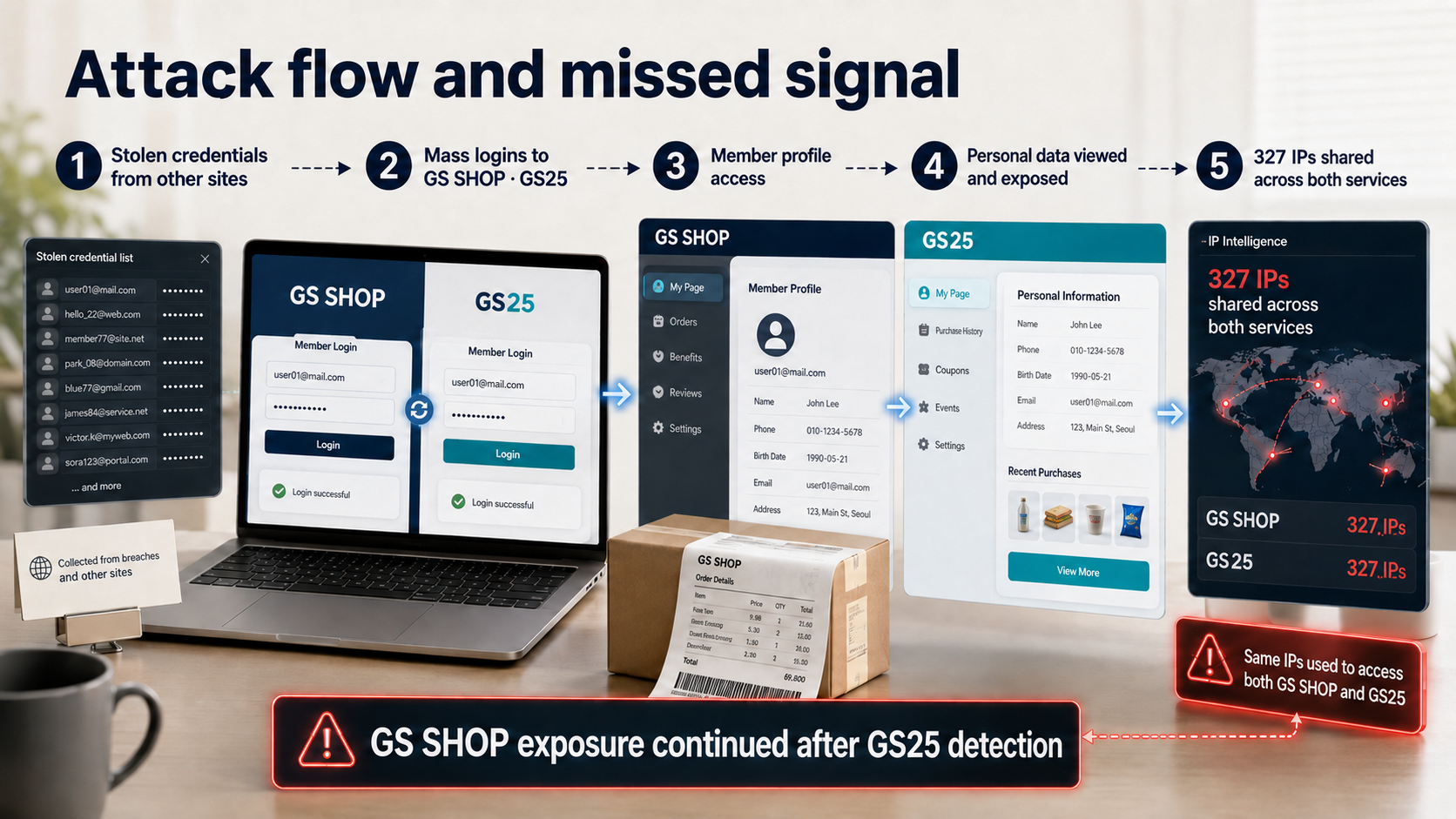
How credential stuffing led to exposure
Credential stuffing does not require an attacker to extract passwords directly from the target. Instead, credentials leaked elsewhere are automatically tested against other websites and apps. Reused passwords turn a breach at one service into access at another. Once a login succeeds, the attacker may use the same permissions as the legitimate customer and open profile or account-settings pages.
The regulator found that GS Retail had not implemented sufficient controls to detect and block large numbers of login attempts from the same IP address, and that sharp increases in login attempts and failures were not recognized as abnormal. Separate PIPC guidance says organizations should compare activity with normal baselines and consider repeated attempts from the same IP, failure rates, excessive speed, VPN characteristics, and service-specific behavior together rather than relying on one universal threshold.
Profile pages became the exposure point after successful logins. Because such pages often show contact and delivery information in one place, defenses must extend beyond the login form. Rate limits and anomaly detection should be combined with data masking, step-up verification before sensitive viewing or changes, device and login notifications, and cross-service monitoring.
Operational findings
The investigation also cited the absence of a dedicated privacy organization and fragmented security operations. When logs and incident authority are divided by service, an indicator found in one channel may not be propagated promptly to another. The 327 shared IP addresses are a concrete example of why common incident correlation matters.
Notification timing was another finding. Investigators identified 1,599 additional affected people after the initial notice, but notification to them was sent more than 72 hours later without a justified reason. Continuing investigation does not remove the need to inform newly identified people promptly so they can change reused credentials and recognize impersonation attempts.
Corrective orders require policies that identify abnormal access, preventive measures, dedicated privacy staff, and clearer authority and responsibility for the chief privacy officer. The lesson is that technical controls, cross-service incident coordination, and notification must operate as a single response chain.
Priority actions for users
If you received a GS SHOP or GS25 notice, open the official app or type the service address yourself instead of using a link in a message. Review the categories listed in your notice, then set the scope of your response. Contact, address, and order-related data can make delivery, refund, or customs impersonation sound convincing, so knowledge of those details alone is not proof that a caller or sender is legitimate.
- Change any password reused on GS SHOP or GS25.
- Change the same credential combination on email, shopping, portal, and other accounts.
- Enable two-step verification and new-login alerts where available.
- Review login history, delivery addresses, contact details, and orders in the official interface.
- Verify order, delivery, refund, and customs messages through official support channels rather than the message link or phone number.
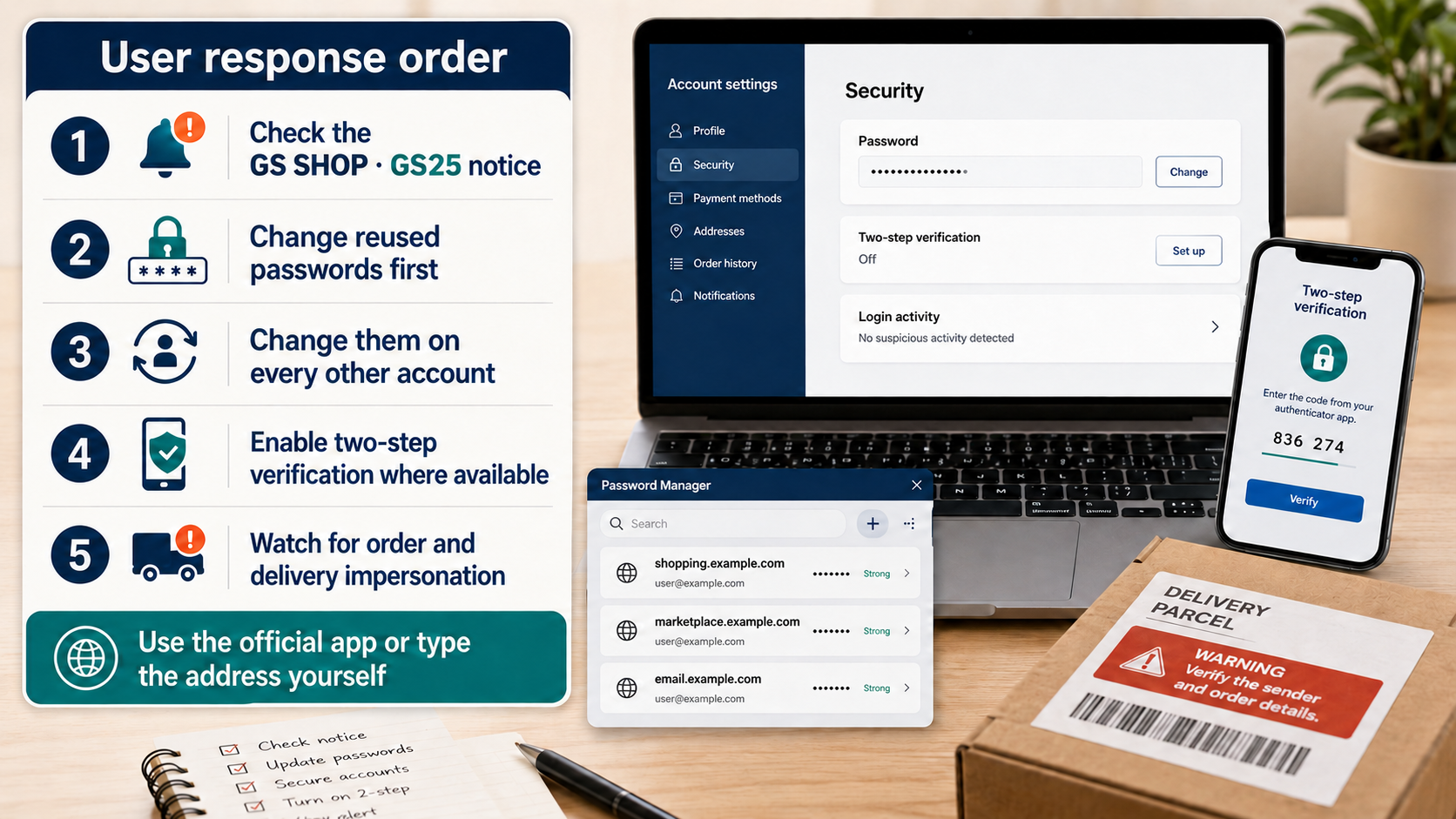
Do not make a slightly modified version of an old password. Create a long, unique value for each account; a password manager can make this practical. Email should be high priority because it receives password-reset links for other services. If email and shopping accounts shared a password, change both and review recovery methods and active sessions.
What organizations should verify
The incident shows that login anomaly detection, cross-service correlation, data minimization, and rapid notification are not separate checklists. A mature workflow detects abnormal attempts, searches indicators across every consumer service, reviews data-access events for successful accounts, updates the affected population, and sends timely notices.
- Monitor login volume and failure rates against normal baselines
- Limit excessive account switching and repeated access from the same IP, device, or session
- Distribute incident indicators immediately across all services
- Mask profile data and require step-up verification for sensitive viewing or changes
- Update and notify the affected population as new evidence is confirmed
- Give dedicated privacy staff and the CPO clear decision authority
Password reuse is only one side of this event. Automated login volume, unusual failure rates, 327 IP addresses shared across services, and continued exposure after the first detection were signals the operator could connect. Users can reduce secondary risk by ending password reuse and verifying suspicious messages; operators must correlate those signals across channels and respond as one incident.
Incident exercises should also connect account, order, customer-service, security, and privacy teams rather than remain within one service. Managing attack IPs, affected accounts, successful profile access, and newly identified notification recipients under one incident record makes it easier to search every service when new evidence appears. The decision shows that this correlation is an operational control that can limit continued exposure.
Sources reviewed
- 개인정보 160여만명 유출…개인정보위, GS리테일 등 3곳에 과징금 129억전자신문
- 크리덴셜 스터핑 공격으로 개인정보 유출되면 무조건 과징금 처분받나?개인정보보호위원회 · Official source
- KISA, 브라우저 자동 로그인 사용주의 권고 발표한국인터넷진흥원 · Official source
- '개인정보 유출' GS리테일에 과징금 128억원…GS25 해킹 인지 후에도 GS샵 40일간 추가 유출조선비즈
- GS리테일, 홈쇼핑만 158만건 개인정보 유출보안뉴스
SECUFOCUS NOW reorganized and analyzed the material above. This article does not replace the original sources.
Related SecuNote articles
Langflow Code Injection RCE (CVE-2026-0768): Active Exploitation and Response
CVE-2026-0768 is now being exploited against internet-accessible Langflow deployments. This analysis explains the vulnerable…
Sality Botnet Disruption: How the P2P Sinkhole Cut Its Command Path
A multinational operation disrupted Sality's peer-to-peer command path across more than 15,000 infected hosts. This analysis…

Dropbox Account Breach: Lenovo ID Integration and Confirmed Impact
A legacy Lenovo ID integration enabled unauthorized access to about 5,000 Dropbox accounts. This report explains the confirmed…
Comments
No comments yet.