
Gitea diffpatch Remote Code Execution (CVE-2026-60004): Exposure and Response
A practical analysis of CVE-2026-60004, covering the diffpatch-to-Git-hook execution path, exposure conditions, service-account impact, and the upgrade and validation steps for Gitea 1.27.1 or later.
Why the advisory changes the priority
KISA issued a security update advisory for CVE-2026-60004 on August 27, 2026. The affected range is Gitea 1.17 through versions before 1.27.1, and the stated resolution is Gitea 1.27.1 or later. Operators should evaluate more than internet exposure: registration policy, repository write permissions, and the operating-system privileges of the Gitea service account all shape the practical risk.
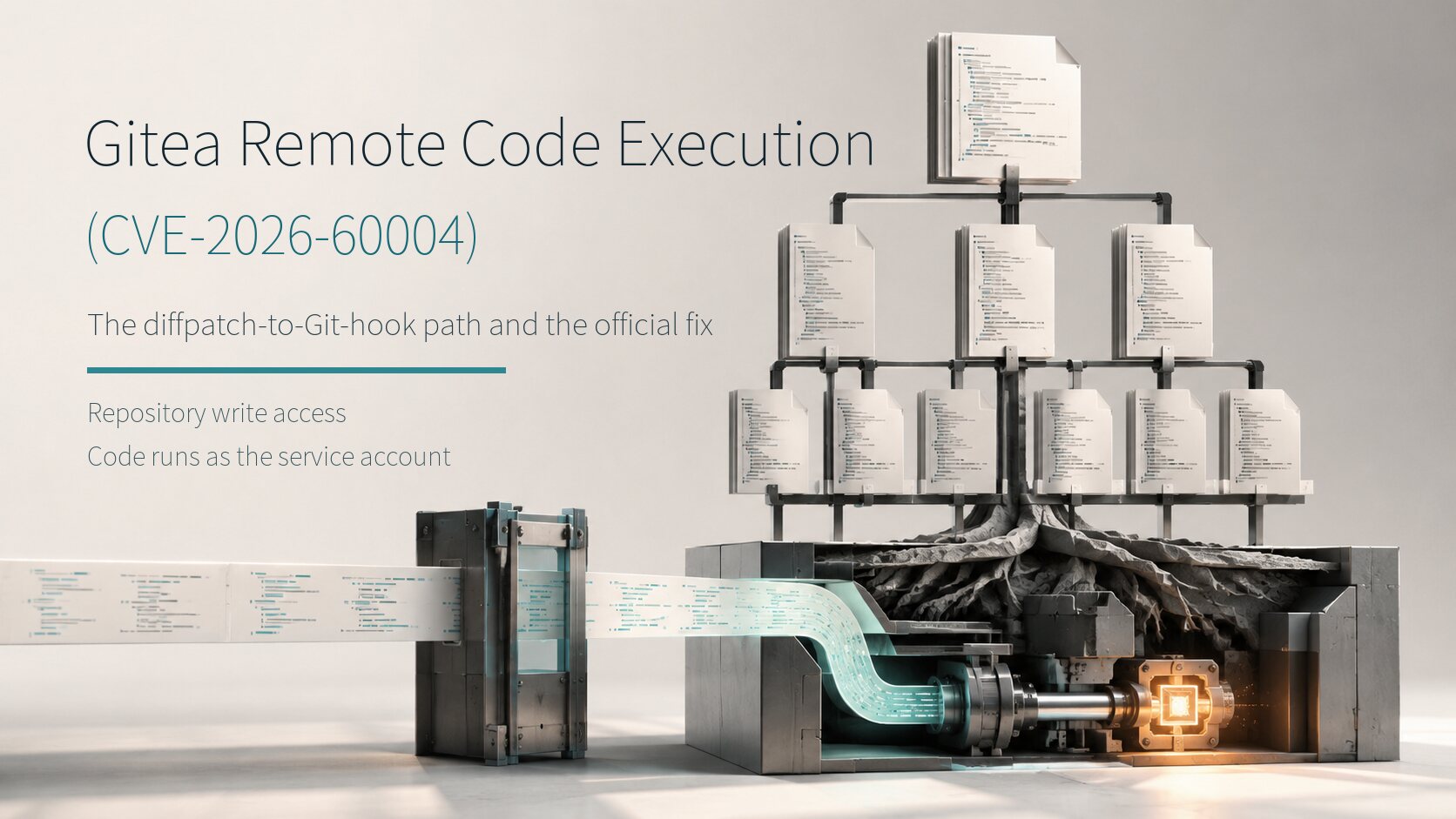
Gitea describes the issue as remote code execution through Git hook installation via the diffpatch API. An account with ordinary repository write access can reach the vulnerable path, and code runs as the operating-system account that hosts Gitea. A web feature therefore crosses into the server privilege boundary.
Conditions required for the attack path
The advisory identifies several conditions that should be checked together. Version alone does not show which instance should be handled first.
- Gitea version 1.17 or later and earlier than 1.27.1
- Repository write access available to the attacker
- Git 2.32 or later with the diffpatch route enabled
- A temporary filesystem that is writable and executable
- Open registration that lets a visitor create an account and repository
Open registration matters because a visitor without an existing account may register, create a repository, and obtain the required write access. If registration is closed, the vulnerable code remains relevant to existing users, compromised accounts, external collaborators, and automation identities that can write to repositories.
From diffpatch to a live Git hook
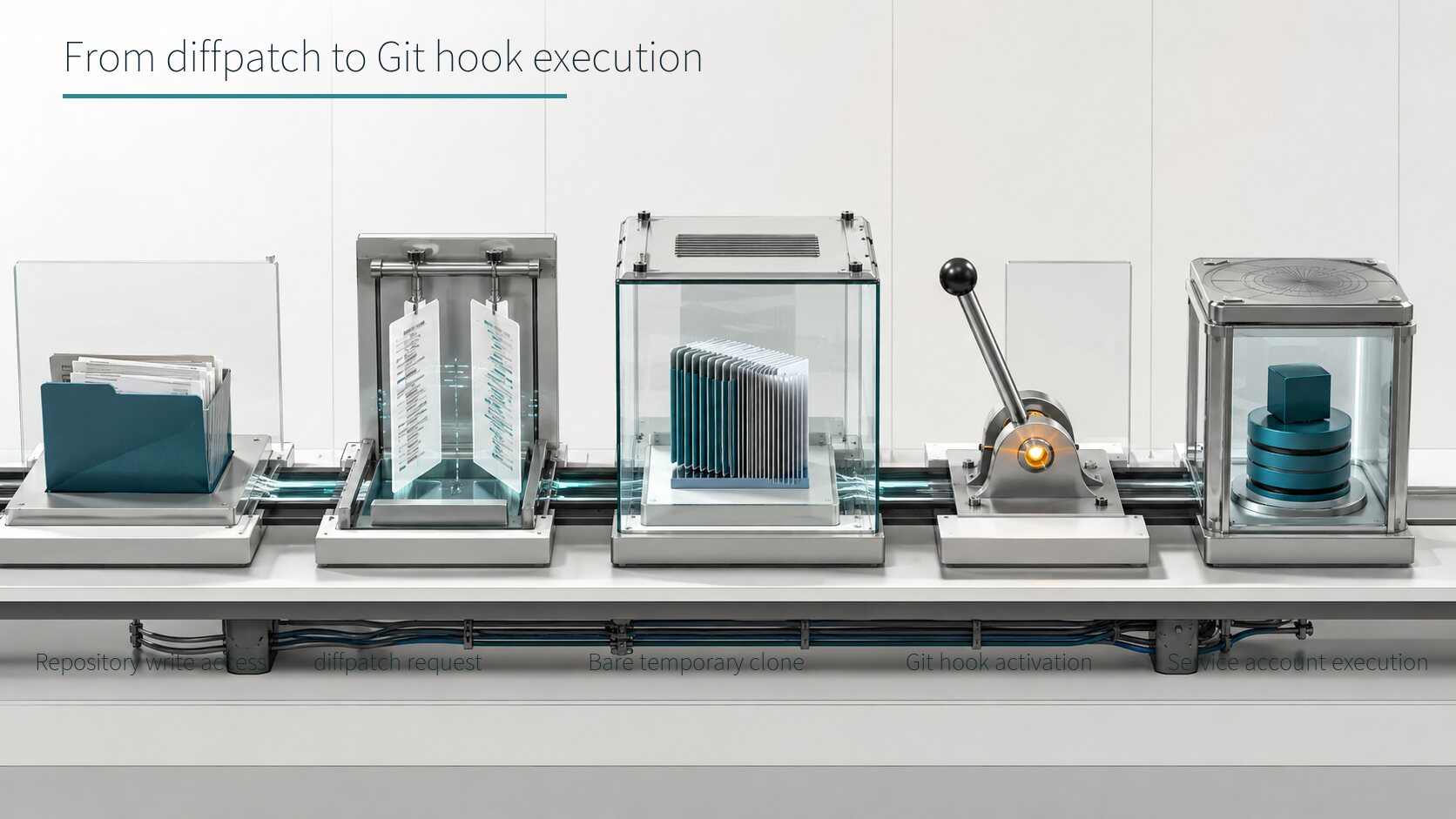
Gitea applies repository-controlled patches in a shared bare temporary clone. Under the documented collision condition, Git's three-way fallback checks an indexed path out. In a bare clone, the repository root is the Git directory, so repository content can reach a live hook path.
When Git writes the index, the hook executes and repository write access becomes command execution as the Gitea service account. The advisory classifies the weakness as code injection, CWE-94. Its CVSS 3.1 base score is 9.8, reflecting a network attack path, low attack complexity, no required user interaction, and high impact to confidentiality, integrity, and availability.
Impact follows the service account boundary
The first execution context is the Gitea service account. Depending on deployment isolation and account privileges, reachable assets may include app.ini and application secrets, process environment secrets, mounted repositories, database credentials and contents, OAuth and integration credentials, and other internal services.
Container isolation, read-only mounts, least-privilege database access, and a restricted service account can reduce the blast radius. Broad filesystem access or reusable internal credentials can turn a Gitea compromise into a wider infrastructure problem. The patch removes the known code path; least privilege limits the consequence of future server-side flaws.
Response order
Prioritize internet-facing instances that allow open registration and repository creation. Next, address organization instances with many developers, external collaborators, or broad write roles. Internal-only deployments still require the official fix because compromised credentials or insider access can satisfy the write-permission requirement.
- Confirm the running Gitea version from the binary, package, or container image
- Prepare configuration, database, and repository recovery points
- Upgrade to the official fixed release, Gitea 1.27.1 or later
- Reduce open registration, repository creation, and write permissions to business need
- Review the privilege boundaries around the Gitea service account and connected secrets
- Validate login, clone, push, pull requests, webhooks, and Actions after the upgrade
Check every replica or node rather than relying on one banner or one upgraded container. Select the package and upgrade procedure that matches the deployment model and follow Gitea's official installation guidance. The 1.27.1 release includes security and functional fixes, so validation should cover the authentication and repository workflows used in production.
If an immediate upgrade must be staged, temporarily restricting open registration, new repository creation, and unnecessary write access reduces prerequisites for the attack path. Tightening the temporary filesystem and service-account privileges is also useful, but these controls complement rather than replace the fixed release.

Validation and follow-up review
After the change, confirm that every running instance is on the fixed release or later. Test normal workflows such as clone, push, pull requests, diff rendering, webhooks, and Actions. Validation should not reproduce the exploit; it should prove that the expected version, access policy, and production workflows are in place.
For instances that exposed an affected version, preserve and review account creation, repository creation, permission changes, and API access records. Correlate unusual write activity with service-account file and process activity. If the review finds evidence of unauthorized execution or secret access, rotate Gitea configuration secrets, database credentials, OAuth tokens, and integration credentials according to the service account's reachable scope.
CVE-2026-60004 shows why repository write permission cannot always be treated as a narrow content-editing privilege. Gitea connects repository data, Git execution, temporary storage, databases, and integration credentials. Applying the official fix while reviewing registration, write access, and service-account isolation addresses both the vulnerable path and the potential blast radius.
Sources reviewed
- Gitea 제품 보안 업데이트 권고KISA 보호나라 · Official source
- Gitea 1.27.1 is releasedGitea · Official source
- Remote Code Execution via diffpatch Git Hook InstallationGitea GitHub Security Advisory · Official source
SECUFOCUS NOW reorganized and analyzed the material above. This article does not replace the original sources.
Related SecuNote articles
Langflow Code Injection RCE (CVE-2026-0768): Active Exploitation and Response
CVE-2026-0768 is now being exploited against internet-accessible Langflow deployments. This analysis explains the vulnerable…

Sality Botnet Disruption: How the P2P Sinkhole Cut Its Command Path
A multinational operation disrupted Sality's peer-to-peer command path across more than 15,000 infected hosts. This analysis…

Dropbox Account Breach: Lenovo ID Integration and Confirmed Impact
A legacy Lenovo ID integration enabled unauthorized access to about 5,000 Dropbox accounts. This report explains the confirmed…
Comments
No comments yet.