
Fake Online Casino Scams: Repeated Deposits, Referral Lures, and Blocked Withdrawals
Fake casino platforms can use social ads, small early payouts and referral rewards to build trust before blocking withdrawals and demanding more money. This guide explains the warning signs and the safest next steps.
A small early payout does not prove that a platform is legitimate. If the withdrawal rules suddenly change, verify the operator and the payment recipient before sending anything else.
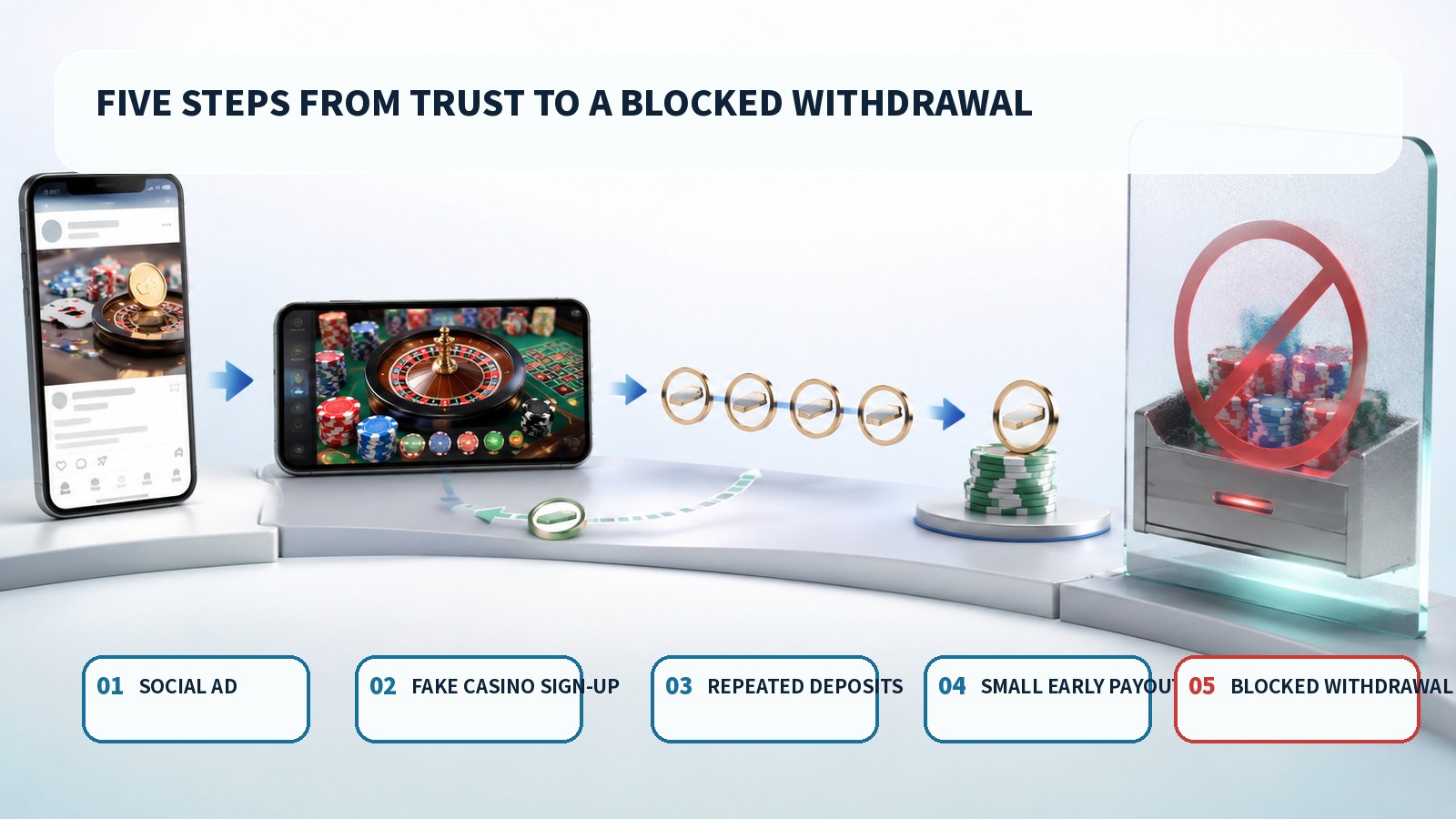
This briefing reviewed public information released between 4:00 p.m. KST on August 17 and 3:59 p.m. KST on August 24, 2026. During that period, South Australia's Consumer and Business Services issued a dedicated warning about “scambling,” a scheme built around fake online gambling and casino platforms, and highlighted it again in an August 24 update on scam losses. The common pattern starts with social media advertising or messaging groups, moves users to a polished website or app, and encourages a series of deposits before withdrawals are blocked.
South Australian authorities reported more than AUD 6 million in scam losses across all categories during the first half of 2026, including AUD 3.5 million linked to investment scams and AUD 730,000 linked to account and identity takeovers. Those figures are regional totals, not a loss figure for fake casinos alone. The same update nevertheless singled out fake casino platforms as an emerging method, making the deposit-and-withdrawal pattern relevant beyond a general warning about gambling sites.
Online gambling laws and regulatory systems differ by jurisdiction. This article does not classify any particular service as legal or illegal. Its purpose is to identify common scam behaviour between an advertisement and a payment. Users should rely on the official register for their own location, compare the exact domain and licence holder, and give more weight to the real payment recipient and withdrawal terms than to an advertisement or app interface.
How the fake platform is built
The platform may lower the barrier with bonus credits, free spins or unusually attractive odds instead of asking for a large payment immediately. A landing page can lead to a convincing login screen, game catalogue, live transaction table and list of partner casinos. A polished interface, an app-store listing or positive reviews do not establish who operates the service or whether withdrawals will be honoured. Regulators advise users to verify the operator independently rather than treating professional presentation as proof.
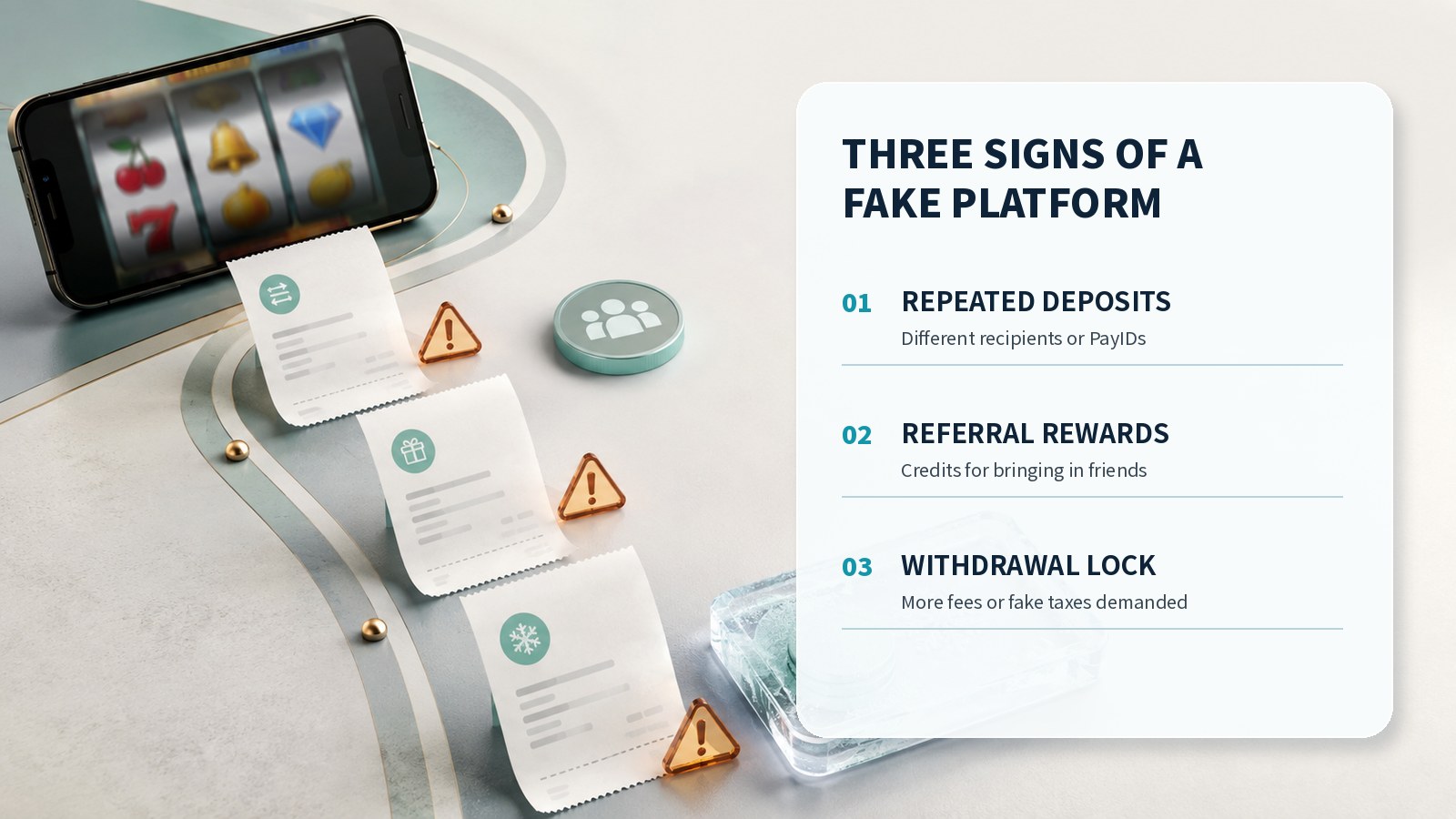
Payment instructions provide another clue. A user may be told to make repeated low-value transfers to different individuals, bank accounts or PayIDs. The pressure is often framed as a fast top-up, a loyalty-tier requirement or a limited-time event. Even if each payment looks small, the total can grow quickly, and constantly changing recipients make the money trail harder to understand. A legitimate operator should be able to explain how the named recipient is connected to the business.
Why early payouts and referrals matter
Some fake platforms do not reject every withdrawal from the start. They may send a small return or display a growing in-app balance to create the impression that the system works. Australia's National Anti-Scam Centre warns that small early payouts can be used to build trust before larger deposits are requested. The relevant questions are not whether one small payment arrived, but who operates the platform, which regulator licenses it, whether the payment recipient matches that operator and whether withdrawals remain possible without another transfer.
Referral rewards can turn one victim's trust into access to friends and relatives. Credits or bonuses may be offered for bringing in another user, and a person who received an early payout may recommend the service with confidence. A referral from someone you know does not mean that person independently verified the operator. Treat the referrer's experience and the platform's legal identity as separate questions.
When withdrawal conditions change
Once the apparent balance becomes larger, the account may be suspended and new conditions introduced. The platform can demand a withdrawal fee, tax payment, identity deposit or recovery charge, promising that one final transfer will release everything. Regulators warn that legitimate platforms do not ask users to pay separately to unlock winnings, recover losses or prove identity. A demand for more money to release existing funds should be treated as an escalation, not as a normal recovery process.
An in-app balance is not the same as money in a bank account. If the operator controls both the displayed figures and the game results, it can manufacture a winning streak or create losses at will. Check whether money actually reached an account in your name, whether the withdrawal terms match what was shown before the deposit and whether you can exit without another payment. If every request produces a new condition, do not assume that the displayed balance is recoverable.
Checks before sending money
- Close the advertisement and use the relevant regulator's official register to verify the business name, exact web address and licence holder.
- Compare the payment recipient with the registered operator. Stop if the recipient keeps changing or payments are split across personal accounts.
- Review the terms for demands for extra taxes, deposits, verification fees or loss-recovery payments before a withdrawal.
- Do not treat an app-store listing, celebrity image, review screenshot or group-chat profit claim as independent evidence of legitimacy.
- Do not forward a referral link until the operator and payment path have been independently verified.
It is safer to work backwards from an official register than to click the first search advertisement. A fake service can copy a legitimate business name, logo or licence-number image. Compare the exact domain, legal entity and contact details shown in the register with the service you are using. A similar name is not enough to establish that they are the same operator.
Protect identity and account data
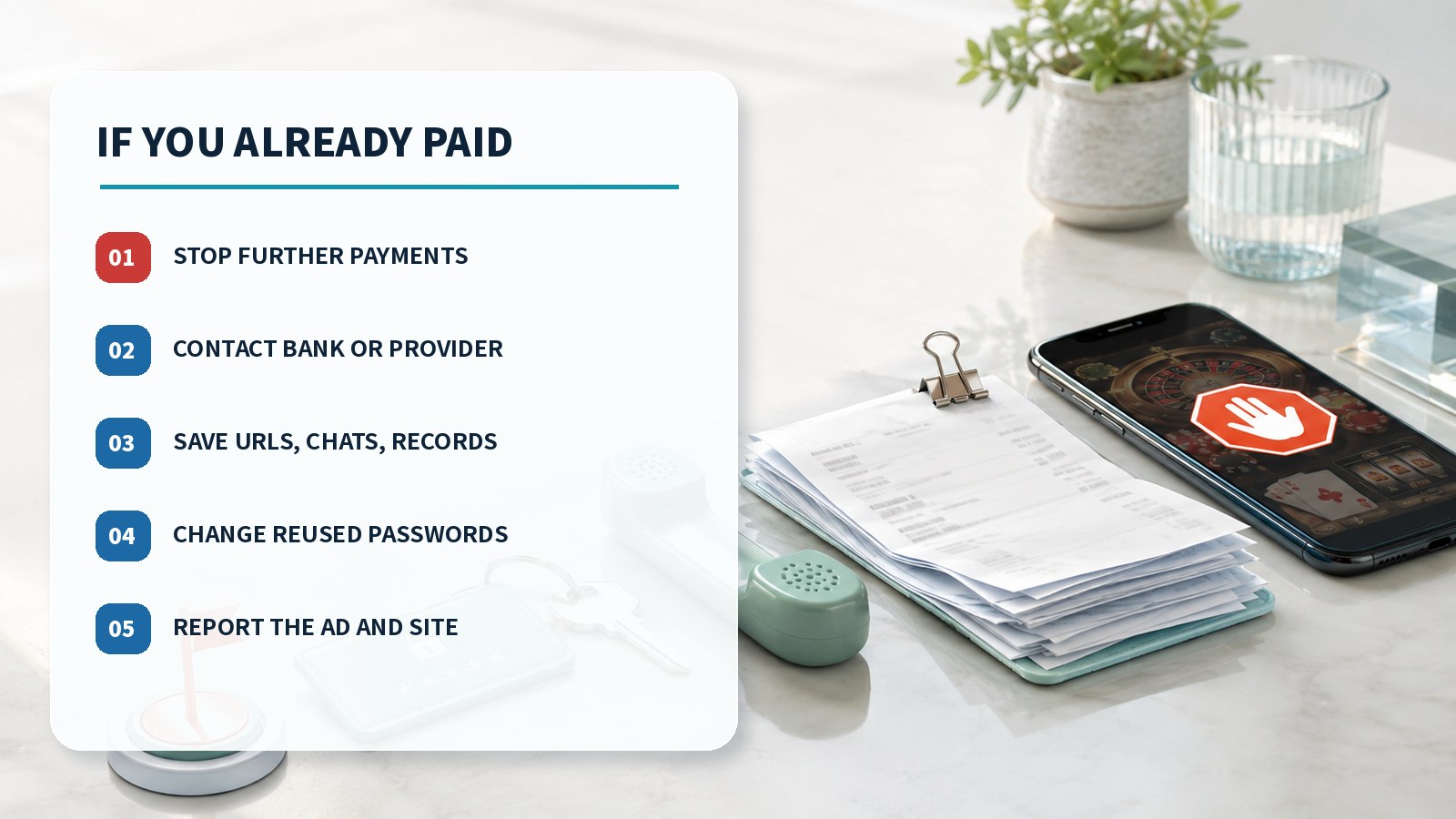
Fake casino operators may ask for an identity document, selfie, bank details, email address and phone number under the label of withdrawal verification. This information can support more convincing impersonation or attempts to access other accounts. If the password used during sign-up was reused elsewhere, change it from a trusted device and review login activity and recovery methods on the associated email and financial accounts.
If the service required another app, review its installation source and permissions. An app-store presence does not turn an unknown payment recipient into a legitimate operator, while an installation file delivered through a private link adds further risk. Stop if the app requests access to contacts, messages, photos, accessibility controls or screen sharing without a clear need. Remove the app, revoke those permissions and disconnect any remote-control session before opening financial apps again.
If you already sent money
Do not follow the platform agent's promise of a final payment. Stop sending money and contact the bank or payment provider immediately with the transaction time, amount, recipient and payment method. Use the institution's official app or the number printed on the card rather than contact details supplied by the platform. Available recovery and account-protection steps depend on the payment method, so early contact matters.
Preserve evidence before deleting the app. Save the advertisement and posting account, exact URL, app name, messaging-group invitation, support conversations, referral code, payment receipts and withdrawal-error screens in chronological order. Keep passwords and verification codes out of public screenshots, and confirm the official submission channel before sharing evidence. Report the ad, site and app through the platform that distributed them as well as through the appropriate local reporting service.
Three claims that should slow the decision
- “A small payout worked, so it is safe” does not replace operator verification.
- “A friend recommended it” does not establish that the link or recipient is legitimate.
- “One more payment will release everything” may be the next deposit demand, not a withdrawal process.
Fake online casino scams are revealed less by the game graphics than by an imbalance between deposits and withdrawals. Deposits are accepted quickly through changing recipients, while withdrawals trigger new conditions. Small rewards and referral incentives help maintain trust. Pausing before the first transfer—and again when the withdrawal terms change—creates the best opportunity to limit the loss. Verify the operator and payment path independently instead of paying again to chase a balance displayed inside the app.
Sources reviewed
- Beware 'scambling'South Australia Consumer and Business Services · Official source
- South Australians lose $6 million to scamsSouth Australia Consumer and Business Services · Official source
- New taskforce to tackle 'scambling' as fake online casinos target First Nations AustraliansAustralian Competition and Consumer Commission · Official source
- Gambling and betting scamsScamwatch · Official source
SECUFOCUS NOW reorganized and analyzed the material above. This article does not replace the original sources.
Related SecuNote articles

Cloned Car Dealership Websites: How to Verify a Vehicle Before Paying
Scammers are cloning real car dealership websites, listings, photos, reviews, and sales policies to demand upfront wire payments…
Unfamiliar Configuration Profile on iPhone? Check Management and Secure the Device
Configuration profiles can apply work or school accounts, VPN settings, certificates, and other controls to an iPhone. This guide…
Fake Buyer-Protection Portals: Refund, ID and Bank-Detail Checks
A newly disclosed HKICL impersonation scheme combined refund support, identity verification, bank details, a fake wallet and an…
Comments
No comments yet.