
Disaster Relief Donation Scams: How to Verify a Charity Before Paying
Urgent appeals after disasters can include fake charities and lookalike pages that divert money away from relief work. This guide explains how to verify the organization independently, review the requested payment method, and respond if a donation later looks suspicious.
Major floods, earthquakes, hurricanes, and other disasters often trigger an immediate wave of donation appeals. Many are genuine, but the same urgency gives imposters an opportunity to create fake charities or copy the names and visual identity of established relief organizations.
On August 27, 2026, the U.S. Federal Trade Commission warned that fake charities and lookalike organizations can divert money intended for disaster relief. The practical question is not whether an appeal looks emotional or polished. It is whether the organization, destination, and payment request can be verified through sources that are independent of the message or social post.
How the impersonation works
A scam appeal usually starts with urgency: dramatic images, a short deadline, and a link or text number that makes immediate payment feel like the only helpful response. A post being shared by a friend does not verify the fundraiser. The FTC specifically recommends researching social-media appeals instead of assuming they are legitimate because someone familiar reposted them.
Imposters may use a name that resembles a well-known charity, a slightly altered domain, or a newly built page with professional photos. A secure HTTPS connection protects data in transit, but it does not prove who operates the site. The charity name, official domain, relief program, recipient, and use of funds need to agree across independent records.
Verify the organization outside the appeal
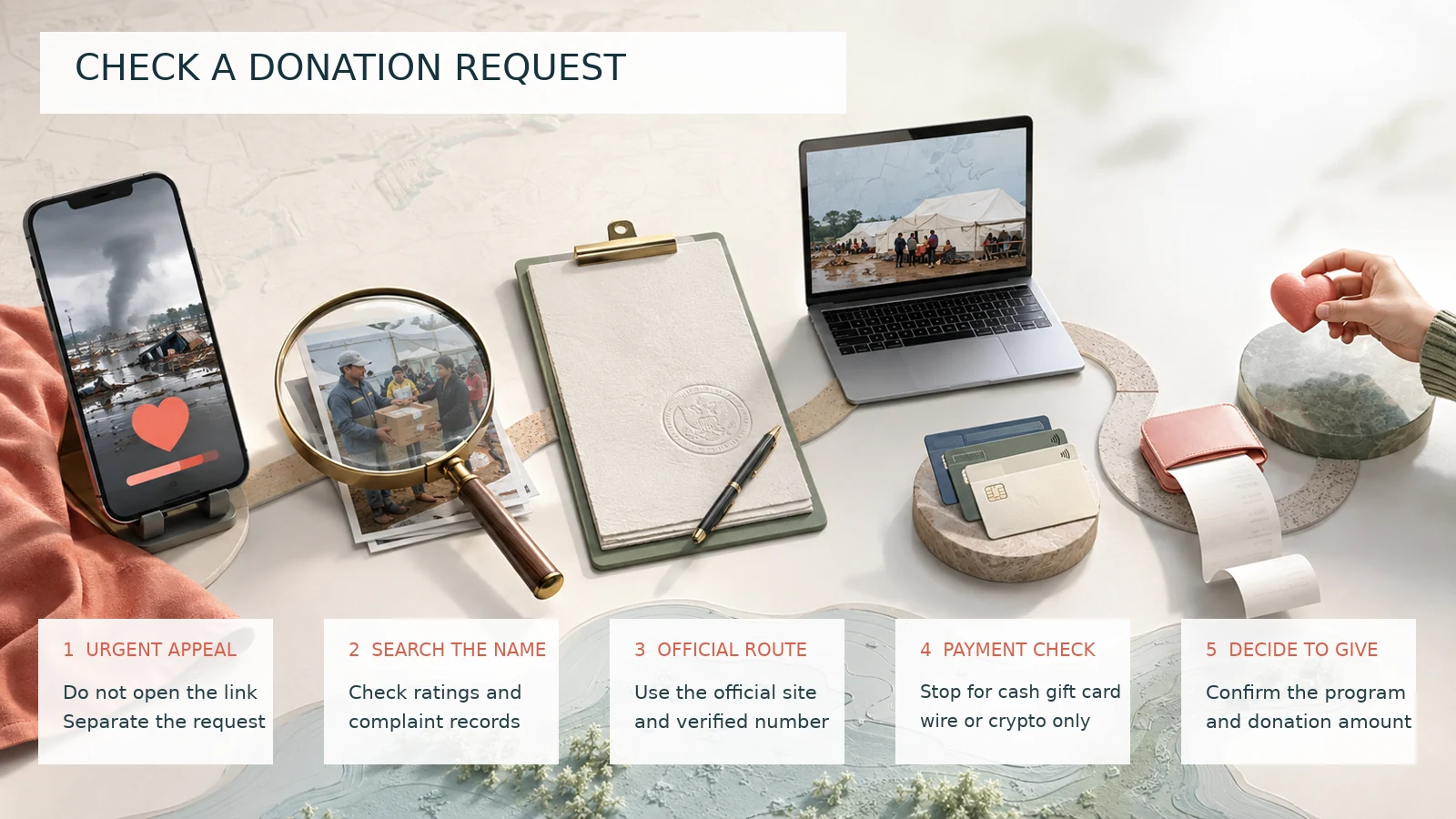
Do not begin with the link in the message. Write down the charity's name and search for it separately, adding terms such as complaint, rating, fraud, or scam. Open the official site directly and compare its relief area, programs, and use-of-funds information with the claims in the appeal.
For text-to-donate requests, confirm the number on the charity's own website. For a phone appeal, ask for the exact legal name, official website, and mailing address, then end the call and contact the organization through a verified number. Caller ID can be spoofed, so a familiar local code or organization name is not enough.
The first search result is not automatically official. An imposter can buy an advertisement using a real charity's name or promote a lookalike domain. Distinguish sponsored results and compare the domain and contact details with public registration records, verified social accounts, and the organization's earlier releases. Do not use a new fundraising page that the official charity does not link to.
- Search for the organization and official domain independently
- Compare the relief program and use of funds on the official site
- Confirm donation phone and text numbers through the charity itself
- Review registration, activity, ratings, and complaint records
- Identify who actually receives money from a social fundraiser
Registration and disclosure records
For donations to a Korean organization, the National Tax Service explains that qualifying donation organizations disclose annual fundraising and spending results on their website and through Hometax. Those disclosures can help a donor compare the organization's legal name, programs, and use of contributions with the claims made in an appeal.
Treat disclosure as an independent comparison source rather than a guarantee. If a similar but different entity appears in the registry, or the payment recipient does not match the disclosed organization, stop and use an official contact channel. For an overseas charity, check the relevant national or state charity registry and a reputable evaluator.
Payment methods as warning signals
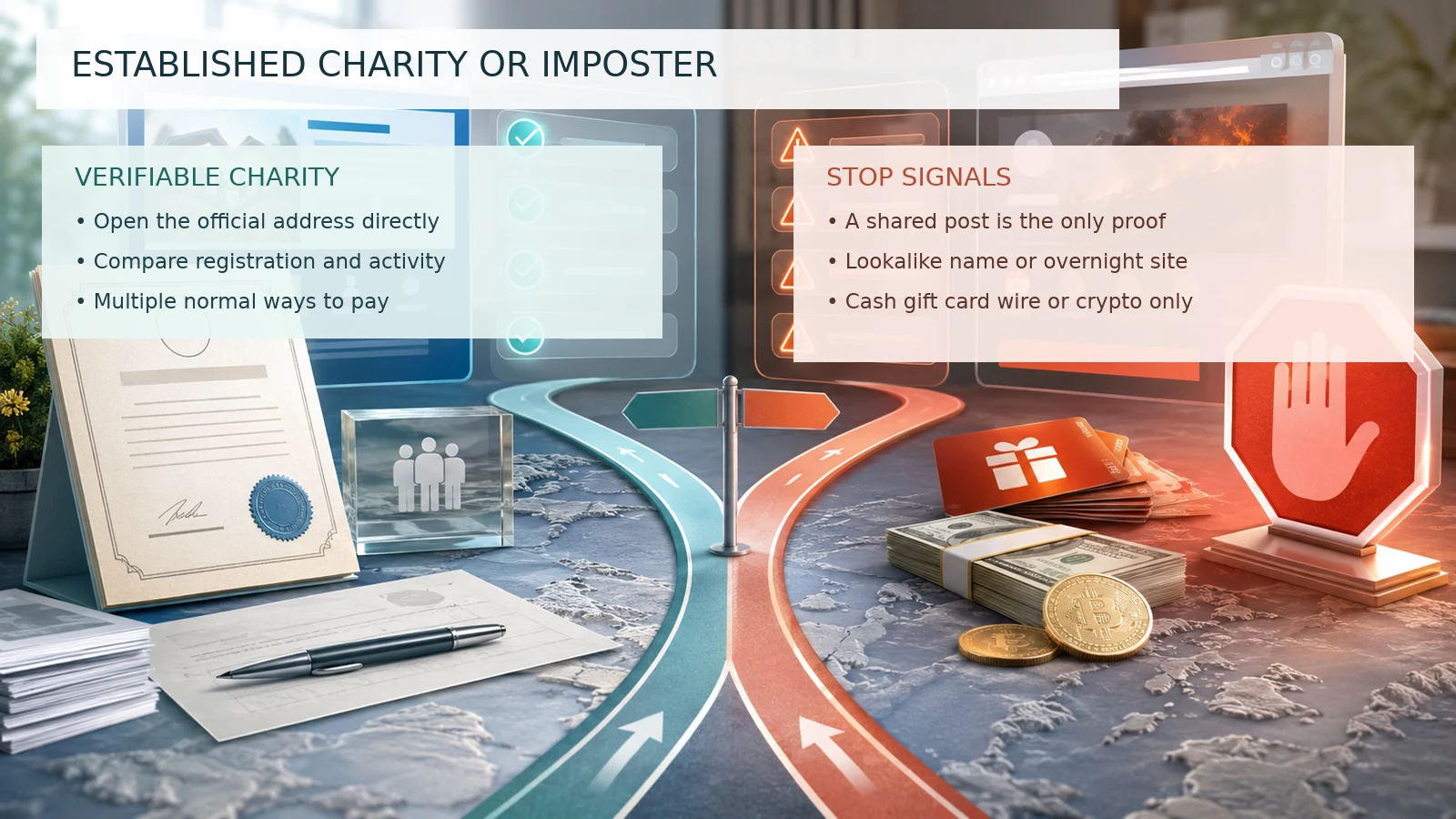
Pause when an appeal pushes payment before verification. The FTC warns against fundraisers that insist cash, gift cards, wire transfers, or cryptocurrency are the only ways to give. These methods are difficult to reverse. A legitimate organization normally offers more than one ordinary payment option and gives the donor time to review the program and amount.
On the payment page, check the recipient name, exact amount, and whether the charge is one-time or recurring. Keep the receipt and review the next bank or credit-card statement. A secure connection is useful, but it does not replace verification of the organization behind the page.
- Only cash, gift card, wire transfer, or cryptocurrency is accepted
- The appeal pressures you to pay before a short deadline
- The account holder does not match the charity name
- The recipient and use of funds are vague
- A recurring charge appears alongside a one-time donation
A final check before paying
Start the donation from the official domain you verified, not from the original post or an advertisement. On crowdfunding and social platforms, identify the organizer and the person or organization that will actually receive the funds. Ask the person who shared the appeal whether they know the organizer directly.
On a crowdfunding page, verify the organizer, final recipient, campaign target, use-of-funds plan, platform fees, and treatment of any remaining balance. A familiar charity name in the description does not prove that the charity approved a campaign that sends money to a personal account.
Review how the charity describes its programs and spending. The FTC recommends looking for specific details about the mission, the relief work, and how much of a donation supports the program. If the page relies on sentimental claims but provides little operational detail, choose another established organization.
If the payment later looks suspicious
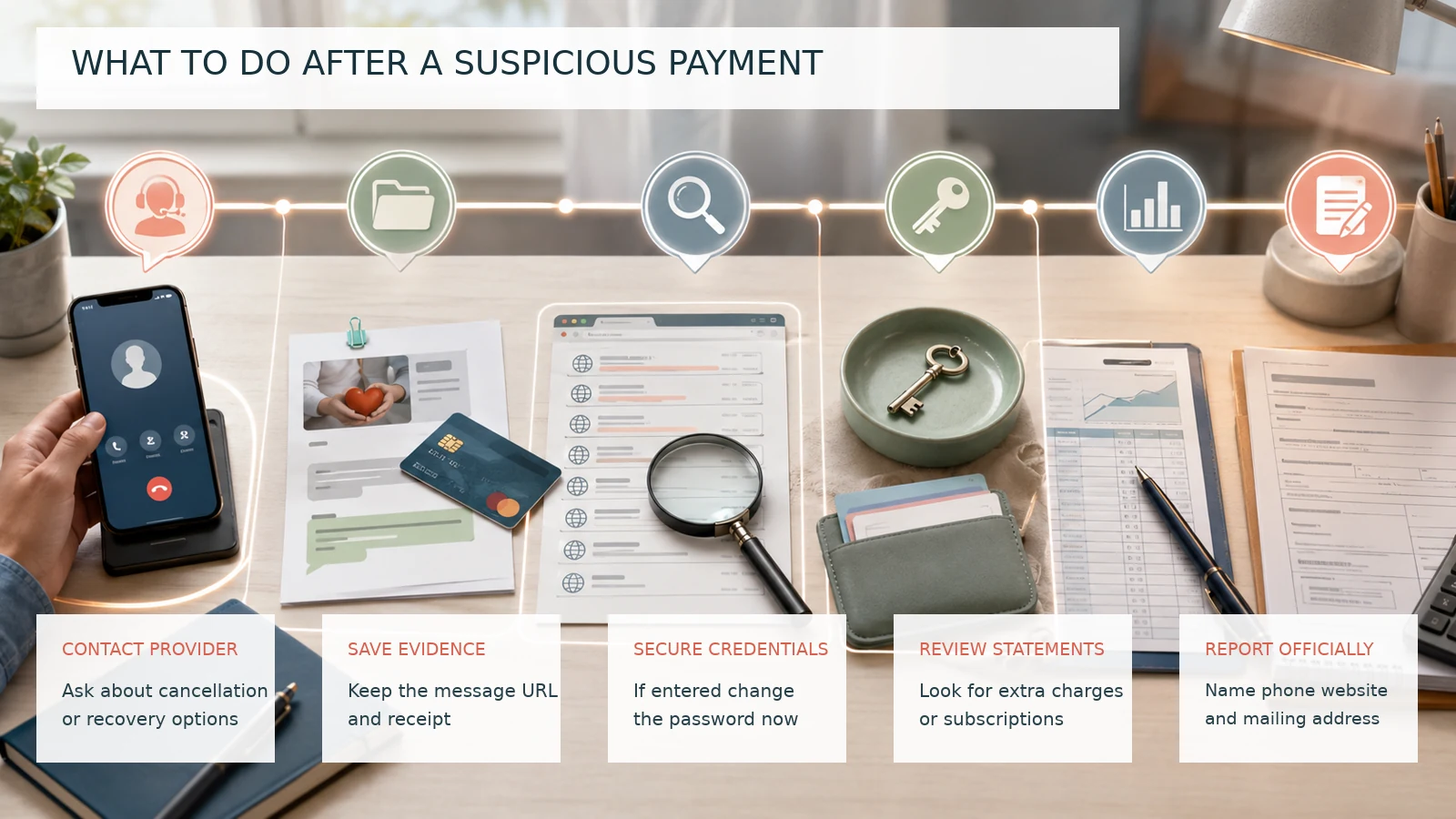
Contact the card issuer, bank, payment app, or transfer provider immediately and ask about cancellation or recovery options for that payment method. Review statements for additional charges or an unintended recurring donation.
Preserve the original message, caller number, web address, receipt, recipient name, and time of contact. If you entered account credentials, change the password and update any other account that reused it. A useful fraud report includes the fundraiser's name, phone number, website, mailing address, and every payment detail you received.
Even without a completed payment, personal details entered on a fake page can be used for follow-up contacts. Treat later messages about refunds or receipts as a continuation of the same verification problem. Use the organization's official channel, secure any affected account, enable multi-factor authentication, and review recent sign-in activity.
- Contact the payment provider and ask about cancellation or recovery
- Save the message, post, URL, receipt, and recipient information
- Change any password or credential entered on the suspicious page
- Review statements for extra charges or recurring payments
- Report the imposter through the appropriate official fraud channel
Protecting the purpose of a donation
Fast relief matters, but money sent to an imposter never reaches the affected community. A few minutes spent separating the appeal from the organization, checking official records, confirming the recipient, and reviewing the payment method protects both the donor and the purpose of the gift. Bookmarking the official sites of trusted organizations also creates a safer path for the next emergency.
Sources reviewed
- When donating, support those in need, not a scammerU.S. Federal Trade Commission · Official source
- Before Giving to a CharityU.S. Federal Trade Commission · Official source
- 공익법인등(구·지정기부금단체)의 의무사항국세청 · Official source
SECUFOCUS NOW reorganized and analyzed the material above. This article does not replace the original sources.
Related SecuNote articles

Cloned Car Dealership Websites: How to Verify a Vehicle Before Paying
Scammers are cloning real car dealership websites, listings, photos, reviews, and sales policies to demand upfront wire payments…
Unfamiliar Configuration Profile on iPhone? Check Management and Secure the Device
Configuration profiles can apply work or school accounts, VPN settings, certificates, and other controls to an iPhone. This guide…
Fake Buyer-Protection Portals: Refund, ID and Bank-Detail Checks
A newly disclosed HKICL impersonation scheme combined refund support, identity verification, bank details, a fake wallet and an…
Comments
No comments yet.