
Connecticut HUSKY Provider Portal Breach Exposes Claims Data of 41,000 Members
A compromised provider reimbursement account exposed claims and payment information tied to about 41,000 Connecticut HUSKY members. Here is the confirmed access path and the checks affected members should make.
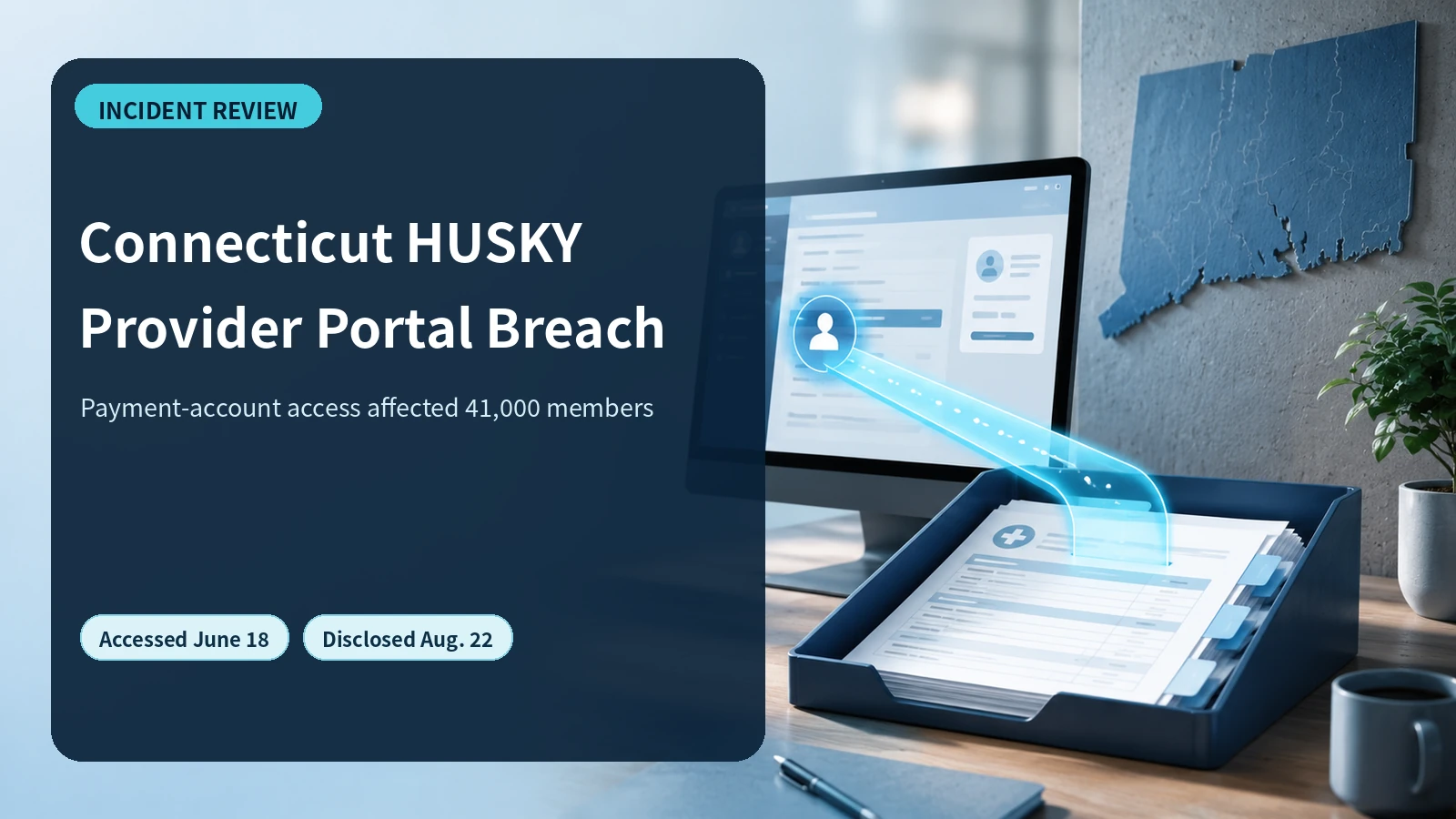
Incident overview
Connecticut’s Department of Social Services and Gainwell Technologies disclosed unauthorized access to payment accounts on the HUSKY Medicaid provider portal. An unauthorized party first accessed a provider reimbursement account on June 18 and obtained claims and payment information associated with about 41,000 members.
The incident centers on a provider payment account rather than a compromise of the full clinical environment. Because one reimbursement account can connect to many member claims, access at the provider level expanded the number of people whose service and billing records were involved.
Timeline and affected records
Gainwell became aware of unauthorized access on June 25, seven days after the first access identified by the investigation. DSS and Gainwell began mailing notices to affected individuals on August 21 after identifying the member population and the data categories involved.
The exposed categories varied by person. In aggregate, they included names, identifiers associated with provider payment accounts or Medicaid claims, dates of medical services, descriptions of services and how they were billed, billed and paid amounts, and policy or group numbers for applicable non-Medicaid health insurance.
DSS and Gainwell separated this scope from electronic health records, Social Security numbers, and financial-account information, which they said were not compromised. That distinction makes claim-history review more relevant than treating the event only as a payment-card breach.
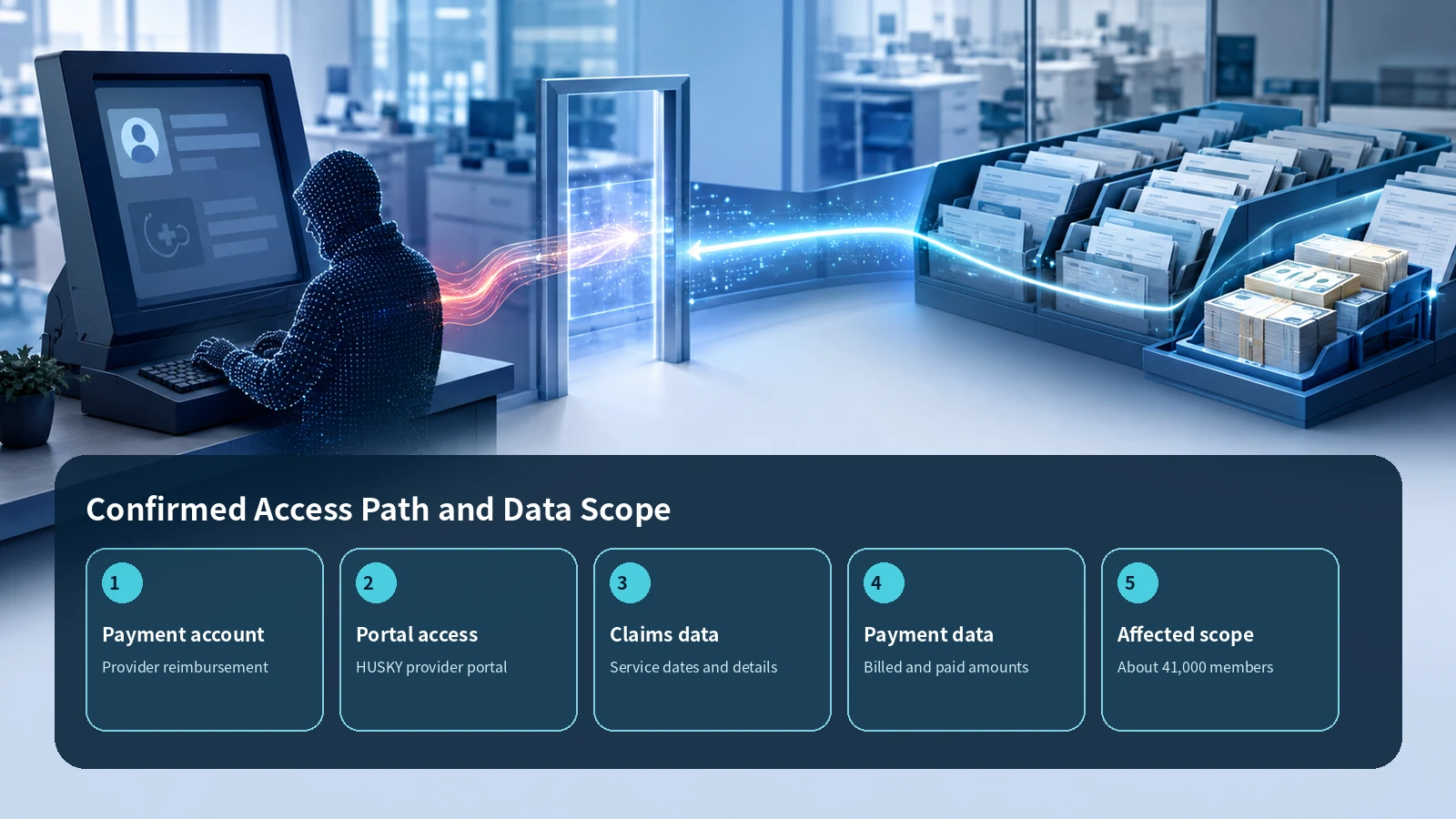
How the access expanded
The confirmed path began with a provider reimbursement account and reached claims and payment information in the HUSKY provider portal. This differs from the mass takeover of individual member accounts: the provider account acted as a shared operational point connected to records for many members.
DSS and Gainwell assessed the activity as financially motivated rather than directed primarily at obtaining patient data. A payment account sits close to claim approval and reimbursement workflows, so an effective review must cover login activity, payout changes, unusual claim amounts, and unexpected service dates together.
The incident illustrates a broader healthcare control issue. Clinical systems and reimbursement portals may be managed as separate assets, but an access incident in the billing layer can still combine identity, service, insurance, and payment details in a way that matters to patients and providers.
Response and member checks
Gainwell secured the provider portal and deployed additional controls. DSS and Gainwell are working with external cybersecurity specialists and state and federal law enforcement. Mailed notices offer credit and identity monitoring along with fraud-support services.
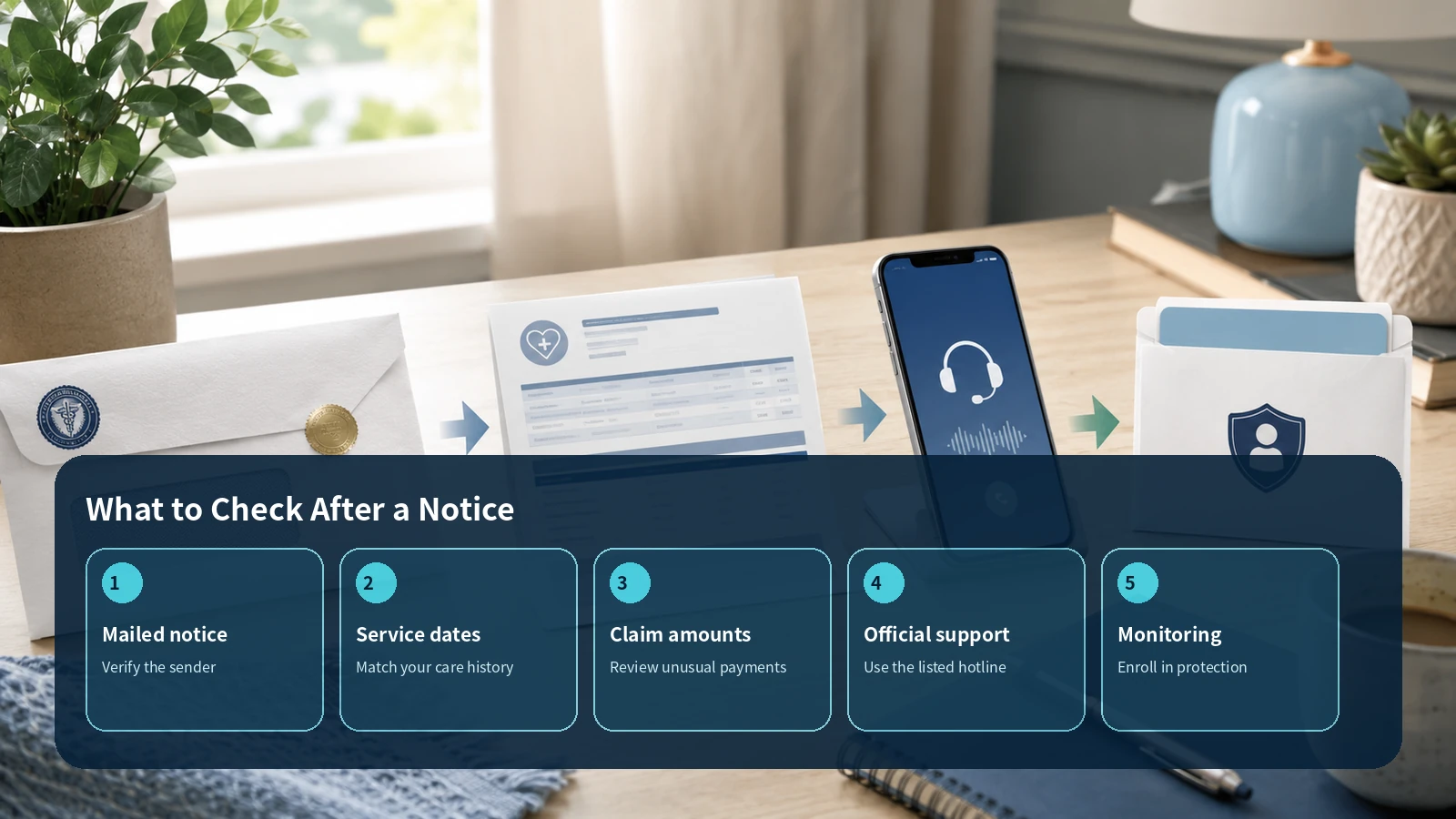
Affected members should verify the sender of a mailed notice through an official DSS page, then compare service dates, provider names, descriptions, and claim amounts with their actual care history. A service or provider they do not recognize should be treated as a claim-record discrepancy and reported through the official support channel.
- Verify the sender and phone number against the Connecticut DSS security notice.
- Match service dates, providers, and service descriptions to your own care history.
- Review billed and paid amounts and any non-Medicaid policy or group number.
- Record unusual entries and use the official hotline to confirm scope and correction steps.
- Enroll in the offered monitoring and fraud-support services through the official notice route.
Providers and portal operators should review recent login locations, authentication changes, payout-account edits, bulk queries, and export activity as one sequence. Accounts that can reach multiple member records deserve stronger approval gates for payment changes and closer monitoring of high-volume access.
Priority controls for operators
High-impact actions in a claims portal should not be treated like ordinary record views. Payout-account changes, recipient edits, bulk claims access, and exports should trigger reauthentication and separate approval. Administrators should also split account creation, privilege assignment, and payment-change authority so one compromised identity cannot redirect the entire workflow.
Detection should combine business events rather than count only failed logins. A sign-in from an unusual location followed by rapid access to many member claims, a payment-setting change, and an export is a stronger signal when evaluated as one sequence. Investigators likewise need authentication, claims-query, and payout-change logs on the same timeline.
Impact and defensive relevance
The confirmed direct scope is about 41,000 Connecticut HUSKY members. Claims data can reveal when and where a person received care, how a service was billed, and what amount was paid. When paired with a name and claim identifier, those details can also make healthcare or insurance impersonation more convincing.
The operational lesson applies beyond Connecticut. Public and private insurance systems often connect a single provider account to many patient records. Organizations should monitor billing portals as sensitive data systems in their own right, with least privilege, strong authentication, additional approval for payout changes, and detection for abnormal bulk access.
The published categories do not mean every member had the same fields accessed. The notice says the data varied by individual and lists the overall categories as names, identifiers, service dates, service and billing details, paid amounts, and non-Medicaid policy or group numbers. Recipients should use the scope stated in their individual letter rather than assume that every listed category applies to them.
Sources
Connecticut Department of Social Services security notice
https://portal.ct.gov/dss/quality-assurance/report-vendor-fraud-or-abuse
Connecticut DSS and Gainwell Technologies incident announcement
https://www.einnews.com/pr_news/936091862/connecticut-department-of-social-services-and-gainwell-technologies-announces-security-incident-affecting-provider-portal-patient-health-records-not
Evidence cutoff: August 22, 2026 at 11:59 KST, based on the Connecticut DSS and Gainwell announcement.
Sources reviewed
- HUSKY provider portal security noticeConnecticut Department of Social Services · Official source
- Security Incident Affecting Provider Portal; Patient Health Records Not CompromisedConnecticut DSS and Gainwell Technologies
SECUFOCUS NOW reorganized and analyzed the material above. This article does not replace the original sources.
Related SecuNote articles
Langflow Code Injection RCE (CVE-2026-0768): Active Exploitation and Response
CVE-2026-0768 is now being exploited against internet-accessible Langflow deployments. This analysis explains the vulnerable…
Sality Botnet Disruption: How the P2P Sinkhole Cut Its Command Path
A multinational operation disrupted Sality's peer-to-peer command path across more than 15,000 infected hosts. This analysis…
Dropbox Account Breach: Lenovo ID Integration and Confirmed Impact
A legacy Lenovo ID integration enabled unauthorized access to about 5,000 Dropbox accounts. This report explains the confirmed…
Comments
No comments yet.