
CareCloud Health Data Breach: Why the Affected Count Reached 3.76 Million
The official HHS breach count for CareCloud has risen to 3,756,469 people. This analysis covers the AWS EHR intrusion timeline, affected data, and practical checks for notified individuals.
Incident Summary
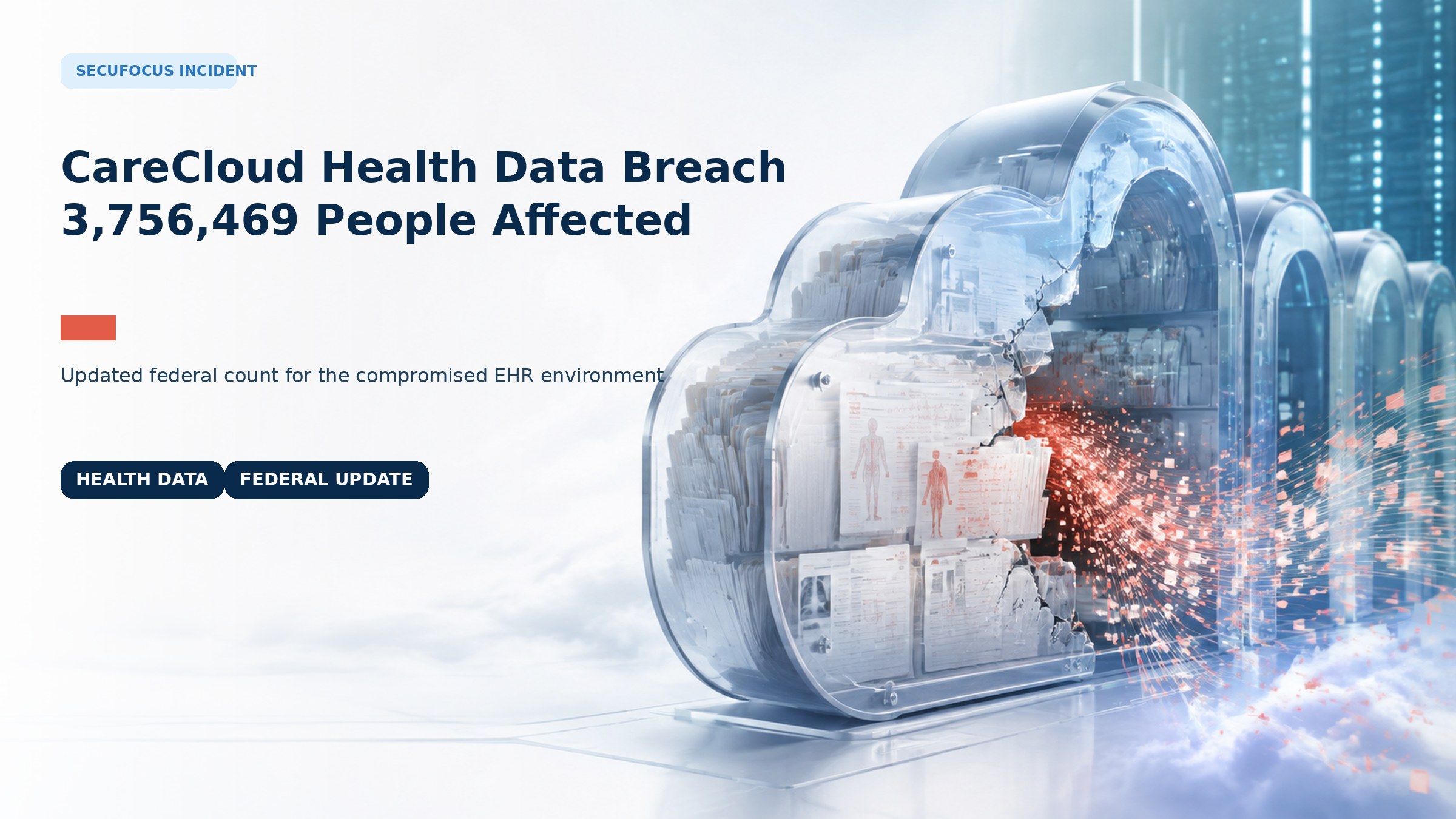
The confirmed impact of the CareCloud health-data breach has risen to 3,756,469 individuals. The U.S. Department of Health and Human Services Office for Civil Rights lists the event as a hacking or IT incident involving a network server, and HHS told SecurityWeek that the updated figure is accurate and reflects the latest information submitted to the agency.
CareCloud says an unauthorized third party accessed one AWS environment used by its CareCloud Health division between March 10 and March 16, 2026. The company discovered the event after a disruption in an electronic health record environment on March 16, engaged outside cyber-response specialists, secured the affected environment, and removed the threat. The material development in this reporting window is the official federal count, not a newly inferred attack path.
What Was Disclosed
Intrusion and Disclosure Timeline
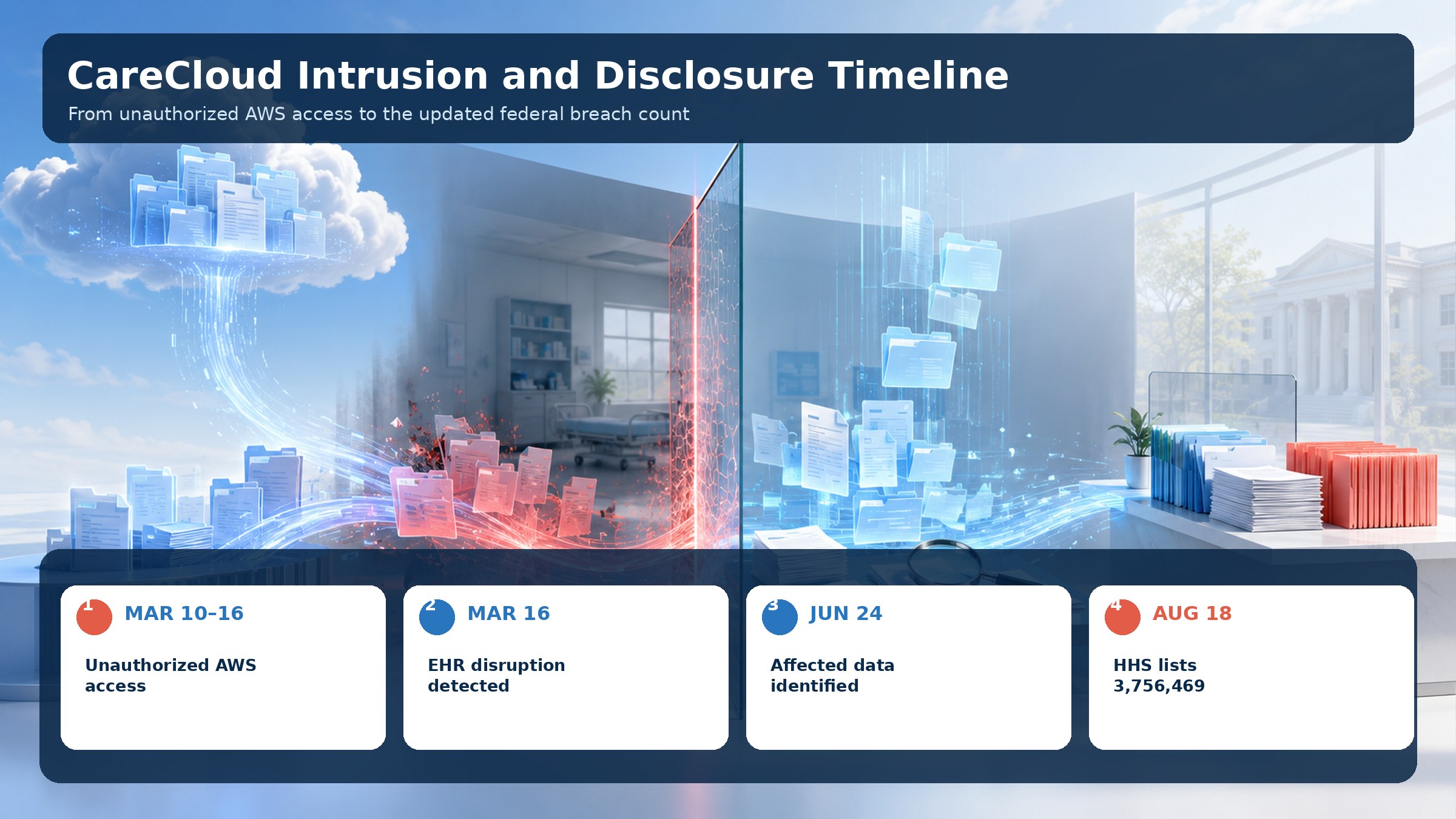
CareCloud opened an investigation after the March 16 disruption. Its investigation determined that the intruder had access to one AWS environment from March 10 through March 16 and claimed to have exfiltrated data from databases in that environment. CareCloud says the environment was secured and no persistent unauthorized access remained.
On June 24, CareCloud determined that the affected data could include protected health information and personal identifiers. The company published its incident notice on July 1. HHS lists a July 24 submission date, and the federal breach portal was updated on August 18 to show 3,756,469 affected individuals. That change expands the reported scope of the same incident; it does not establish a second intrusion.
Affected Environment and Data
The disclosed scope centers on one AWS environment connected to an electronic health record environment in the CareCloud Health division. The HHS portal identifies CareCloud as a business associate and records the location of the breached information as a network server. That designation helps explain why a single service-provider incident can involve records tied to many healthcare organizations and patients.
- Names, addresses, and dates of birth
- Social Security and driver’s license numbers
- Health-plan member numbers, insurer names, policy numbers, and group numbers
- Physician information, medications, allergies, and other medical information
- Financial-account or payment-card information for some individuals
The affected fields vary by person. CareCloud says a very limited subset of individuals had full payment-card information, including the CVV, involved. A notified person should therefore begin with the specific data elements listed in the notice rather than assuming that every category applied to every record.
Why the 3,756,469 Figure Matters
Earlier reporting based on state attorney-general filings put the known total at roughly 350,000 people. The HHS portal showed 3,371,508 people on Monday and 3,756,469 on Tuesday. SecurityWeek asked whether the sharp change was a clerical error; HHS confirmed that it was accurate and represented the latest figure supplied to the agency.
The larger count does not by itself add new categories of compromised information. The data types should still be read from CareCloud’s July notice, while the federal figure represents the number of people now associated with the incident. Separating those two questions keeps the assessment precise.
Response Priorities
When identity and health information appear in the same incident, reviewing a login history alone is not enough. Medical and insurance information can support convincing impersonation, while Social Security or driver’s license numbers may be used in identity-verification workflows. Financial statements, insurance claims, medical records, and credit files should be reviewed through their respective official channels.
CareCloud recommends monitoring financial statements and credit reports and considering a fraud alert or security freeze. It is also offering eligible individuals up to 24 months of identity-theft protection, credit monitoring, and recovery services. Before enrolling, recipients should compare the notice and contact details with CareCloud’s official incident page.
Practical Checks
For Notified Individuals
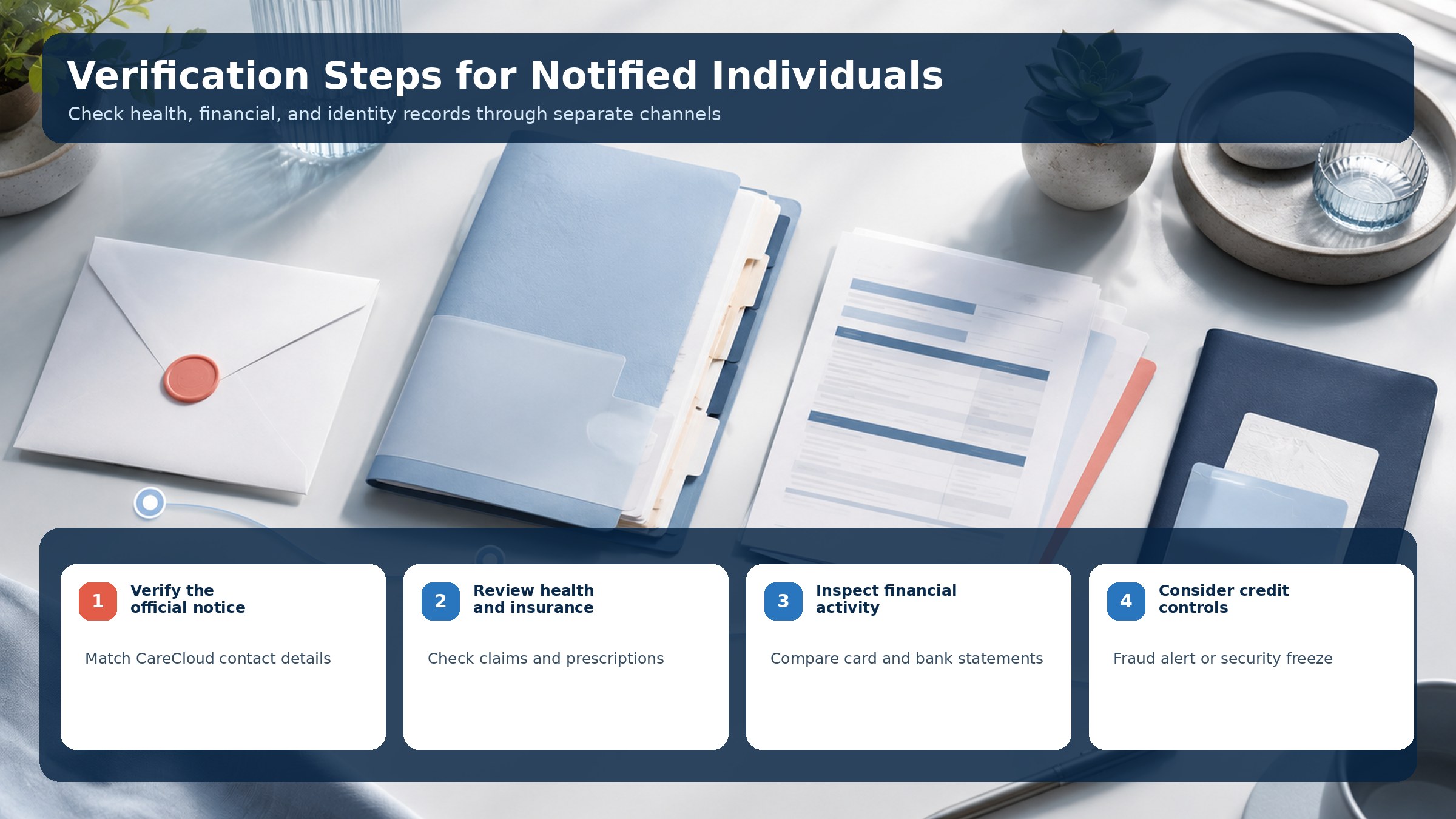
- Match the sender and response-line number in the notice against CareCloud’s official incident page.
- Identify which data categories are named in the individual notice before choosing the next action.
- Review patient-portal records and insurance claims for providers, prescriptions, or services you do not recognize.
- Inspect recent card and bank statements. If full card information was involved, contact the issuer through an official channel.
- Consider a fraud alert or security freeze when identity data was involved, and review the terms for any protection service offered.
CareCloud’s incident page provides a dedicated response line for people who need to determine whether their information was involved. Avoid sending additional identifiers through an unsolicited email or text. If suspicious activity is found, preserve dates, organizations, transactions, and claim details so that banks, insurers, and healthcare providers receive a consistent record.
For Healthcare Organizations and Partners
- Confirm whether CareCloud or CareCloud Health supports any EHR workflow in the organization’s vendor inventory.
- Preserve integration, authentication, and administrative logs around March 10–16.
- Keep patient notification, insurance-dispute, and support workflows tied to one incident reference.
- Use official contact channels in notices and avoid forms that request sensitive identifiers through message links.
- Give support teams the same verified dates, data categories, and official response number.
Organizations should not treat the overall federal count as their own affected population. Their scope should be established from contracts, connected services, direct notices, and the lists supplied through the vendor’s response process. Customer-support teams should still be ready for questions about the event timeline, affected data types, and enrollment assistance.
Impact
The HHS figure makes this a large healthcare-data breach. CareCloud’s role as a business associate means that the environment can sit between multiple healthcare providers and the patients whose data they process. Risk still varies by record: a notice involving contact details differs materially from one involving Social Security numbers, medical data, or complete payment-card information.
The incident also shows that the reported scope of a cloud-service breach can change for months after containment. Vendor inventories, data-processing maps, log-retention responsibilities, patient-identification procedures, and multilingual support plans should be connected before an incident occurs.
Sources
U.S. HHS Office for Civil Rights breach portal
https://ocrportal.hhs.gov/ocr/breach/breach_report_hip.jsf
CareCloud Notice of Data Security Incident
https://carecloudhealth.com/notice/index.html
SecurityWeek report on the updated impact count
https://www.securityweek.com/carecloud-data-breach-impact-grows-to-3-7-million-individuals/
Evidence cutoff: August 19, 2026, 5:59 p.m. KST.
Sources reviewed
- Breach Portal: Notice to the Secretary of HHS Breach of Unsecured Protected Health InformationU.S. Department of Health and Human Services Office for Civil Rights · Official source
- Notice of Data Security IncidentCareCloud, Inc. · Official source
- CareCloud Data Breach Impact Grows to 3.7 Million IndividualsSecurityWeek
SECUFOCUS NOW reorganized and analyzed the material above. This article does not replace the original sources.
Related SecuNote articles
Sality Botnet Disruption: How the P2P Sinkhole Cut Its Command Path
A multinational operation disrupted Sality's peer-to-peer command path across more than 15,000 infected hosts. This analysis…
Dropbox Account Breach: Lenovo ID Integration and Confirmed Impact
A legacy Lenovo ID integration enabled unauthorized access to about 5,000 Dropbox accounts. This report explains the confirmed…
Novocure Cyber Incident Exposed Patient and Contact Records
Unauthorized access to a Novocure subsidiary exposed internal patient IDs and a smaller set of identifying and contact records in…
Comments
No comments yet.