
Berlin Government Network Breach: Data Theft, Extortion and the Investigation Timeline
Berlin confirmed data theft between August 7 and 12 and an extortion attempt after its state-network breach. This analysis separates the intrusion timeline, service impact and response.

Incident summary
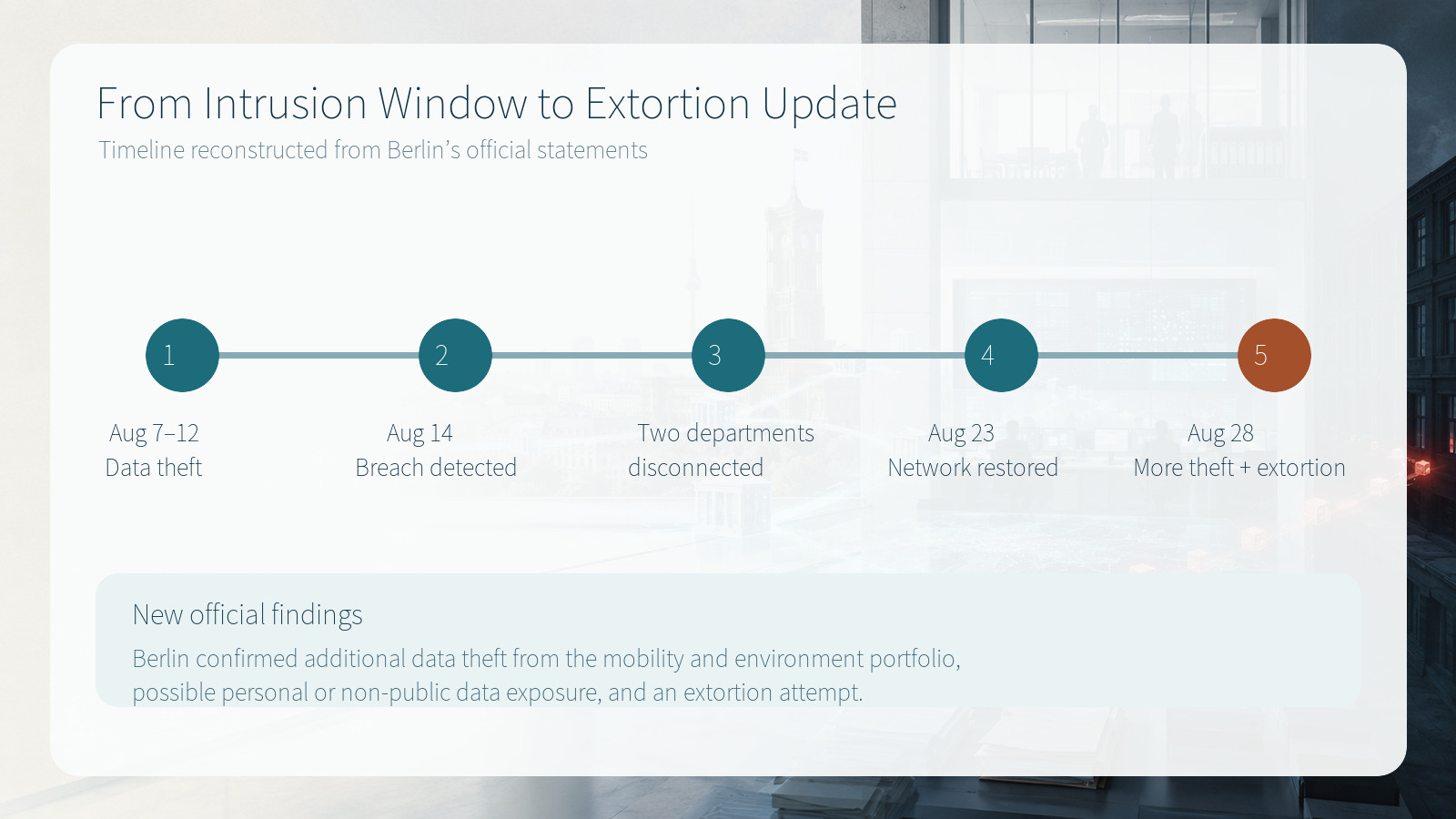
Berlin’s state government confirmed that its network intrusion involved additional data theft and an extortion attempt. An August 28 statement placed the exfiltration between August 7 and 12 and tied it to the mobility, transport, climate-protection and environment portfolio.
The update materially changes the public record. Berlin detected the incident on August 14, disconnected two Senate departments and reconnected them on August 23. The latest disclosure adds the theft window, another affected portfolio, possible personal or non-public data exposure and a coordinated criminal investigation.
Berlin said it would not submit to extortion. The State Criminal Police Office, prosecutors and federal security authorities are involved while forensic work and scanning cover the state network.
The sequence shows why service restoration and breach-scope determination are separate milestones. Additional theft and extortion findings emerged after reconnection, so normal operation could not be treated as the end of incident handling.
What Berlin disclosed
Investigators placed exfiltration between August 7 and 12. Authorities detected the incident on August 14 and disconnected the Senate departments responsible for urban development and housing, and for mobility and the environment.
The departments retained basic internal capability, but connected services were affected. Berlin identified delays involving housing assistance and education-participation benefits for children and young people.
On August 23, both departments were reconnected and district specialist procedures became broadly available. Restoration was paired with stronger security measures and increased monitoring.
The August 28 statement confirmed further data theft from the mobility and environment portfolio and included possible personal or other non-public information in the classification work. It also formally acknowledged an extortion attempt.
Containment and restoration
The exfiltration occurred before network isolation. Disconnecting the departments restricted further access and lateral movement but could not reverse data already transferred.
Authentication, remote-access, file-access and bulk-transfer records from before detection are therefore central evidence. Berlin’s August 7–12 theft window is the minimum baseline for connecting preparation and exfiltration activity.
Reconnection is a controlled authorization step. Account cleanup, remote-administration paths, detection coverage and an enhanced monitoring period should all be checked before shared-network access returns.
Berlin’s forensic work and network scans extend the analysis beyond the first two departments. The ICT emergency team remains active to coordinate technical work and government operations.
Impact scope
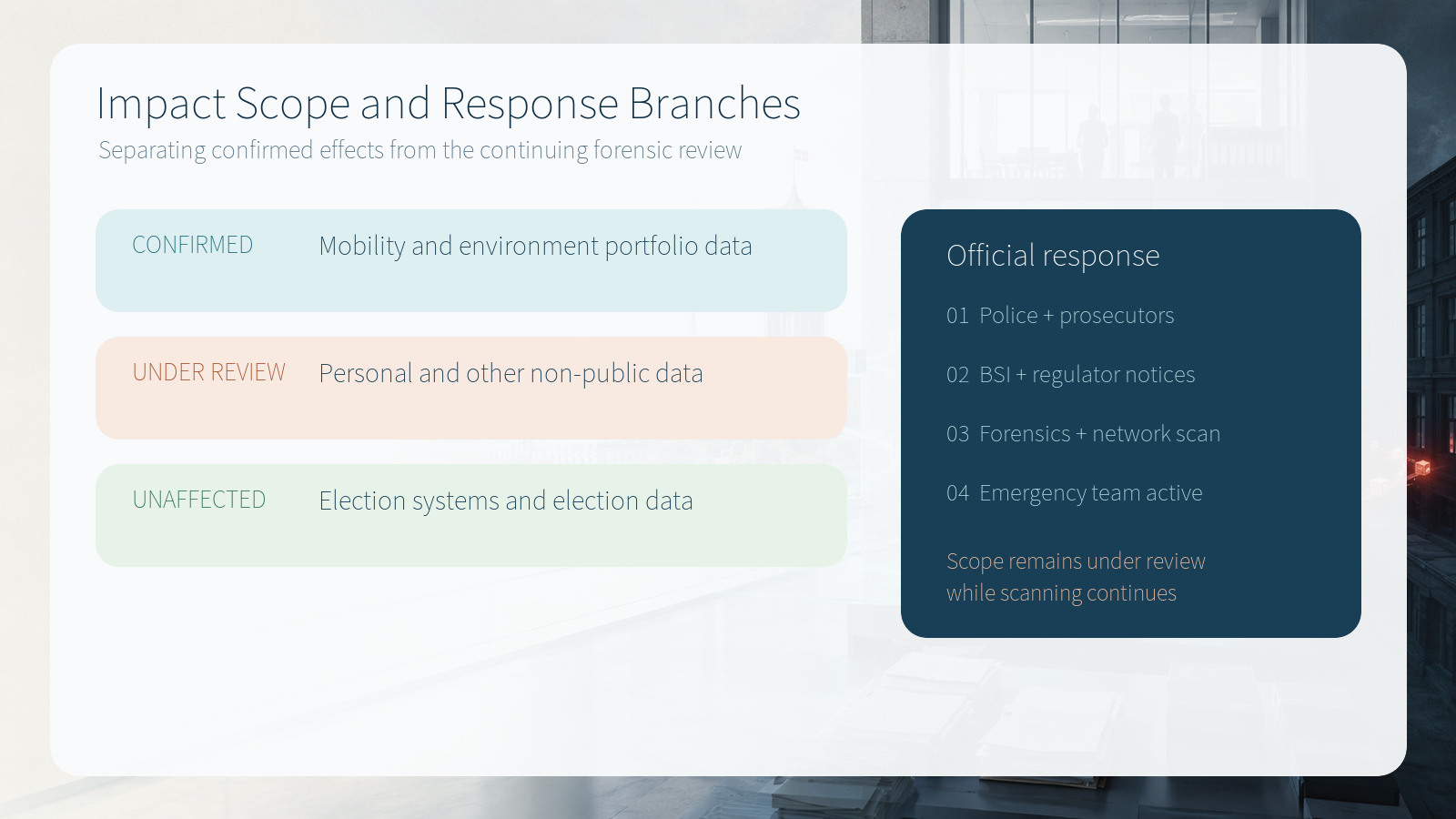
The confirmed exfiltration involves data from the mobility, transport, climate-protection and environment portfolio. Berlin is classifying the material and assessing possible personal and other non-public information.
Classification must connect files to their owners, business processes, access rights and affected residents, employees or partners. Duplicate copies across systems must also be reconciled before notification counts are set.
Operational effects reached housing assistance and education-participation benefits. Restoring access did not complete response work because affected people and external parties still have to be mapped to the data.
Berlin’s interior authorities said election infrastructure and election-related data were not affected. The government separated the compromised administrative environment from systems supporting the September vote.
Investigation and response
The State Criminal Police Office and prosecutors are working with federal security authorities. The state data-protection commissioner and Germany’s Federal Office for Information Security receive new findings.
Technical measures include forensics, network scanning and enhanced monitoring. These preserve evidence while checking restored systems for renewed or related activity.
Berlin publicly rejected the extortion demand and kept scope decisions under its own evidence process rather than an extortionist’s narrative.
Checks for large organizations
Public agencies and large enterprises should track restoration and evidence analysis as separate milestones. A service can return while exfiltration mapping, log preservation, notification scoping and access reviews remain active.
- Preserve authentication, file-access and bulk-transfer logs from before detection
- Revalidate user, service-account and remote-administration paths
- Define stronger controls and a monitoring period for reconnection
- Classify exposed material by owner, location and sensitivity
- Report service recovery and forensic findings separately
- Retain extortion communications while basing scope on internal evidence
Residents and external parties should use established administrative channels for follow-up notices. Verify the named service and affected information through the original agency contact point before following links or supplying documents.
Why this matters
The incident illustrates how shared government environments connect data theft, service disruption and long-running evidence analysis. Detection, isolation, restoration and exfiltration confirmation are distinct stages.
Korean public agencies, financial institutions and large enterprises can apply the same distinction through predefined isolation boundaries and documented reconnection approval.
Sources
Berlin Senate Chancellery statement, August 28
https://www.berlin.de/rbmskzl/aktuelles/pressemitteilungen/2026/pressemitteilung.1708208.php
Berlin state network restoration update, August 23
https://www.berlin.de/en/news/10587704-5559700-after-hacker-attack-senate-departments-b.en.html
Reuters report, August 28
https://www.reuters.com/world/berlin-city-government-says-it-wont-submit-extortion-after-pre-election-cyberattack-2026-08-28/
Sources reviewed
- The State of Berlin will not submit to extortionState of Berlin · Official source
- After a hacker attack: Senate departments back onlineState of Berlin · Official source
- Berlin city government says it won't submit to extortion after pre-election cyberattackReuters
SECUFOCUS NOW reorganized and analyzed the material above. This article does not replace the original sources.
Related SecuNote articles
Langflow Code Injection RCE (CVE-2026-0768): Active Exploitation and Response
CVE-2026-0768 is now being exploited against internet-accessible Langflow deployments. This analysis explains the vulnerable…

Sality Botnet Disruption: How the P2P Sinkhole Cut Its Command Path
A multinational operation disrupted Sality's peer-to-peer command path across more than 15,000 infected hosts. This analysis…

Dropbox Account Breach: Lenovo ID Integration and Confirmed Impact
A legacy Lenovo ID integration enabled unauthorized access to about 5,000 Dropbox accounts. This report explains the confirmed…
Comments
No comments yet.