
August 27 Consumer Security Briefing: Messenger Impersonation, Fake Benefits Mail, and Brushing Parcels
Three current scam warnings show how to verify WhatsApp transfer requests, fake veterans’ benefits postcards, and unexpected brushing parcels through independent channels.
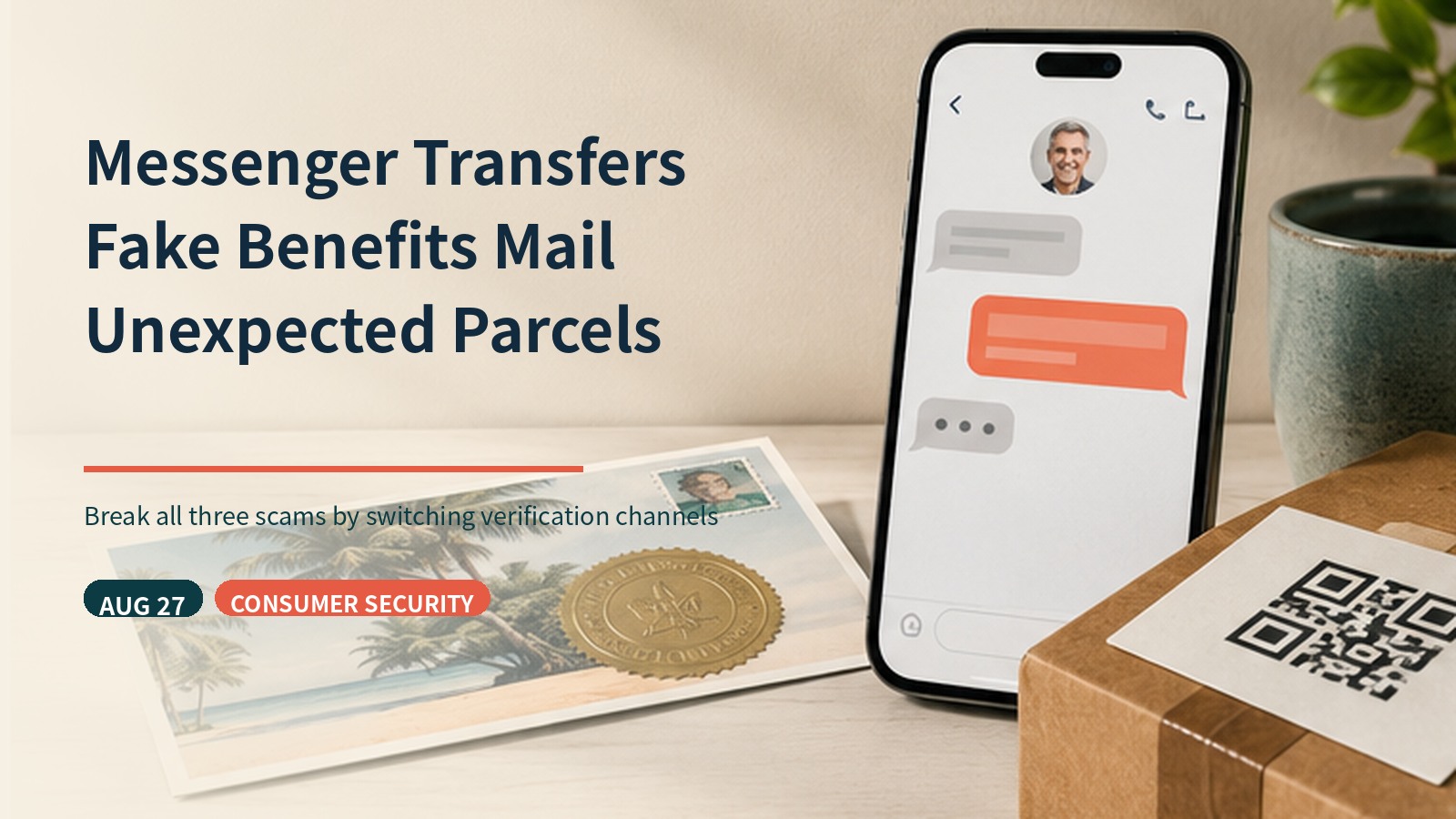
This week’s consumer-security warnings show why scam checks cannot stop at suspicious links. A familiar WhatsApp account, a government-style postcard, and a parcel that physically arrives at your home can all create enough credibility to trigger the next step. The safe response is to leave the channel chosen by the sender and verify through a contact method, official website, or account history you opened independently.
Do not resolve an unexpected request inside the same message, postcard, or parcel that introduced it. Switch channels before money or personal data moves.
One pattern across three different contacts
Singapore Police reported on August 26 that self-effected transfers were involved in 80.8% of reported scam cases in the first half of 2026. In many cases, criminals did not need direct control of a bank account; deception persuaded the victim to complete the transaction. Online platforms were the first point of contact in 89.0% of scam cases, while the FTC alerts show that paper mail and physical parcels can create similar pressure.
Each scenario carries a realistic detail: a known profile, the name of a genuine benefit, or the recipient’s correct address. Those details are not proof that the request is legitimate. The more useful questions are where the money or information is going and whether the victim independently selected the channel used to verify it.
The report recorded 16,821 scam cases and about S$410.6 million in losses in the first half of 2026. Although both totals declined year over year, 69.5% of loss cases involved less than S$5,000. A request that looks like a small favor from a friend therefore still deserves the same independent verification as a larger transfer.
WhatsApp impersonation transfer requests
The Singapore Police report counted 391 cases involving compromised WhatsApp accounts in the first half of 2026, representing 66.6% of social-media impersonation scam cases. Criminals impersonated friends, relatives, or colleagues, cited an emergency loan or a bank-transfer problem, and directed victims to bank or payment-service accounts controlled by the scammers.
The request may continue after an initial payment. The report describes victims being asked to make additional transfers and learning about the deception only after contacting the real account owner. A familiar profile and old conversation history therefore do not establish who is typing now.
Call the person through a previously saved number, start a separate video call, or check through a mutual contact. Review the recipient name before authorizing any transfer. If the person avoids an independent call or switches to another recipient after the first payment, pause the transaction until verification is complete.
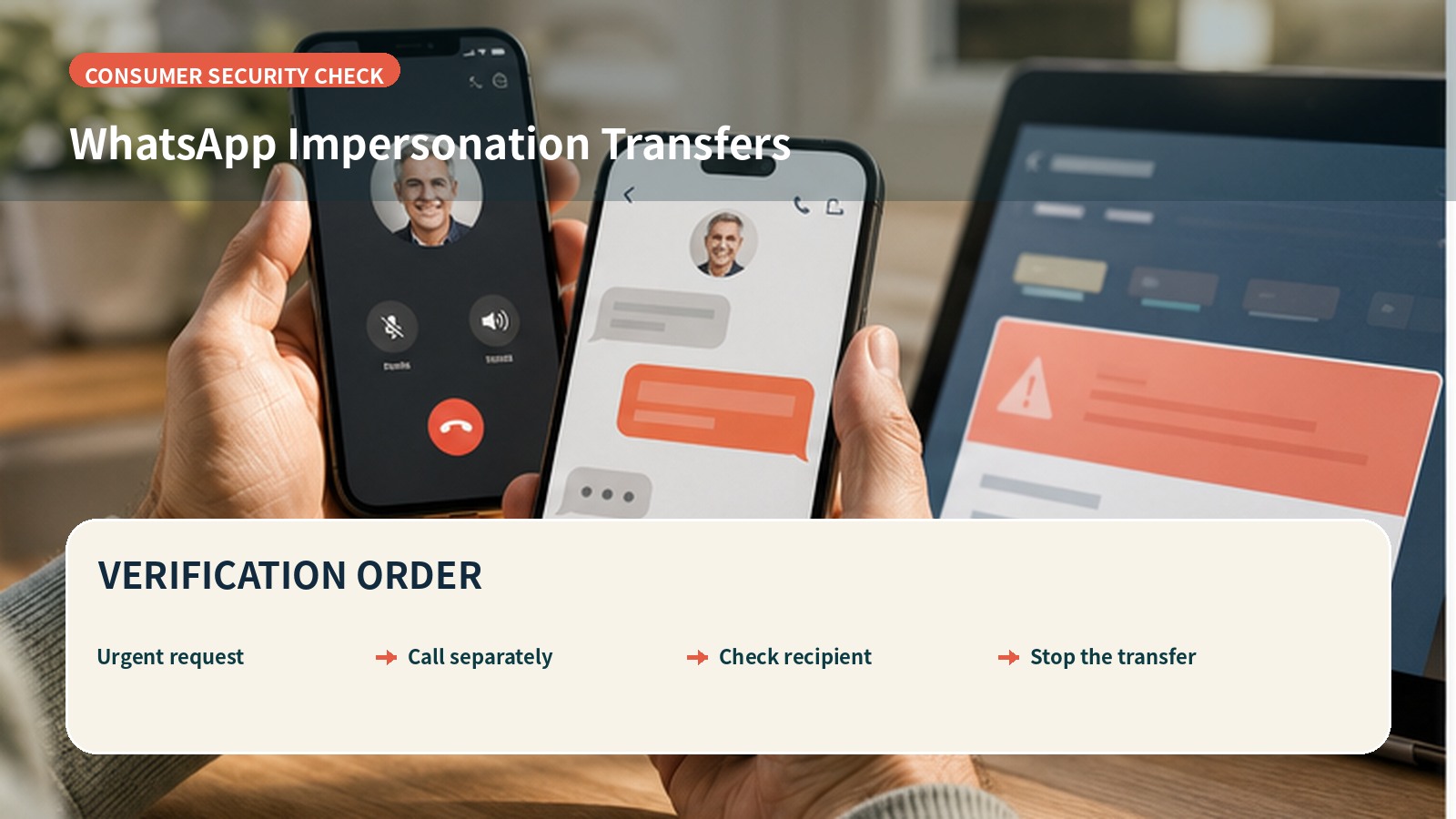
People aged 50 to 64 formed the largest share of social-media impersonation victims at 35.5%. Households can reduce the risk by agreeing that money requests will always be confirmed by voice or video, or by using a family verification phrase that is not stored in the same chat account.
Why the separate call matters
Account takeover preserves the visual cues people normally trust. The decisive control is moving the conversation away from the compromised channel. An urgent deadline, an unfamiliar recipient, and a request for repeated transfers should be assessed together, not one at a time.
Fake veterans’ benefits postcards
On August 24, the U.S. Federal Trade Commission warned about postcards sent to veterans that promise extra money through a “Veterans Savings Program.” The FTC says that program is not real. The postcard may include the recipient’s state and mention legitimate benefits such as CHAMPVA or TRICARE For Life to make the offer look credible.
The card urges the recipient to call immediately or lose the supposed benefit. The goal is to get personal data such as a Social Security number or bank-account details over the phone. A real program name elsewhere on the card does not validate the phone number printed beside the offer.
Do not call the number on the postcard. Find the agency’s official website independently and use the contact information published there. U.S. veterans can verify benefits through official VA channels. The same principle applies more broadly to unexpected benefit, grant, refund, or pension mail: confirm the program and the contact point separately before sharing information.
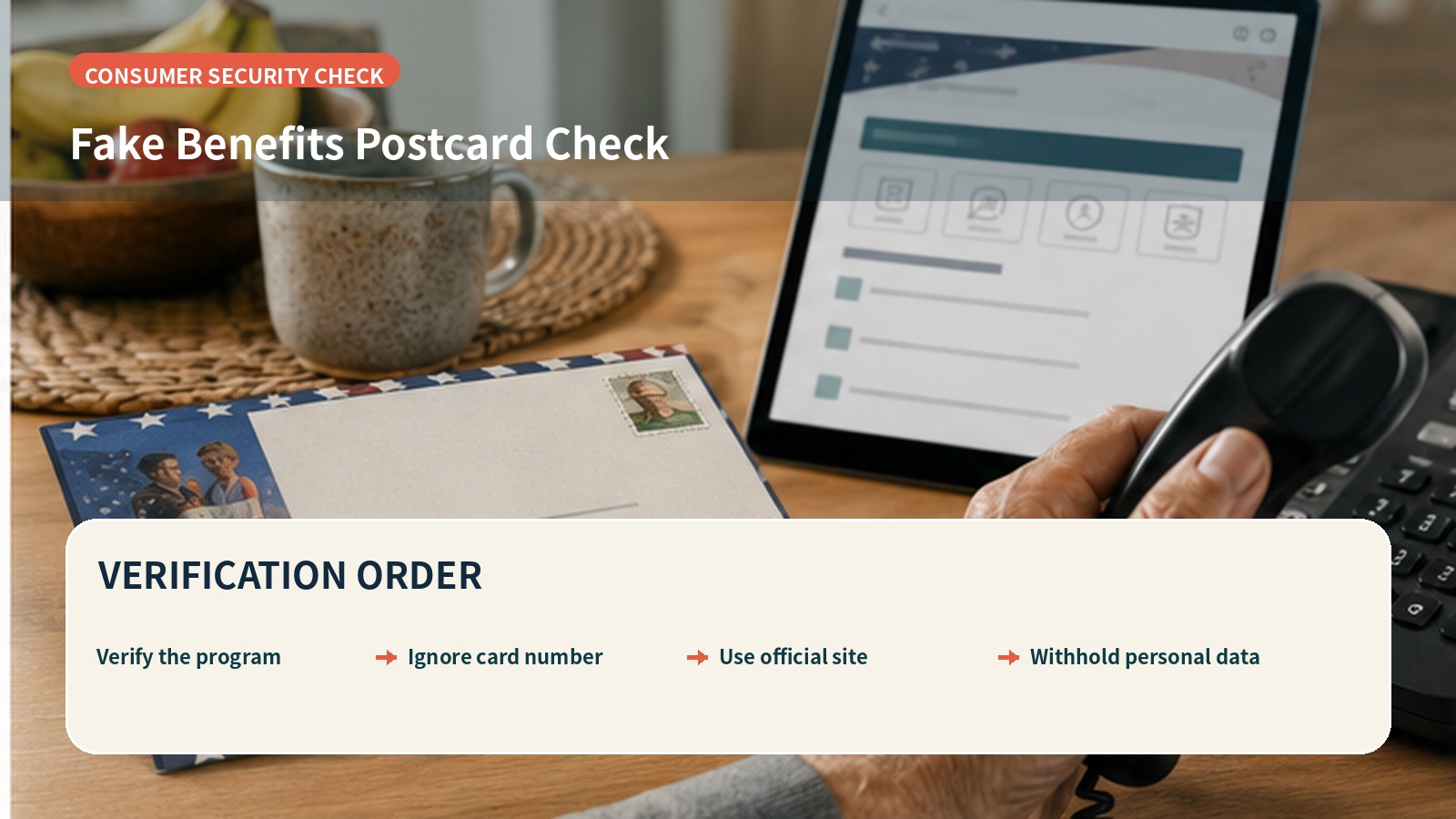
Use a four-part check: search for the named program on the responsible agency’s official domain, confirm that the same benefit and deadline are published there, compare the agency’s published contact details with the postcard, and review whether any requested data belongs in the genuine application process. A mismatch at any stage is a reason to stop.
The trust advantage of paper mail
Physical mail may feel more deliberate and therefore more trustworthy than email. This warning shows how local details and genuine benefit names can be printed into a false offer. Checking design quality is less reliable than confirming that the program exists and that the responsible agency publishes the same contact information.
Unexpected parcels and brushing scams
An FTC alert published on August 20 explains brushing scams involving packages the recipient never ordered. Reports described low-value random items such as baby wipes, toothpaste, or seeds. The sender obtains delivery validation and then uses the recipient’s name to post a fabricated online review that improves the seller’s apparent sales and reputation.
Some packages include a QR code that claims to reveal the sender or process a return. Scanning it could lead to a phishing site designed to steal card numbers, usernames, or passwords. The presence of a real parcel can create pressure to return it, but the instructions inside the box are still supplied by an unknown sender.
Open the marketplace app or website yourself and check order history first. Do not scan the enclosed QR code or contact a number printed inside the package. The FTC advises changing passwords on relevant shopping accounts and asking the marketplace to investigate the seller. It also notes that U.S. law does not require recipients to pay for or return unordered merchandise.
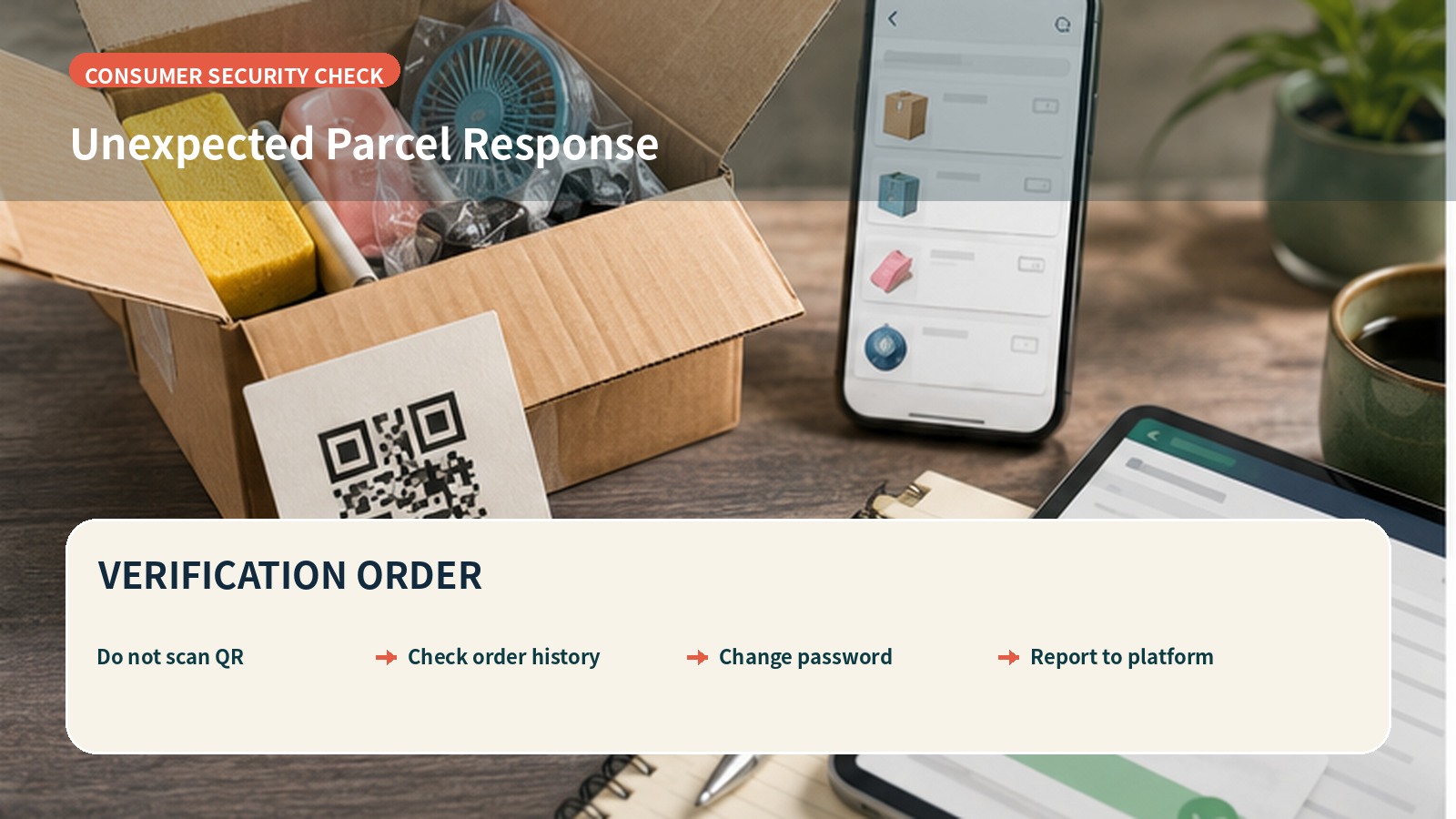
The FTC also recommends monitoring credit reports for signs of identity theft. Outside the United States, start with the official shopping and payment services you use: review orders, recent sign-ins, saved payment methods, and transaction alerts. Photograph the shipping label and enclosed note before reporting the seller or sender through the marketplace.
What the parcel signals about personal data
A correctly addressed parcel means someone used delivery information connected to the recipient. It does not by itself prove an account takeover, but it is a practical reason to review order history, recent sign-ins, and payment methods. Use the marketplace’s own support channel rather than any contact point provided in the box.
Consumer-security checklist
- Verify urgent messenger transfers by calling the real account owner through a number you already had.
- Review the recipient name and pause payment until the request and destination are independently confirmed.
- Check benefits, grants, refunds, and pensions through the responsible agency’s official website, not the number on a mailing.
- Do not scan a QR code or open a return link inside a parcel you did not order.
- Review shopping-account passwords, recent sign-ins, order history, and payment activity after an unexpected parcel.
- Preserve the message, mailing, label, or seller details and report through the platform or official reporting channel.
The rule to apply today
The formats differ, but the criminal’s desired next step is consistent: send money to the named account, call the printed number, or scan the enclosed code. Switching verification channels breaks that sequence. Call the person separately, open the agency site yourself, and inspect marketplace order history before taking action.
A familiar face, official-looking paper, or a real parcel matters less than whether the same claim is confirmed through a channel you chose independently.
Sources reviewed
- Mid-Year Scam and Cybercrime Brief 2026Singapore Police Force · Official source
- How to spot a postcard scam targeting veteransU.S. Federal Trade Commission · Official source
- That unexpected package you got could be a brushing scamU.S. Federal Trade Commission · Official source
SECUFOCUS NOW reorganized and analyzed the material above. This article does not replace the original sources.
Related SecuNote articles
Cloned Car Dealership Websites: How to Verify a Vehicle Before Paying
Scammers are cloning real car dealership websites, listings, photos, reviews, and sales policies to demand upfront wire payments…
Unfamiliar Configuration Profile on iPhone? Check Management and Secure the Device
Configuration profiles can apply work or school accounts, VPN settings, certificates, and other controls to an iPhone. This guide…
Fake Buyer-Protection Portals: Refund, ID and Bank-Detail Checks
A newly disclosed HKICL impersonation scheme combined refund support, identity verification, bank details, a fake wallet and an…
Comments
No comments yet.