
AI Investment Scam Networks: How to Verify Deepfakes, Fake News, and Reviews
A practical guide to independently checking AI-assisted investment scam networks that combine deepfakes, fake news, coordinated reviews and fraudulent trading platforms.

Investment scams no longer rely on a single suspicious ad or message. In a warning published on 17 August 2026, the Australian Securities and Investments Commission (ASIC) described networks that combine AI-generated videos, fabricated news pages, coordinated reviews, scripted calls and fake trading platforms. The objective is to make each element appear to confirm the others.
The crucial change is that the scam can target the victim’s own verification process. A search for the brand may return polished articles, testimonials and websites that were all created by the same operation. This briefing therefore focuses on independent verification through official registers rather than trying to judge a deepfake by visual quality alone.
What the official warning measured
ASIC said it removed more than 19,400 online scams in FY26, an increase of 182% from the previous year. The removals included 5,476 phishing links, up 279%; 7,051 fake investment platforms, up 151%; and 3,106 cryptocurrency investment scams, up almost 30%. These figures describe ASIC’s broader online scam takedown work, not losses from one AI scam.
The same release said public-figure impersonation investment scams generated A$7.4 million in losses reported to Scamwatch. Scammers can change the person they impersonate to match the news cycle. The important signal is not one synthetic video in isolation, but the connected journey that follows it.
The scale also explains why an old-looking domain or a page that appeared in yesterday’s search results is weak evidence. Scam links and fake platforms can be replaced in volume. Verification has to move from the marketing name to the legal entity and licence holder recorded by the regulator.
Six stages that manufacture trust

The journey may begin with an ad on a familiar social or search platform. It promotes a topical investment story using a public figure, celebrity or influencer. A video or interview-style clip then supplies apparent endorsement. Visual artefacts can be useful clues, but a convincing video is not proof that the person participated.
The click-through page may imitate a legitimate news outlet and combine a fabricated article, supportive comments and a sign-up link. Searching the brand can reveal more promotional pages and positive reviews that repeat the same distinctive phrases. Variety in design does not establish independence when the pages are part of one controlled footprint.
After contact details are submitted, callers can guide the target through registration and deposits. ASIC notes that scammers may display fake investment platforms and even make small profit payments to build trust. A balance shown on a dashboard or one successful withdrawal does not establish that the underlying investment exists.
Why search results can look like evidence
People reasonably place more confidence in claims repeated by several sources. Scam networks exploit that habit by creating a brand, product vocabulary and supposed executives, then publishing articles, reviews, ads and websites that use the same terms. A search returns multiple pages, but the apparent corroboration may have a single origin.
Verification should test relationships between sources. Check whether a news story is on the outlet’s genuine domain, whether the platform’s legal entity matches an official register, and whether the licence belongs to the business making the offer. Open regulator websites independently instead of following only links supplied by the ad or caller.
Searching for the company name with words such as “scam” or “review” can provide clues, but it is not a final decision. A coordinated network can seed reassuring answers for defensive search terms as well. Treat search as discovery and move the decision to official registers and independently obtained contact details.
Five independent checks
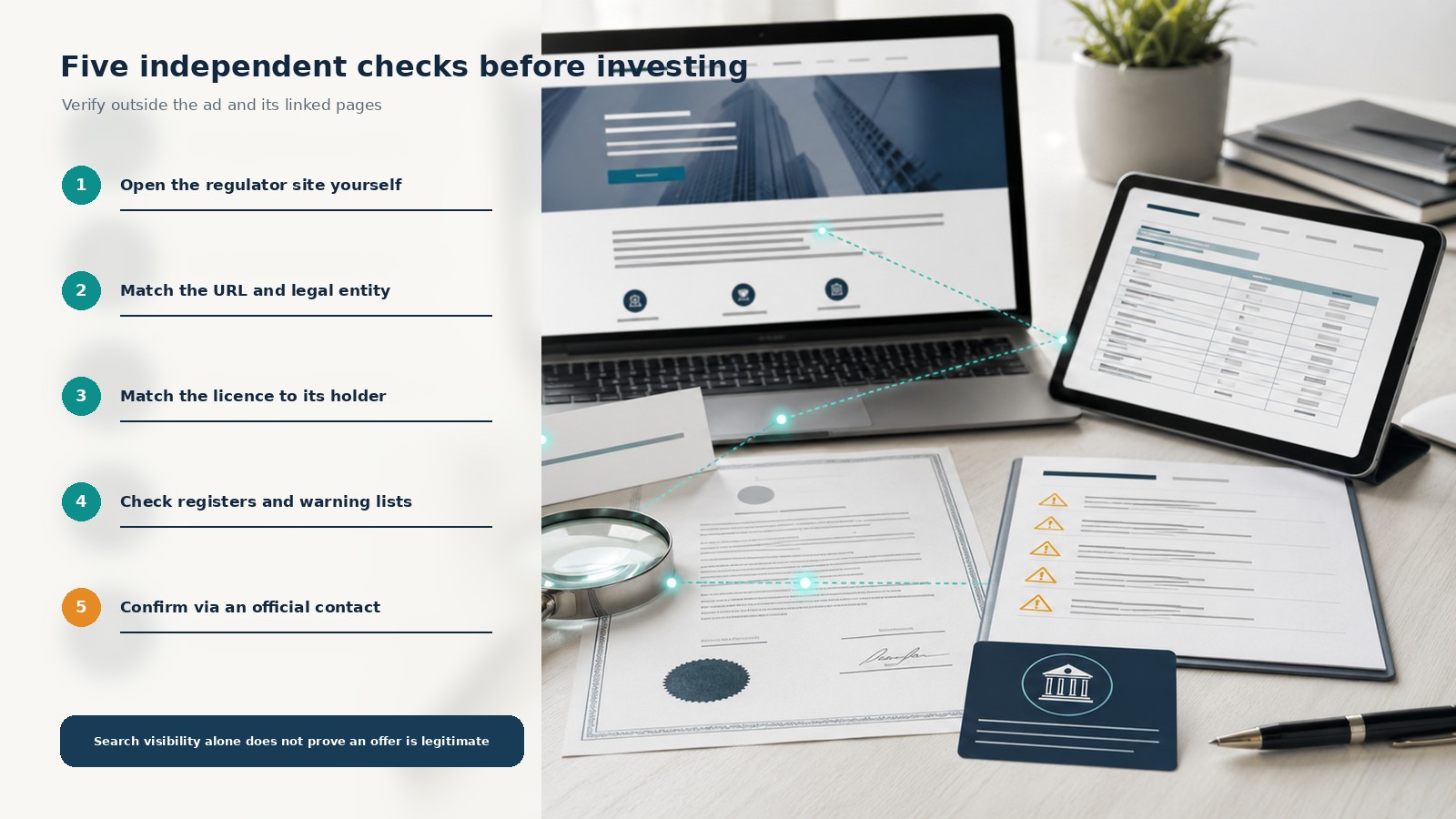
- Open the regulator’s website yourself. Close the ad, article and caller-supplied links before starting the check.
- Match the website address and legal entity. Compare the company name, address, contact details and domain character by character.
- Match the licence to its holder. A real licence number can be copied from another business, so confirm the holder and official website shown in the register.
- Check official registers and warning lists together. Use resources such as the Moneysmart Investor Alert List without treating one search result as a substitute for identity checks.
- Confirm through an official contact. Before transferring money, call a number obtained from the regulator or the genuine company website—not the number in the promotion.
A company name appearing in a register is only the beginning of the check. Compare the name, licence number, address and website as one set, then compare the receiving account name. Pause when the offer adds urgency, guaranteed returns, or demands for tax, verification or release fees before a withdrawal.
If information or money has already been sent
If you submitted credentials or identity information, change the affected password and any reused passwords, enable multi-factor authentication and review login and password-reset alerts. If remote-access software was installed, disconnect the device, remove the software and update the operating system and security tools. Preserve messages, phone numbers, URLs, account details, receipts and screenshots for reports and financial-institution reviews.
If you transferred money, contact the bank or payment service through its official channel immediately and ask about available transaction-intervention or recovery steps. Do not pay additional tax, security or release fees to unlock a withdrawal. Treat a small returned profit as a possible trust-building step and rely on the financial institution’s transaction record rather than the scam platform’s displayed balance.
Use the same independent-contact rule when seeking help. Do not select a recovery service solely because it appears in a search ad or promises to trace funds. Locate the financial institution and reporting authority through their official sites, and organise messages and transaction records in chronological order.
A practical decision rule
An AI investment scam network reduces doubt by supplying more apparent evidence. The more a video, article, review, search result, call and dashboard appear to confirm one another, the more important it is to ask whether they share one origin. The decisive test is whether the legal entity, website, licence and contact details match across independent official sources.
Scamwatch’s Stop, Check and Protect sequence turns that principle into action: stop before sending money or personal information, check the counterparty using contact details you found independently, and protect yourself and others by reporting the scam to your financial institution and the relevant authorities.
Sources reviewed
- 26-195MR ASIC warns scammers are using AI to spin vast webs of deceptionAustralian Securities and Investments Commission · Official source
- Scams Awareness WeekScamwatch · Official source
- Investor alert listMoneysmart · Official source
- Professional registers searchAustralian Securities and Investments Commission · Official source
SECUFOCUS NOW reorganized and analyzed the material above. This article does not replace the original sources.
Related SecuNote articles

Cloned Car Dealership Websites: How to Verify a Vehicle Before Paying
Scammers are cloning real car dealership websites, listings, photos, reviews, and sales policies to demand upfront wire payments…
Unfamiliar Configuration Profile on iPhone? Check Management and Secure the Device
Configuration profiles can apply work or school accounts, VPN settings, certificates, and other controls to an iPhone. This guide…
Fake Buyer-Protection Portals: Refund, ID and Bank-Detail Checks
A newly disclosed HKICL impersonation scheme combined refund support, identity verification, bank details, a fake wallet and an…
Comments
No comments yet.