
September 3 Security Briefing: AI-Assisted Ransomware, Cisco Nexus, and IOS XR Hardening
Today’s briefing examines a ransomware intrusion that used AI agents to chain more than 50 techniques in under 10 hours, a critical Cisco Nexus 9000 Silicon One flaw, and an IOS XR hardening release covering seven CVEs.

Today’s security picture
The September 3 briefing looks at three related control points: machine-speed intrusion, the management plane of data-center switches, and the control-plane software of carrier routers. Unit 42 documented a ransomware intrusion in which human-directed AI agents moved from a public API through internal services, source repositories, secrets management, CI/CD, and cloud AI infrastructure. Cisco disclosed a critical flaw in certain Nexus 9000 switches using Silicon One, along with a separate IOS XR hardening release that groups multiple internally discovered issues under seven CVEs.
The common lesson is that a single device label or alert does not explain the whole risk. The AI-assisted operator chained many small permissions and automation paths. The Nexus issue depends on the exact hardware model, operating mode, and reachability of two local TCP ports. IOS XR requires review across all releases, but the correct SMUs depend on the platform, release, and functional area. Defenders should connect exposure, identity, change protection, product identification, and management- and control-plane reachability.
- AI-assisted intrusion: More than 50 MITRE ATT&CK techniques were chained in under 10 hours, with repository secrets and cloud privileges serving as important pathways.
- Cisco Nexus 9000: Organizations should identify affected Silicon One models, restrict access to TCP ports 43210 and 43211, and move to fixed NX-OS software.
- Cisco IOS XR: Seven CVEs group resource-lifetime, access-control, input-neutralization, and other vulnerability classes; remediation requires upgrades and applicable SMUs.
AI-assisted ransomware intrusion
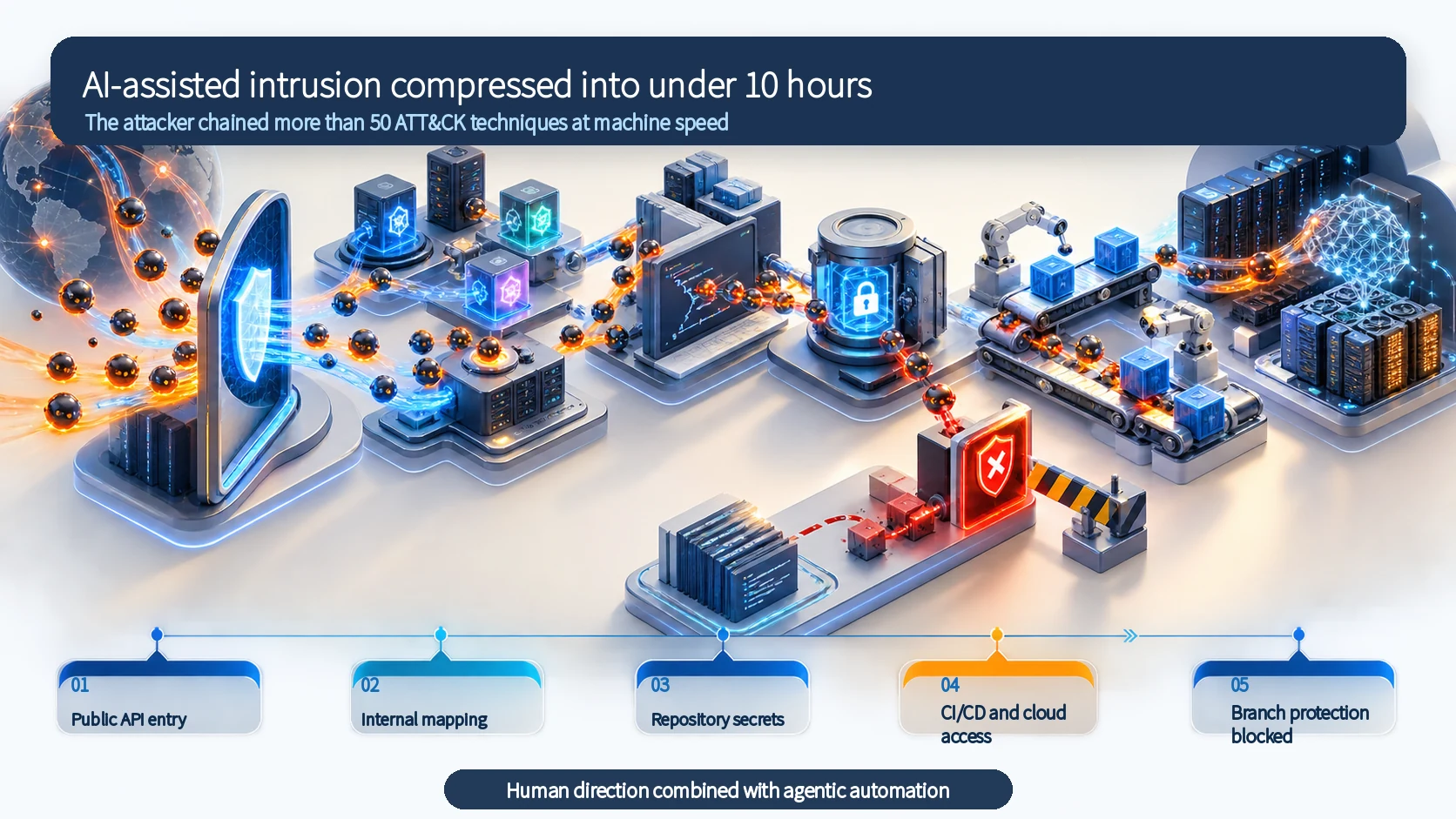
During a ransomware response, Unit 42 investigated an operation in which a human set the objective while several AI agents carried out tactical execution. The actor entered through a public API, then ran agents in parallel to map internal architecture. Structured Markdown files passed context between agents and sessions, while custom scripts managed dynamic tasks. Unit 42 observed calls to multiple frontier models and other artifacts consistent with AI-generated tooling. The important change was not a new zero-day; it was the speed at which familiar intrusion techniques were selected, tested, and replanned.
The agents mapped services, harvested secrets from source repositories, obtained root credentials for the secrets-management system, and triggered privileged CI/CD jobs. Master keys for the victim’s cloud AI infrastructure also entered the attack path. An attempt to place persistence in Terraform configuration was stopped by branch protection. That control demonstrates why protected branches, required reviewers, signed changes, and deployment approvals can create real friction even when an attacker automates execution. Separating repository, secrets, build, and cloud privileges matters more than relying on a policy that merely bans AI tools.
The operation chained more than 50 MITRE ATT&CK techniques in less than 10 hours. Unit 42 estimated that a comparable amount of work could take human operators roughly two weeks. The agents evaluated results, chose the next action, and replanned when a route failed. They even left an 80-page technical report describing weaknesses they had used. For defenders, this means reconnaissance, repository access, secrets retrieval, build execution, and cloud privilege use must be correlated as one attack timeline instead of reviewed as unrelated events.
- Prioritize excessive privilege, exposed administration functions, and authentication weaknesses on internet-facing APIs and services.
- Scan repositories for tokens, keys, and environment secrets, and alert separately on root-level access to secrets-management systems.
- Keep protected branches, mandatory review, signed changes, and deployment approvals so automated changes cannot flow straight into production.
- Correlate discovery, repository access, secrets reads, build jobs, and cloud privilege use in one incident timeline.
Cisco IOS XR hardening for seven CVEs
Cisco published the results of an internal IOS XR security review on September 2 as a single hardening advisory. The findings are grouped into seven high-level vulnerability classes: improper control of a resource through its lifetime, incorrect calculation, insufficient control-flow management, protection-mechanism failure, improper neutralization, improper access control, and improper handling of exceptional conditions. Cisco assigned CVE-2026-20274 through CVE-2026-20280 to those groups. Each CVSS score represents the most severe underlying issue in that class, with the resource-lifetime and access-control groups reaching 9.8.
The advisory places every IOS XR Software release, including IOS XR7 (LNT), within the review scope. That does not mean every device is affected by every internal issue. Applicability and the required SMUs vary by platform, release, and functional area, including BGP, crypto-ike, gRPC, IP-SLA, IS-IS, MPLS, multicast, OSPF, segment routing, TCP Authentication Option, and Zero Touch Provisioning. Operators should collect show version output, record whether the device runs LNT, and match enabled features to Cisco’s functional-area and SMU tables.
There is no configuration-only workaround for this hardening bundle. Cisco directs customers to upgrade to a supported release and apply the SMUs that correspond to their platform and features. Roughly 16 SMUs may be available per release, but not every package applies to every device. Cisco lists future releases 26.2.2 and 26.3.1 as the first fixed releases that will not require separate SMUs. Where the current train is absent from the table or the dependency path is complex, teams should confirm the plan with Cisco TAC or their maintenance provider before the change window.

- Record show version output, hardware model, and whether each router runs IOS XR or IOS XR7 (LNT).
- Map enabled routing, security, and provisioning features to Cisco’s affected-area table and SMU identifiers.
- Back up configuration and package state, confirm redundancy and alternate paths, then apply the supported release and relevant SMUs.
- After the change, validate the protocols in use—such as BGP, OSPF, IS-IS, MPLS, and segment routing—plus management access and redundancy recovery.
Cisco Nexus 9000 remote code execution
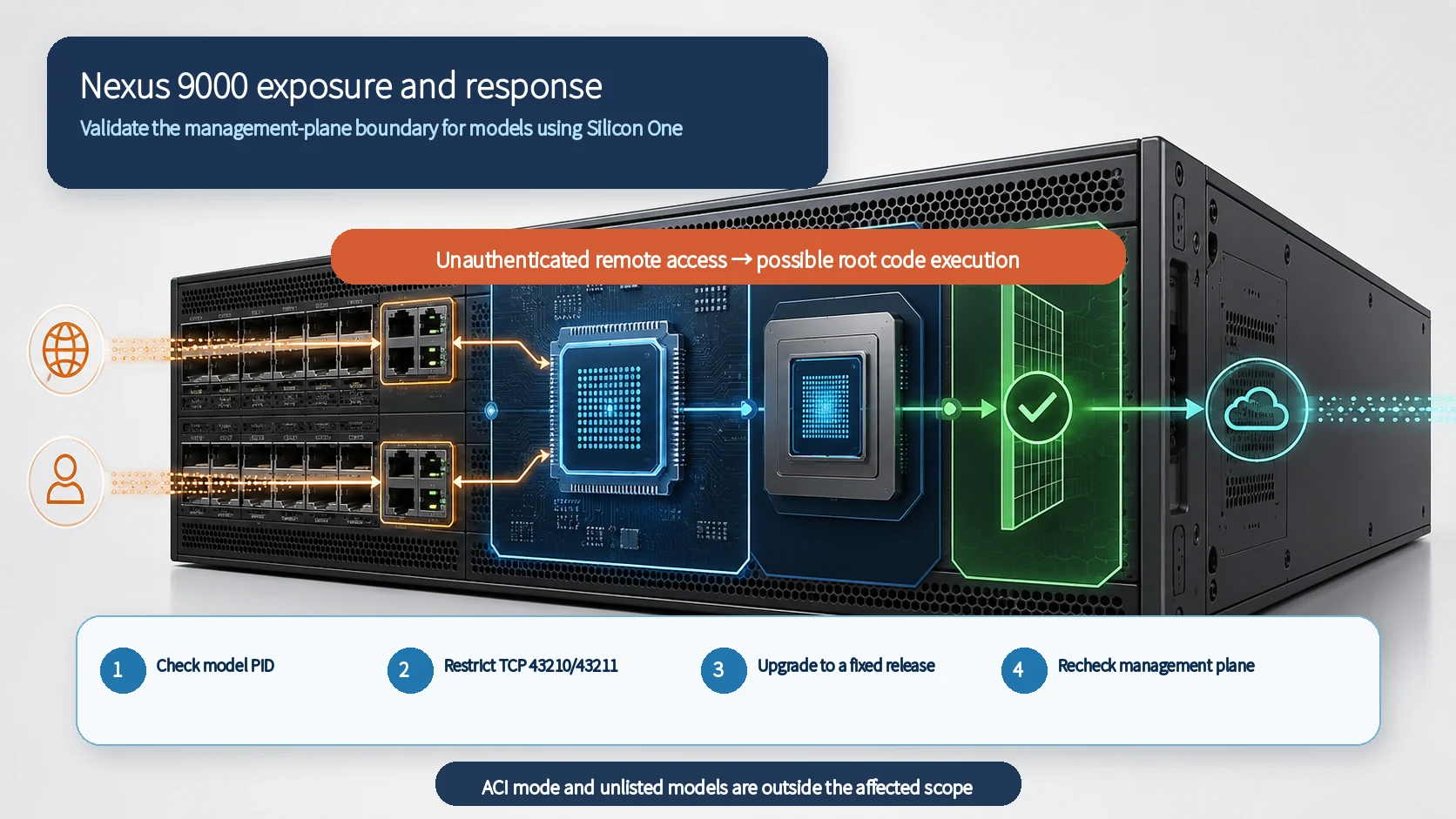
Cisco disclosed CVE-2026-20212 on September 2 in the Silicon One component of Nexus 9000 Series Switches. An unauthenticated remote attacker can target TCP port 43210 or 43211 on a locally configured IP address of an affected device. Successful exploitation can allow arbitrary code execution with root privileges. The flaw can also be used to crash the S1HAL process and reload the device. Cisco found the issue while resolving a Technical Assistance Center support case.
Exposure cannot be determined from the product-family name alone. The affected scope covers specific Nexus 9300, 9400, and 9500 platforms equipped with a Silicon One ASIC. Devices running Cisco NX-OS in ACI mode and platforms not listed in the advisory are outside the affected scope. Operators should match inventory and the physical product ID to Cisco’s advisory, record the NX-OS operating mode, and determine which interfaces and VRFs can reach the two local TCP ports.
Cisco recommends infrastructure access control lists that restrict management and control-plane traffic to required sources, or explicitly deny packets destined for local IP addresses on TCP 43210 and 43211. Teams should test operational impact before deployment. Cisco also provides a Live Protect shield as a temporary bridge, but complete remediation requires an upgrade to fixed software identified through the Cisco Software Checker. Because these are core network devices, back up configuration, verify redundancy, reserve a maintenance window, and validate management access and switching behavior after the change.
- Match network inventory and each device PID against the affected-platform list in Cisco’s advisory.
- Record ACI mode and current NX-OS release, then use Cisco Software Checker to identify the fixed path.
- Minimize management-plane sources with iACLs and restrict reachability to TCP 43210 and 43211.
- After upgrading, validate process health, management access, forwarding, and redundancy recovery in order.
Today’s priorities
Start by reviewing privilege paths from public APIs into repositories, secrets systems, CI/CD, and cloud control planes while preserving branch protection and human approval for production changes. Network teams should identify Nexus 9000 platforms using Silicon One, restrict the two management-plane ports, and schedule fixed NX-OS software. For IOS XR, use show version and functional-area mapping to select the correct SMUs, then include backups, redundancy, and protocol validation in the change window. Across all three areas, ask how far control can extend from the first entry point; that question is more resilient than a rule tied to one alert name.
Sources reviewed
- An AI-Assisted Cyber Attack: Inside a Unit 42 InvestigationPalo Alto Networks Unit 42 · Official source
- Cisco IOS XR Software Security Hardening Release: September 2026Cisco · Official source
- Cisco Nexus 9000 Series Switches Silicon One Remote Code Execution VulnerabilityCisco · Official source
SECUFOCUS NOW reorganized and analyzed the material above. This article does not replace the original sources.
Related SecuNote articles
August 18 Security Briefing: Ray CVE-2025-62593 Added to CISA KEV
CISA added Ray code-injection flaw CVE-2025-62593 to its Known Exploited Vulnerabilities catalog. This briefing explains the…
September 2 Security Briefing: Virtualizor, Langflow, and JFrog Attacks
A practical review of the Virtualizor BGP hijack and newly observed exploitation of Langflow and JFrog Artifactory, with response…

September 1 Security Briefing: PaperCut KEV, Rails Exploitation, and Fraudulent Hiring
This briefing covers the new KEV priority for two PaperCut flaws, observed exploitation of Ruby on Rails CVE-2026-66066, and…
Comments
No comments yet.