
September 2 Security Briefing: Virtualizor, Langflow, and JFrog Attacks
A practical review of the Virtualizor BGP hijack and newly observed exploitation of Langflow and JFrog Artifactory, with response priorities for servers, API keys, and administrator tokens.
What changed today
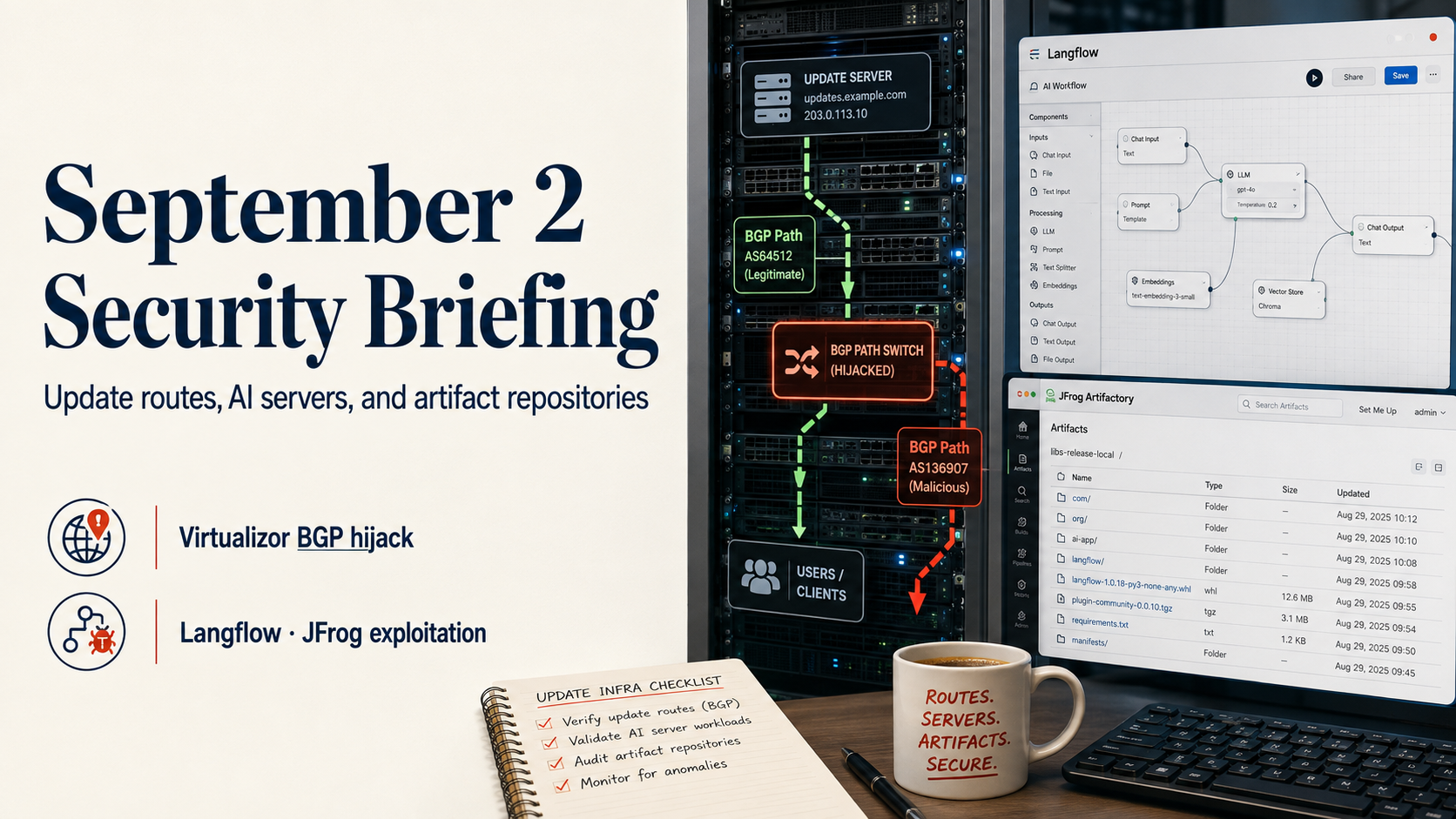
This briefing covers three different trust boundaries: update delivery, an AI application server, and a software artifact repository. Virtualizor’s incident shows how route manipulation and certificate issuance can make a malicious update path look legitimate. Langflow CVE-2026-0768 has moved from a disclosed remote-code-execution flaw to observed credential theft. JFrog Artifactory CVE-2026-82329 has likewise shifted into active exploitation, with attackers reportedly minting administrator tokens only days after disclosure.
- Virtualizor operators should correlate update timing with services, accounts, keys, and outbound connections.
- Langflow operators should upgrade and revoke every API or cloud key that the vulnerable process could read.
- Self-hosted Artifactory operators should patch, then audit newly created admin tokens and repository changes.
Virtualizor update-path hijack
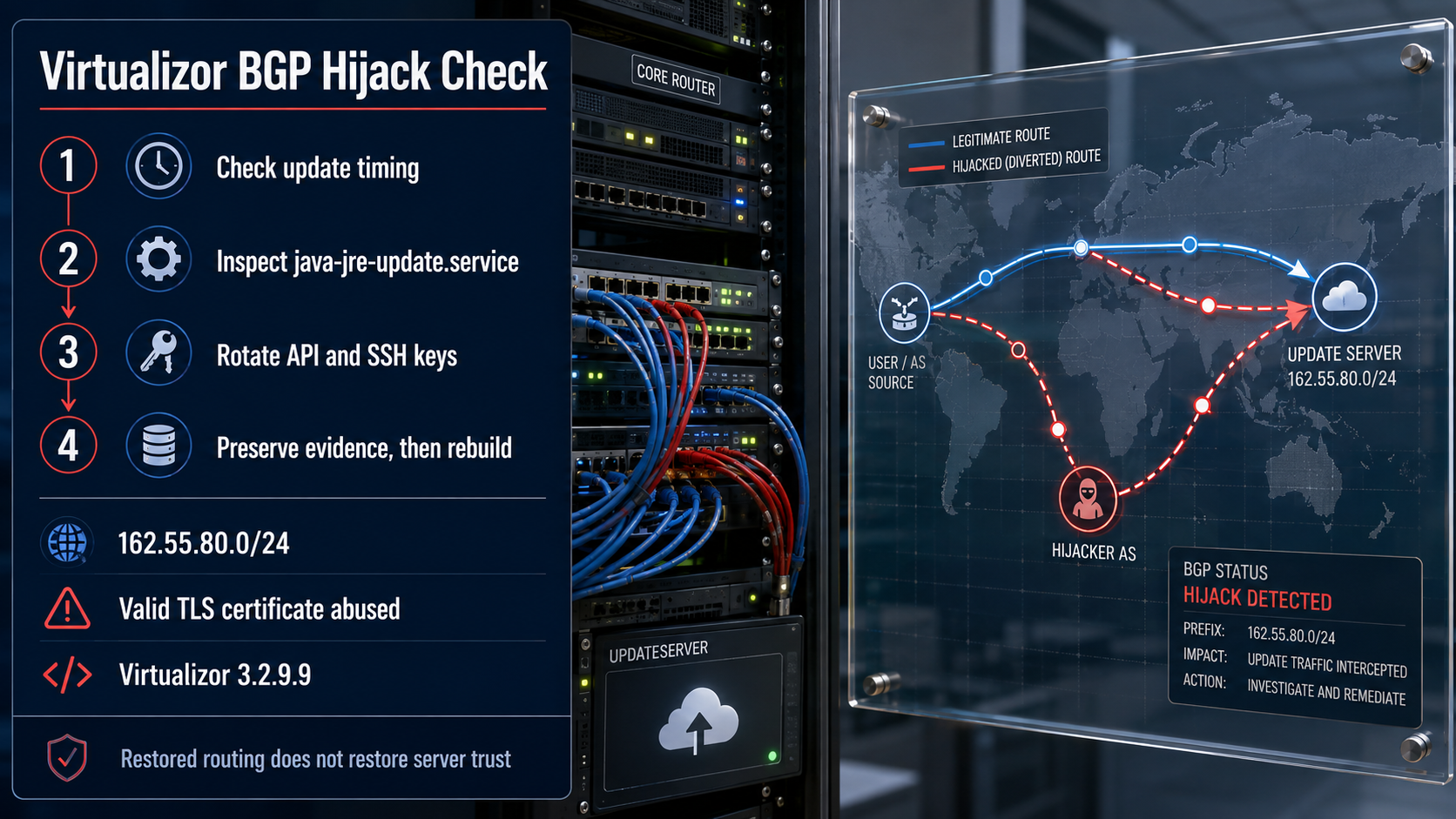
Virtualizor’s investigation says the Softaculous address block 162.55.80.0/24 was affected by two BGP hijack waves between August 28 at 20:57 UTC and August 30 at 06:10 UTC. An unauthorized, more-specific /24 route drew traffic toward infrastructure controlled by the attacker. The route kept Hetzner’s legitimate origin at the end of the AS path, illustrating why monitoring only the origin ASN can miss a malicious path inserted upstream.
The attacker also obtained a technically valid TLS certificate because domain-validation traffic followed the diverted route. Clients therefore reached the attacker-controlled endpoint without a certificate warning. A malicious Virtualizor package was delivered to a small number of installations whose update checks overlapped with diverted intervals. The event demonstrates that HTTPS transport alone cannot establish the provenance of an update package; independent package signatures and routing anomaly detection must reinforce it.
Operators should identify systems that updated during the affected window and inspect for /etc/systemd/system/java-jre-update.service, newly added root SSH keys, accounts, cron jobs, startup services, altered application files, and unusual outbound connections. If evidence appears, preserve disks, memory, logs, and file hashes before cleanup. Rebuild from a trusted image, rotate Virtualizor API credentials and shared SSH keys, and extend the review to connected nodes.
- Map each asset to its update time and confirm Virtualizor 3.2.9.9.
- Inspect the known service, accounts, authorized_keys, cron, startup services, and outbound traffic.
- Rotate API keys, management credentials, and shared SSH keys while narrowing their scope.
- Preserve evidence before rebuilding affected systems and checking adjacent nodes.
Network teams should also validate RPKI and ROA coverage, alert on more-specific announcements and rapid path changes, and monitor certificate-transparency logs for unexpected issuance. Routing recovery restores the network path; it does not automatically restore trust in a server that may have executed a malicious update.
Langflow CVE-2026-0768 exploitation
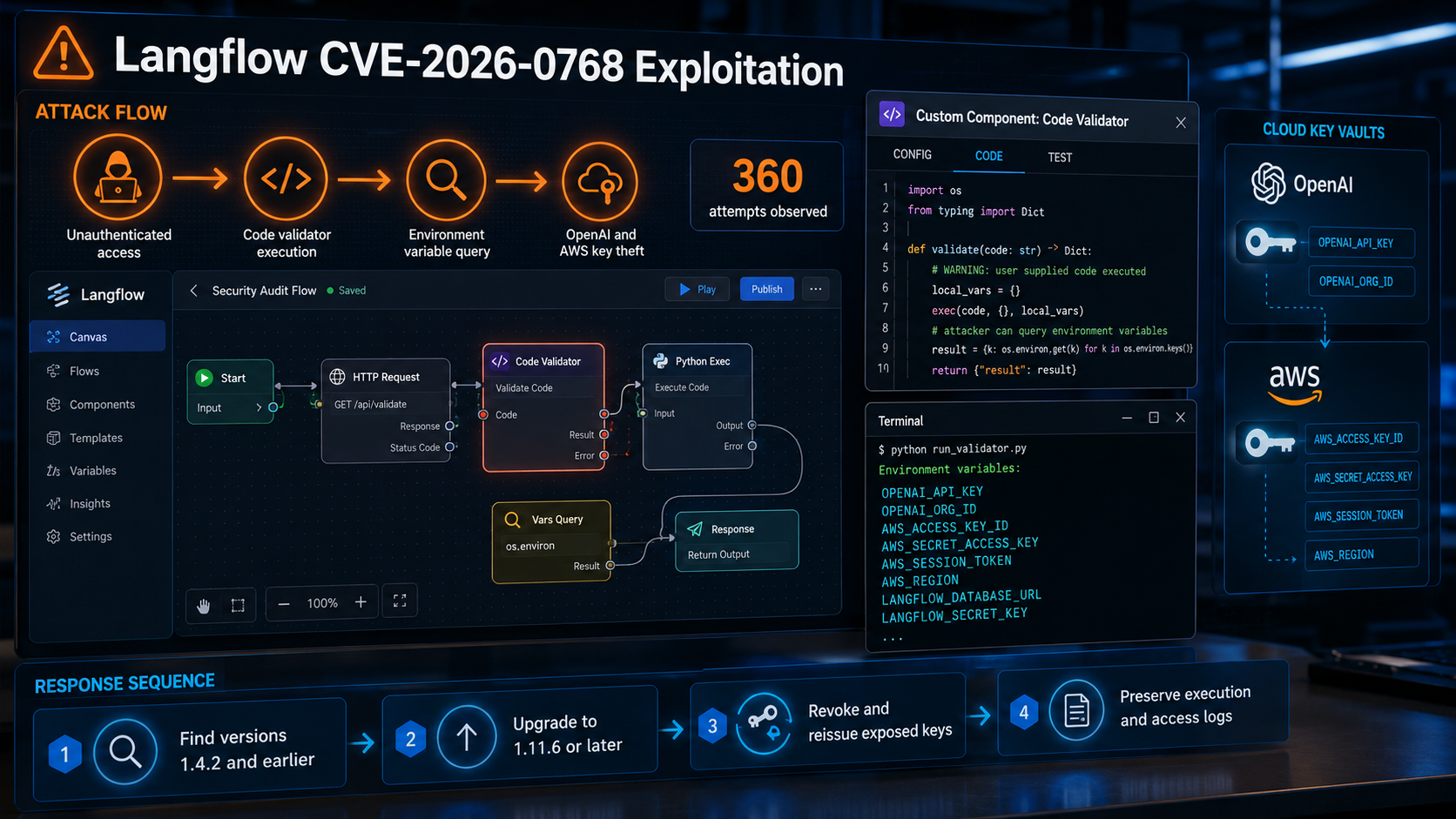
CVE-2026-0768 is an unauthenticated remote-code-execution flaw in the code validator used by Langflow’s custom component editor. Public reporting identifies version 1.4.2 and earlier as affected. Attackers are now using the flaw against exposed servers and searching the process environment and local configuration for credentials, changing the issue from a patching concern into an active credential-exposure scenario.
Observed commands queried LANGFLOW_SUPERUSER, Langflow secret material, values beginning with OPENAI_API, and AWS_ACCESS and AWS_SECRET variables. The activity also inspected SSH configuration and shell history. A Langflow deployment often connects to model providers, cloud platforms, databases, vector stores, and source repositories, so the process identity and its secret scope determine how far an intrusion can reach.
Inventory exposed and internal Langflow instances, identify versions 1.4.2 and earlier, and move to supported release 1.11.6 or later. Preserve container images, volumes, and logs for review. Then revoke and reissue OpenAI, AWS, database, and repository credentials stored in environment variables, .env files, workflow settings, or container secrets. Apply the minimum permissions and source restrictions required by each workflow.
- Locate Langflow assets and vulnerable container images.
- Upgrade to 1.11.6 or later while preserving forensic data from vulnerable instances.
- Revoke and reissue AI, cloud, database, and repository credentials.
- Correlate application, runtime, and cloud audit logs for follow-on use.
- Restrict management and execution APIs to authenticated administration networks.
Detection should focus on the behavior chain rather than a single command or IP address: an external request followed by shell execution from the validator, reads of environment or history files, and unfamiliar cloud or AI API calls. The reported dataset counted 360 attempts, making time-aligned application, container, and cloud logs essential for determining impact.
JFrog Artifactory exploitation update
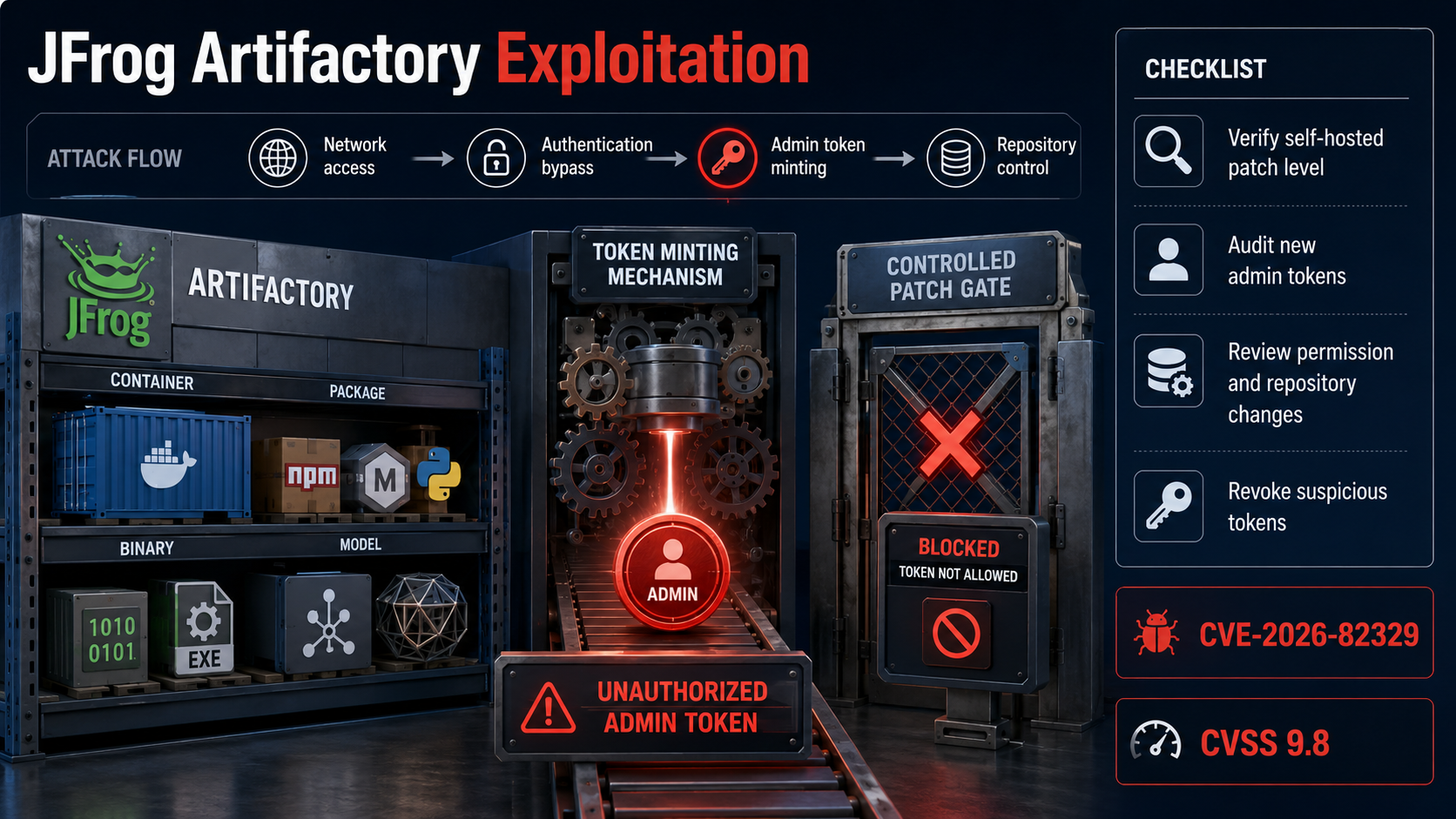
CVE-2026-82329 is a CVSS 9.8 authentication weakness that can allow an unauthenticated attacker with network access to gain administrative privileges under Artifactory’s default configuration. JFrog released fixes on August 28 and patched its cloud service. Self-hosted deployments should move to the appropriate fixed build: 7.111.21, 7.117.28, 7.125.20, 7.133.29, 7.146.38, or 7.161.20 and later.
The material change in this cycle is watchTowr’s report that attackers were already exploiting the vulnerability to mint administrator tokens. Artifactory administration controls packages, container images, binaries, and AI models that feed build and release pipelines. The investigation therefore needs to cover repository configuration, permissions, remote repositories, deployment credentials, and token activity—not only access to the web console.
After patching, audit administrator and service tokens created since August 28. Compare each token with its issuing identity, source address, and actual use. Review new users, groups, permission targets, repository creation or deletion, replication settings, remote repository URLs, and management API calls from unfamiliar sources. Revoke suspicious tokens and reissue CI/CD credentials with reduced privileges.
- Upgrade every self-hosted deployment to the fixed build for its release branch.
- Audit recently created admin and service tokens, including issuer, source IP, and use.
- Review identity, permission, repository, replication, and remote URL changes.
- Revoke suspicious tokens and reconnect CI/CD with least-privilege credentials.
- Validate checksums, signatures, and deployment history for critical artifacts.
Response priorities
All three cases abused something that normally conveys trust: a valid domain and certificate, an authorized application process, or an administrator token. Treat the response as four connected tasks: restore or patch the delivery path, revoke credentials that may already be exposed, verify configuration and artifact history, and preserve evidence before destructive cleanup.
Sources reviewed
- Security Incident – BGP HijackingVirtualizor · Official source
- Hackers push malicious Virtualizor update in BGP hijacking attackBleepingComputer
- CVE Record: CVE-2026-0768CVE Program · Official source
- Critical Langflow flaw exploited to steal OpenAI and AWS keysBleepingComputer
- JFrog Security AdvisoriesJFrog · Official source
- Critical JFrog Artifactory Vulnerability Reportedly Exploited in the WildSecurityWeek
SECUFOCUS NOW reorganized and analyzed the material above. This article does not replace the original sources.
Related SecuNote articles
August 29 Security Briefing: Hasbro Employee Data, JFrog Auth Bypass, and the QTFY Correction
This briefing reviews Hasbro's employee-data notification, a critical JFrog Artifactory authentication bypass, and the U.S…
September 1 Security Briefing: PaperCut KEV, Rails Exploitation, and Fraudulent Hiring
This briefing covers the new KEV priority for two PaperCut flaws, observed exploitation of Ruby on Rails CVE-2026-66066, and…
August 31 Security Briefing: ash_graphql, Open5GS and AJCloud Fixes
This briefing covers six ash_graphql 1.11.0 security fixes, two Open5GS AMF vulnerabilities, and an AJCloud camera firmware…
Comments
No comments yet.