
August 29 Security Briefing: Hasbro Employee Data, JFrog Auth Bypass, and the QTFY Correction
This briefing reviews Hasbro's employee-data notification, a critical JFrog Artifactory authentication bypass, and the U.S. government's correction separating QTFY targets from confirmed victims. It focuses on verified scope and immediate operational actions.
Today’s briefing at a glance
The three developments in this briefing require different kinds of decisions. Hasbro’s notification is primarily an identity and financial-protection issue for employees. The JFrog Artifactory disclosure requires self-hosted operators to identify their release branch and move to a fixed build. The QTFY update is an evidence-quality issue: threat reports must distinguish an organization that was targeted from one that was demonstrably compromised. Treating all three as a single generic cyber risk would blur the actions that matter.
- Personal response: verify Hasbro’s official notice and any credit-monitoring instructions
- Product response: identify the Artifactory deployment model and upgrade self-hosted systems
- Intelligence response: separate targeting, attempted access, and confirmed compromise in QTFY reporting
The topics were also checked for duplication. Berlin’s government-network breach has a standalone incident article on the same publication date, while PaperCut and Manchester Airports Group have no material new official findings beyond their existing incident coverage. Hasbro adds a distinct employee-data response intent, JFrog adds a newly disclosed CVE and fixed releases, and QTFY is limited to the government’s material evidence correction rather than repeating the earlier campaign narrative.
Hasbro employee-data notification
The Massachusetts Attorney General’s August 2026 breach-notification list includes a Hasbro notice for employees. The state record counts 436 affected Massachusetts residents. That figure describes the jurisdictional filing, not Hasbro’s entire workforce. The important operational change is the disclosure of data categories that can support identity theft and financial fraud.
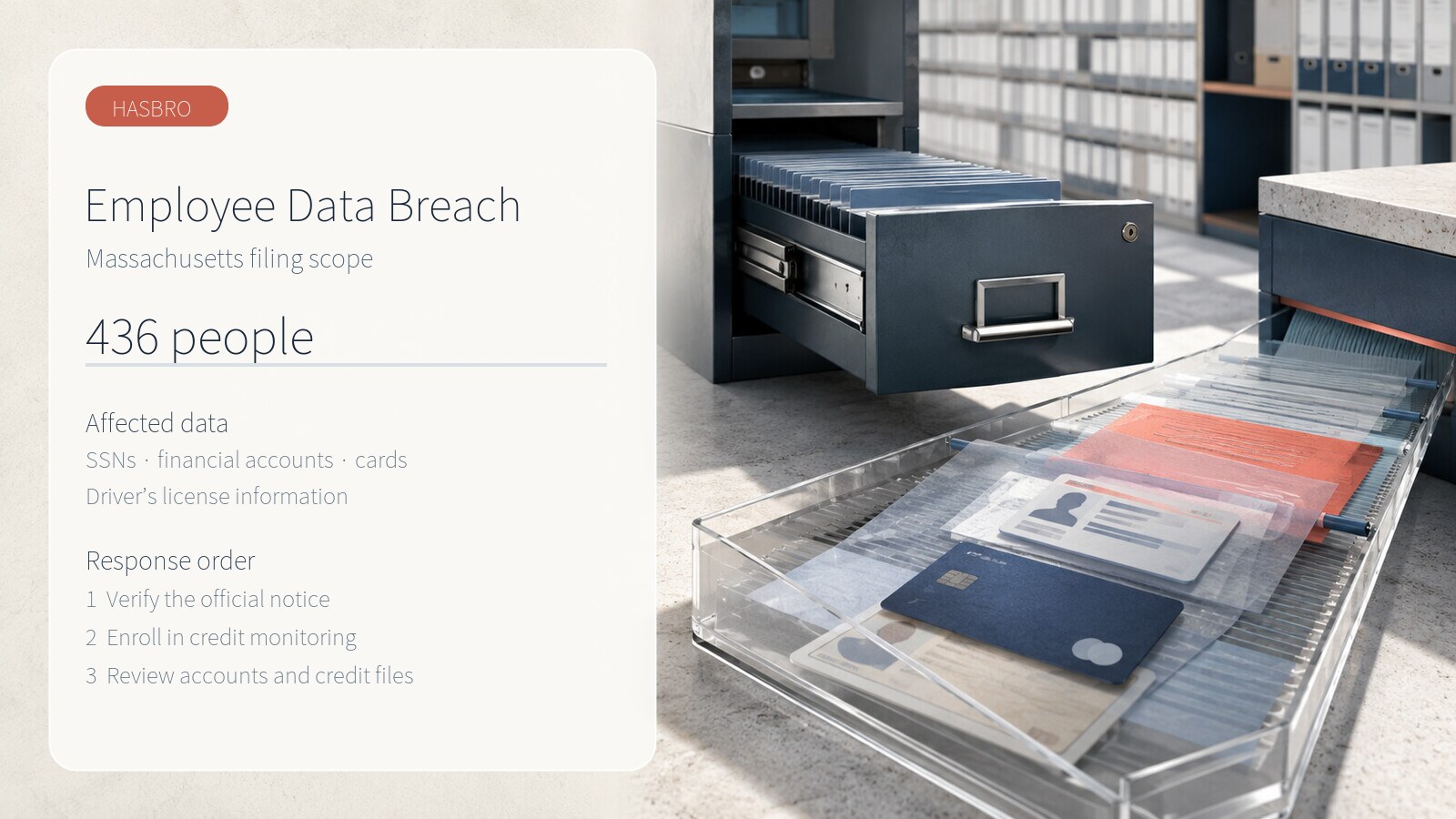
The filing identifies Social Security numbers, financial-account information, credit or debit card information, and driver’s-license information. These data types require more than a password reset. Social Security and license data can be used in identity-verification abuse, while account and card data call for transaction monitoring and direct review with the relevant financial institution.
Recipients should verify the sender through an established company or HR contact before following links in a message. If the official notice offers credit monitoring, review the enrollment deadline and coverage, then examine credit files, bank accounts, and card transactions together. Unexpected credit inquiries, address changes, or account-recovery alerts should be checked directly with the organization that generated them.
For the response team, notification tracking and technical forensics should remain connected but separately managed. Track who was notified, what protection was offered, and which inquiries remain open. Maintain account, endpoint, and network evidence in the incident record. Completion should be measured against each affected data category rather than a single company-wide password reset.
JFrog Artifactory authentication bypass
JFrog published CVE-2026-82329 on August 28 and rated it Critical. Under the default configuration, an unauthenticated attacker with network access may exploit the authentication weakness to obtain administrative privileges. Because Artifactory stores software packages and build outputs, administrative access can affect repository configuration, credentials, and the trusted path between build and deployment systems.
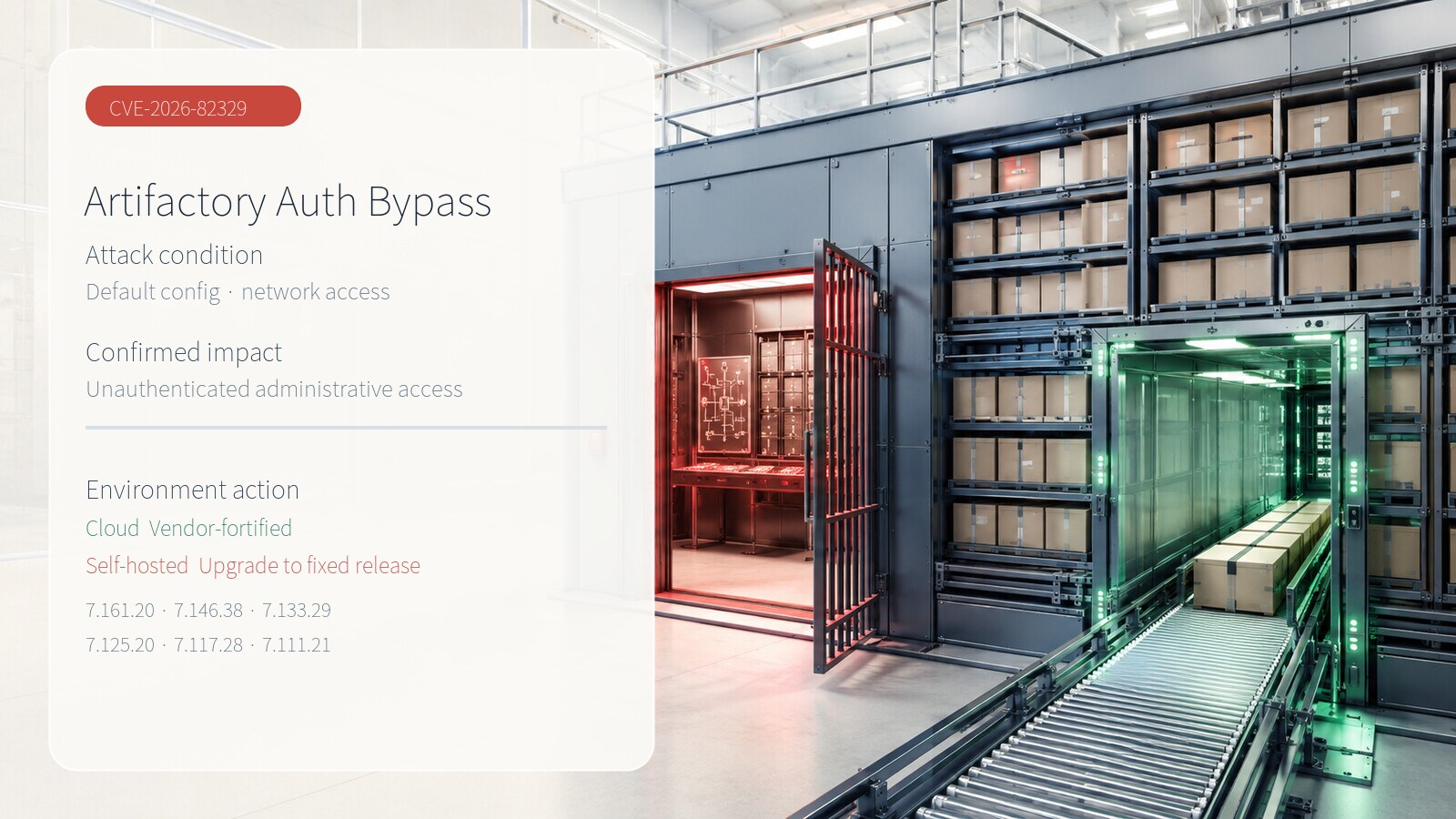
JFrog lists fixed releases across several maintenance branches: 7.161.20, 7.146.38, 7.133.29, 7.125.20, 7.117.28, and 7.111.21. Operators should match the installed branch against the vendor table instead of selecting a version solely by its highest number. In high-availability deployments, verify that every node reaches the intended version.
Deployment type changes the response. JFrog says affected cloud environments have already been fortified, while self-hosted environments should upgrade to the fixed release for their branch. Asset inventories should therefore separate SaaS from self-hosted instances, then record version, exposure path, and who can reach the administrative interface. Broadly reachable or internet-facing management services deserve an accelerated change window.
Validation should go beyond confirming that the service starts. Back up configuration and repository metadata, perform the upgrade, then review node health, administrator accounts, newly issued tokens and keys, and recent permission changes. Include credentials used by build and deployment pipelines. Unexpected administrator creation, privilege escalation, bulk downloads, or repository-policy changes should be reconciled against authorized work.
This vulnerability is also being handed to the standalone CVE workflow. The immediate briefing action remains straightforward: confirm the provider’s protection for cloud use, or upgrade self-hosted systems to the fixed branch release and review privileged activity and repository changes.
QTFY: correcting targets and confirmed victims
On August 28, the U.S. Department of Justice edited its QScan and QTRouter release to reflect the allegations in the supporting affidavit more accurately. The revised text identifies NASA, the Federal Reserve, the U.S. Senate, and other organizations as targets of QTFY. It no longer presents every named organization as a confirmed victim. This is a material evidence correction, not a cosmetic wording change.
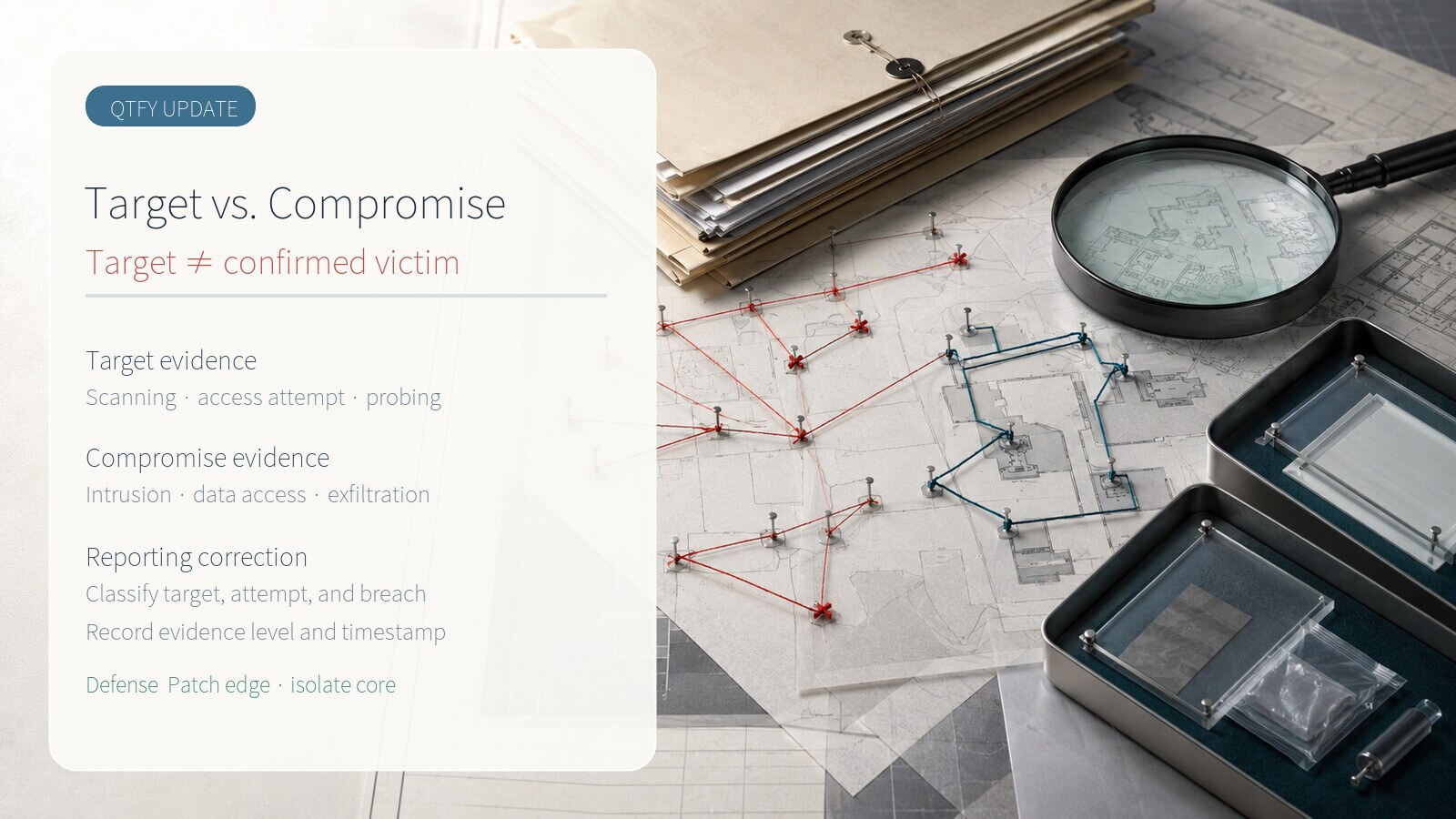
The correction does not reduce the need for defensive action. QScan was described as a large-scale scanning and exploitation system, while QTRouter used compromised IoT devices and proxies to conceal the source of malicious traffic. Reporting must still separate scanning, failed access, exploitation artifacts, credential theft, lateral movement, data access, and exfiltration. Being targeted justifies defensive attention; declaring a breach requires additional evidence.
Organizations that reused the August 27 public release should update internal reports. Search headlines and summaries for named agencies described as breached, then reclassify them as targeted, attempted, or confirmed compromised according to the affidavit and revised release. Attach an observation date and evidence source to each claim so later changes can be traced without rewriting the entire assessment.
Action priorities
- Hasbro notice recipients should verify the official sender and begin credit, account, and transaction monitoring.
- Artifactory operators should separate cloud from self-hosted deployments and upgrade self-hosted branches to the vendor’s fixed releases.
- QTFY reporting should classify targeting, attempted access, and confirmed compromise separately with source and timestamp.
The shared lesson is that a one-line cyber headline does not produce a reliable response. A data notification leads to identity and financial controls, a product vulnerability leads to versioned change management, and an intelligence correction leads to evidence and document-quality controls. Assign owners and define completion separately for each track.
Sources reviewed
- 2026-1427 — Hasbro, Inc. Data Breach NotificationMassachusetts Attorney General · Official source
- JFrog Security Advisories — CVE-2026-82329JFrog · Official source
- Justice Department and FBI Seize Platforms Operated and Used by China State-Sponsored Hackers to Target U.S. Critical InfrastructureU.S. Department of Justice · Official source
SECUFOCUS NOW reorganized and analyzed the material above. This article does not replace the original sources.
Related SecuNote articles
September 2 Security Briefing: Virtualizor, Langflow, and JFrog Attacks
A practical review of the Virtualizor BGP hijack and newly observed exploitation of Langflow and JFrog Artifactory, with response…
August 27 Security Briefing: QTFY, Ubiquiti, and Chrome 152
A practical review of the QTFY QScan/QTRouter disruption, three CVSS 10.0 Ubiquiti flaws, and the Chrome 152 security rollout…
September 1 Security Briefing: PaperCut KEV, Rails Exploitation, and Fraudulent Hiring
This briefing covers the new KEV priority for two PaperCut flaws, observed exploitation of Ruby on Rails CVE-2026-66066, and…
Comments
No comments yet.