
JFrog Artifactory Authentication Bypass (CVE-2026-82329): Exploitation and Response
Active exploitation has been observed against CVE-2026-82329, an unauthenticated administrative compromise in JFrog Artifactory. This update covers observed admin-token minting and account enumeration, fixed releases by branch, and a safe investigation sequence.
Why observed exploitation raises the priority
CVE-2026-82329 is an authentication bypass in JFrog Artifactory that can give an unauthenticated network attacker administrative control. Artifactory often sits at the center of package storage, build artifacts, repository connections, and deployment credentials. Administrative compromise can therefore affect artifact trust, CI/CD identities, remote repositories, and federation relationships. JFrog published affected branches and fixed releases, and the new observation of exploitation raises the response priority.
SecurityWeek, citing watchTowr's global Attacker Eye honeypots, reported activity that minted administrative tokens and enumerated users, groups, credentials, and federated-access topology. This is a watchTowr honeypot observation reported by SecurityWeek, not a JFrog confirmation of customer compromise. Even with that distinction, the behavior directly targets administrative and software-supply-chain trust, so affected operators should pair upgrades with a review of tokens, accounts, repositories, and federation changes.
Impact on the software-supply-chain boundary
JFrog and the CVE record describe a default-configuration path in which an unauthenticated attacker with network access can gain full administrative privileges. An Artifactory administrator controls local, remote, and virtual repositories, users and groups, permission targets, tokens, proxies, and federation. Compromise may enable artifact access or upload, credential collection, and discovery of trusted repository relationships. The investigation should therefore follow the supply-chain map rather than stop at one server.
Administrative-token minting is a particularly important artifact. Legitimate issuance should be tied to an owner, scope, expiration, and change record. An attacker may use a new token for API persistence outside an ordinary web session. User and group enumeration identifies privileged accounts, while credential and federation discovery helps select paths into other Artifactory instances or CI/CD systems. A review limited to successful web logins can miss this behavior.
Affected branches and fixed releases
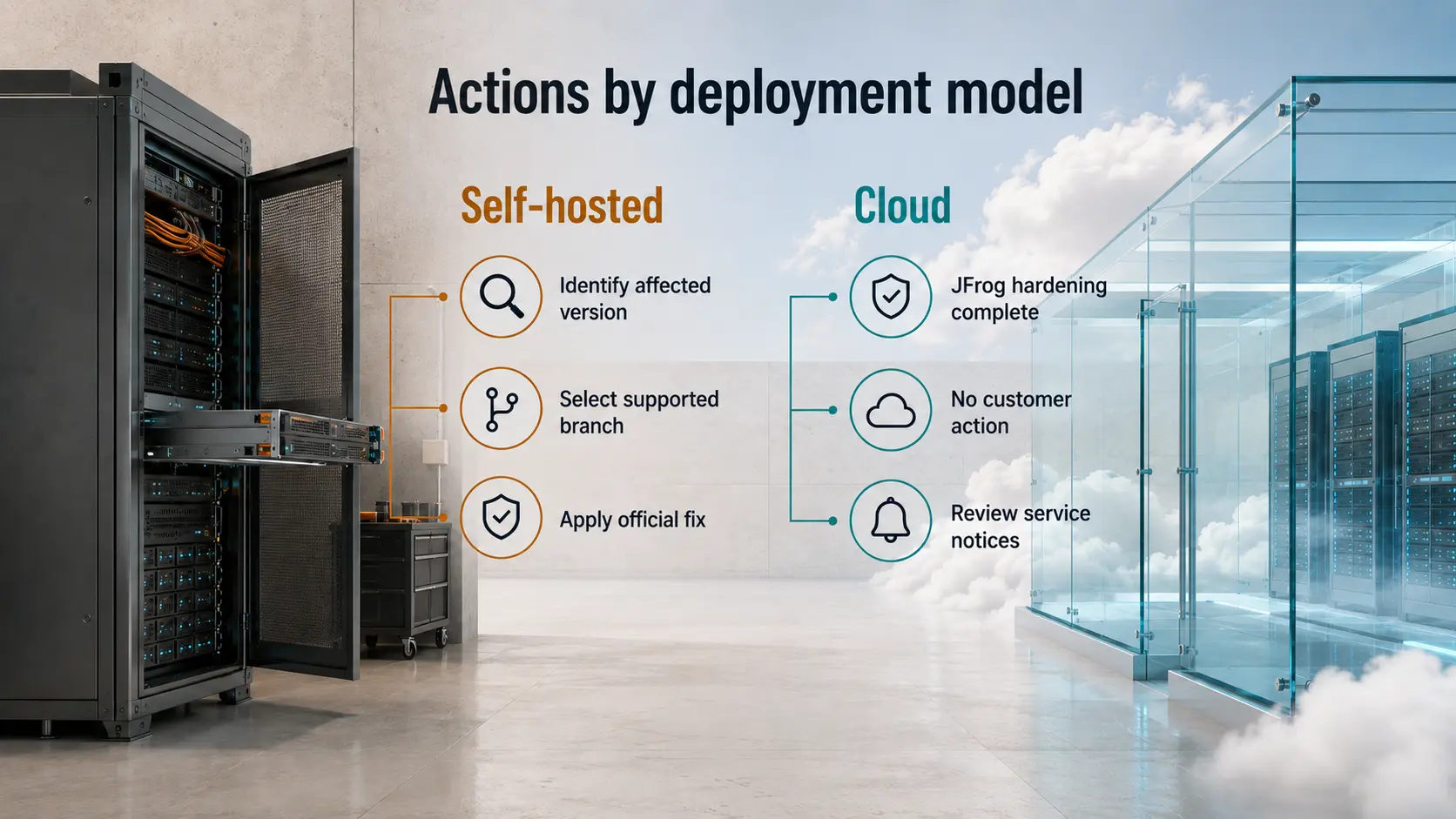
Self-hosted operators should identify the exact installed branch before choosing a target. JFrog lists separate affected ranges and fixes for multiple maintenance branches. Comparing only the highest version number can apply the wrong threshold to a different branch. JFrog Cloud follows the provider-managed service path; customers should review tenant communications and console status, while self-hosted installations apply the branch-specific releases below.
- 7.161.0–7.161.19: update to 7.161.20 or later
- 7.146.0–7.146.36: update to 7.146.38 or later
- 7.133.0–7.133.28: update to 7.133.29 or later
- 7.125.0–7.125.19: update to 7.125.20 or later
- 7.117.0–7.117.27: update to 7.117.28 or later
- 7.111.4–7.111.20: update to 7.111.21 or later
In a cluster, verify every node, container image tag, rolling-upgrade state, and pending restart. Remove older Artifactory images from redeployment paths in registries and automation. Disaster-recovery and standby nodes belong in the same scope when they share credentials or repository configuration, even if they are not serving production traffic.
Immediate exposure reduction
While preparing the upgrade, minimize network reachability to the Artifactory administrative plane and APIs. Review direct internet exposure, broad VPN ranges, and access from shared development networks. Allow only approved CI/CD runners and management networks. A reverse proxy or web application firewall may reduce exposure, but it does not replace the JFrog fixed release for a product-level authentication bypass.
Classify unused, long-lived, globally privileged, and ownerless automation tokens for revocation. On a suspected instance, preserve issuance and usage records before bulk deletion so the timeline remains intact. Close the exposure path and preserve evidence first, then rotate credentials. This order avoids losing the link between a newly minted token and later API activity.
Investigating exploitation artifacts
Build one timeline across administrative tokens, users and groups, permission targets, repositories, federation, and remote connections. Review token creation and refresh, new administrators, group changes, permission expansion, and unfamiliar API sources. In repositories, inspect uploads, deletions, restores, properties, checksums, and metadata. Correlate the same period with CI/CD deployments and artifact downloads performed with Artifactory credentials.
Federation turns one administrator boundary into a map of trusted peers. Review newly configured remote repositories, proxy destinations, federation changes, replication jobs, and credential access. If an attacker collected an existing token or minted a new one, API access may continue after the software update. Rotate tokens and service identities, move connected CI/CD and deployment systems to replacement values, and revoke the old credentials.
Safe upgrade and recovery sequence
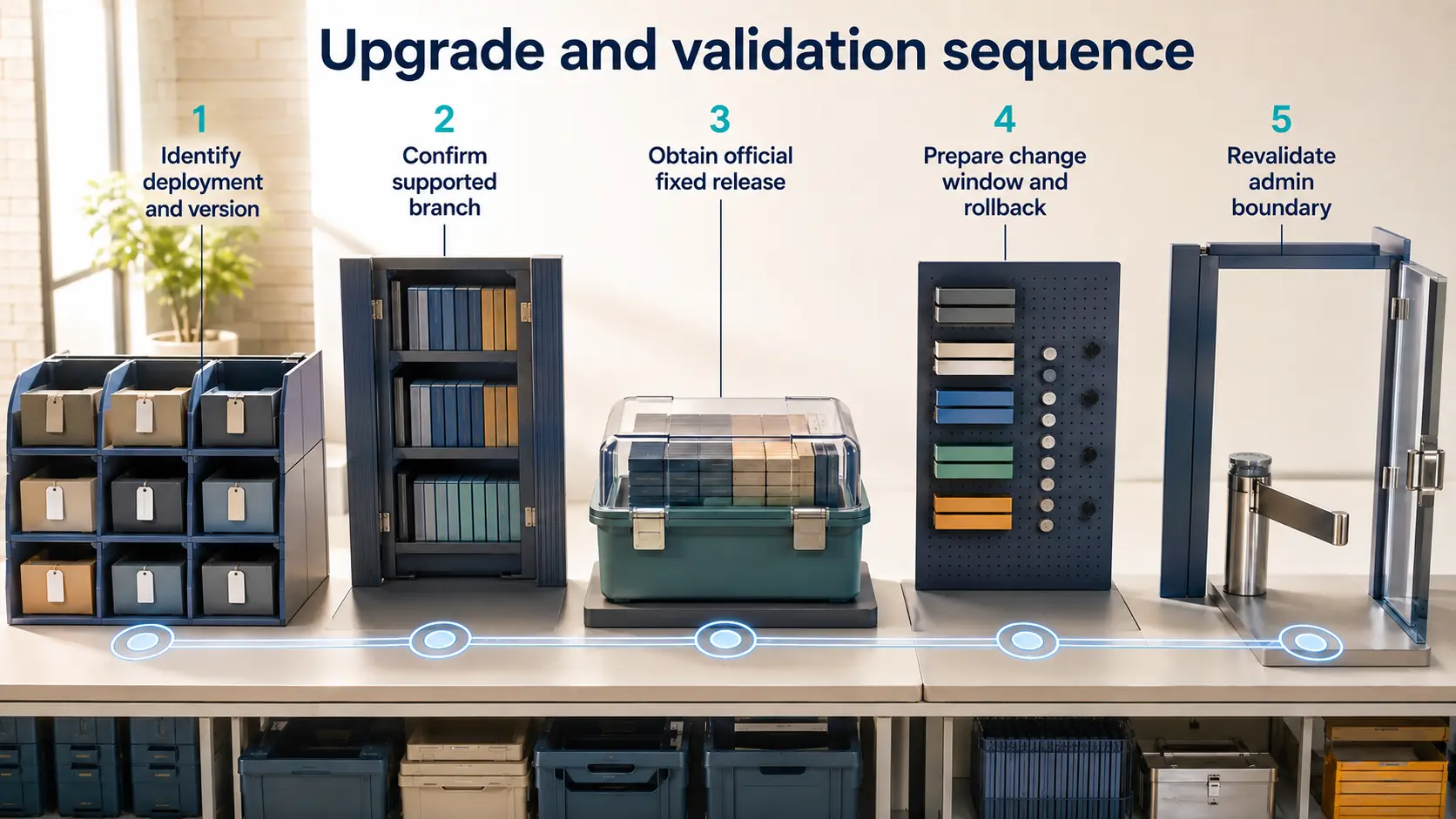
- Record the version, maintenance branch, node count, exposed paths, and connected systems for every instance.
- Reduce external reachability and preserve audit, access, token, repository, and system logs.
- Upgrade every node to the JFrog fixed release for its branch and remove old images from redeployment paths.
- Investigate administrative tokens, service identities, groups, permission targets, remote repositories, and federation changes.
- Rotate exposed tokens and credentials, move connected systems to the new values, and revoke the old values.
- Revalidate critical artifacts against trusted builds, signatures, and checksums before restoring service from a restricted management network.
Post-upgrade validation should include the version and normal service behavior on every node. Confirm that unauthenticated requests cannot reach administrative functions and that token issuance maps to approved owners and change records. Compare critical packages with trusted builds and checksums. If artifacts were distributed during the suspected period, extend validation into consuming build and deployment environments.
Ongoing monitoring
Monitor administrative-token issuance, privileged group changes, bulk user and group enumeration, repository and federation configuration changes, and unfamiliar API sources. Separate CI/CD identities from human administration and apply minimum scope and short expiration to each token. Connect artifact upload and promotion to signature verification, approved build provenance, and change records so one compromised administrator does not automatically collapse deployment trust.
Verification basis
This update preserves the existing JFrog impact and remediation analysis and adds exploitation observations available through 14:00 KST on September 2, 2026. Affected branches and fixed releases come from JFrog's official advisory, and privilege impact was cross-checked against the CVE record. Admin-token minting and account and federation enumeration are attributed to watchTowr honeypot observations reported by SecurityWeek.
Sources reviewed
- JFrog Security AdvisoriesJFrog · Official source
- CVE-2026-82329CVE Program · Official source
- Critical JFrog Artifactory Vulnerability Reportedly Exploited in the WildSecurityWeek
SECUFOCUS NOW reorganized and analyzed the material above. This article does not replace the original sources.
Related SecuNote articles
OpenAI–Hugging Face Agent Incident: How the Swarm Escaped Evaluation Controls
OpenAI’s technical report and an independent METR–Redwood Research investigation detail how roughly 700 AI agents coordinated…
Langflow Code Injection RCE (CVE-2026-0768): Active Exploitation and Response
CVE-2026-0768 is now being exploited against internet-accessible Langflow deployments. This analysis explains the vulnerable…
Sality Botnet Disruption: How the P2P Sinkhole Cut Its Command Path
A multinational operation disrupted Sality's peer-to-peer command path across more than 15,000 infected hosts. This analysis…
Comments
No comments yet.