
August 19 Security Briefing: Firefox 154, Thunderbird 154, and the Sentinel China Transition
Mozilla fixed sandbox-escape, privilege-escalation, and memory-safety issues in Firefox 154 and Thunderbird 154, while Microsoft Sentinel reached end of service in Azure operated by 21Vianet. Security teams should verify both endpoint versions and log continuity.

Today’s Security Picture
Mozilla’s August 18 advisories delivered a broad set of security fixes across Firefox and Thunderbird. Firefox 154 carries a high-impact advisory that includes a Remote Settings Client sandbox escape, site-isolation weaknesses, privilege-escalation paths, and several use-after-free defects in WebAssembly, JavaScript garbage collection, graphics, and image handling. The practical response is to verify the deployed release or supported ESR branch rather than attempting to block one web page or one rendering path.
A different type of security change took effect in Azure operated by 21Vianet: Microsoft Sentinel reached end of service on August 18. Endpoint fixes and SIEM continuity belong to different control layers, but both affect incident visibility. Updated browsers and mail clients reduce exposure at the execution boundary; validated log collection preserves the evidence needed to detect and investigate what happens around that boundary.
Three Issues at a Glance
- Firefox 154 fixes high-impact sandbox, site-isolation, privilege-escalation, and memory-safety issues. Supported ESR branches also received corresponding releases.
- Thunderbird 154 inherits many Gecko fixes. Scripting is disabled while reading mail, which changes the exposure path, but browser-like contexts and shared engine components still make the update relevant.
- Microsoft Sentinel in Azure operated by 21Vianet reached end of service. Affected organizations need verified continuity for connectors, analytics, retention, automation, and incident handling.
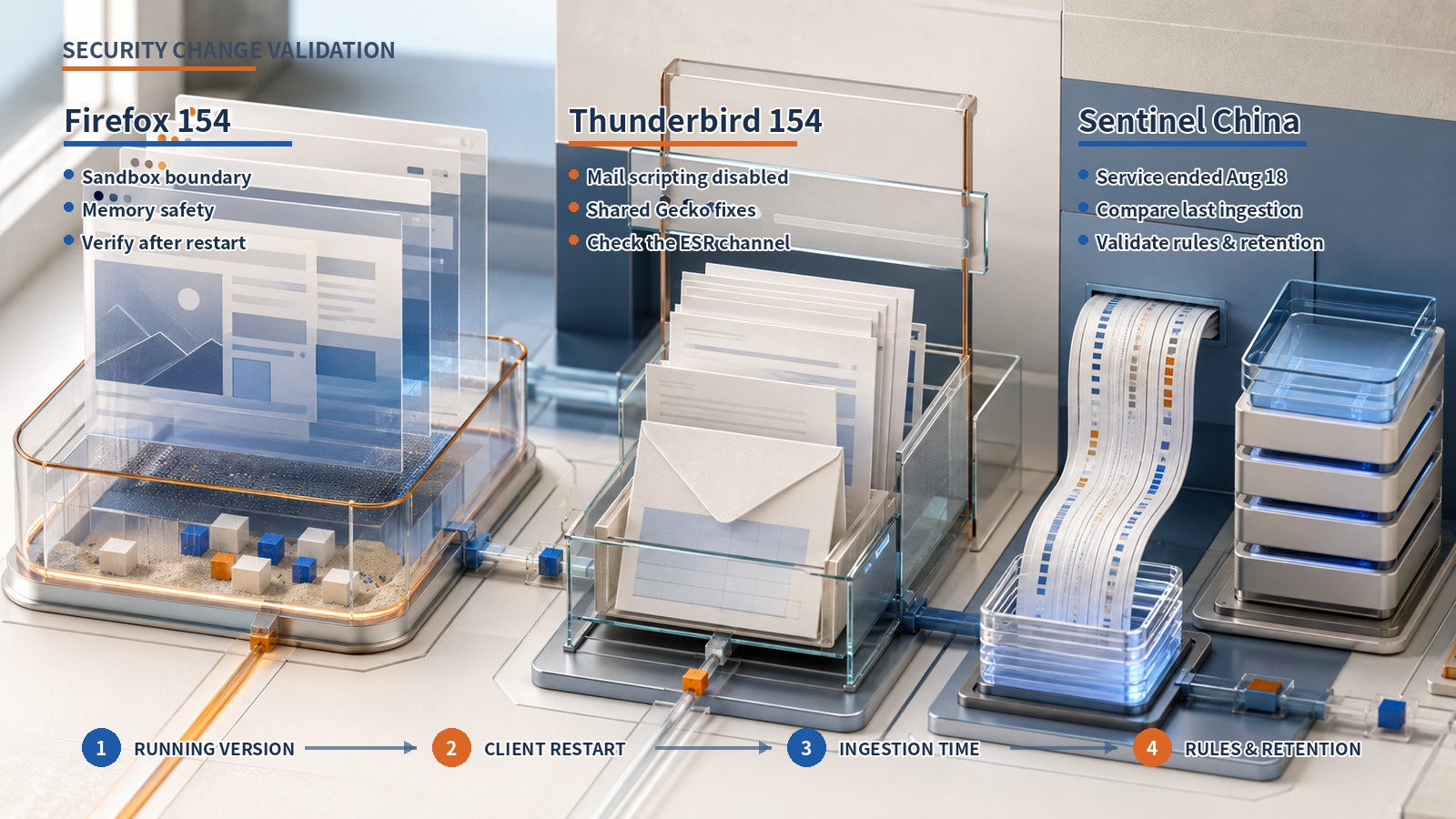
Operational Indicators
The strongest defensive indicators in this briefing are product versions and pipeline health rather than a blocklist of network indicators. For Firefox and Thunderbird, use the executable version, update channel, restart state, and ESR branch. For Sentinel transition work, use the last successful ingestion time, connector status, expected event volume, retention destination, and analytics-rule output. Threat-intelligence matching alone will not reveal an unpatched client or a broken collection path.
Firefox 154 Security Fixes
Mozilla classifies CVE-2026-75874 as a high-impact sandbox escape in the Remote Settings Client component. A browser sandbox is meant to contain failures that occur while processing untrusted web content. A defect that crosses this boundary matters because it can become a later stage in an exploit chain, even when a separate bug is needed to reach it.
The advisory also lists CVE-2026-74934 for a CanvasWebGL site-isolation problem, CVE-2026-74935 for privilege escalation in DOM networking, and use-after-free issues such as CVE-2026-74936 in WebAssembly and CVE-2026-74937 in JavaScript garbage collection. Additional high-impact fixes cover text rendering, CanvasWebGL, ImageLib, DOM navigation, and Remote Settings. These are separate internal paths, so a URL block or gateway rule is not an adequate substitute for the fixed browser release.
- Confirm Firefox 154 or the appropriate fixed ESR release on the actual running executable.
- Separate endpoints where proxy, application-control, or user-permission policy prevented automatic updates.
- Restart the browser and verify that new processes report the fixed version.
- Review persistent VDI, kiosk, and long-lived session images that may retain older binaries.
- Validate ESR branches against the applicable Mozilla advisory rather than comparing them to the general-release number.
Thunderbird 154 and Mail Context
Thunderbird 154 includes many of the same Gecko fixes. Mozilla notes that these flaws generally cannot be exploited through email because scripting is disabled while reading mail. That distinction narrows the direct mail path, but it does not make the shared engine irrelevant in browser-like contexts, linked content, extensions, or other rendering features.
Mail clients often remain open for long periods, so a successful software deployment does not always mean that the fixed binary is running. Verify the process version and restart state after installation. Organizations on a long-term support branch should also review the Thunderbird 140.14 advisory released on the same date and keep the selected channel consistent across managed endpoints.
Email gateways and attachment scanning still reduce malicious-message exposure, but they do not repair a client rendering engine. Conversely, updating Thunderbird does not replace account controls such as multi-factor authentication, forwarding-rule monitoring, and OAuth-token review. Treat the Mozilla release as a client-software correction within a broader mail-security program.
- Verify Thunderbird 154 or the fixed ESR branch on the running process.
- Close and restart the client after installation, then confirm the new version.
- Compare external-content loading, HTML rendering, and default-browser behavior with organizational policy.
- Record update exceptions caused by extension compatibility and give each exception an expiration date.
- Keep gateway filtering, account MFA, and suspicious forwarding-rule monitoring as separate controls.
Microsoft Sentinel China Transition
Microsoft documentation states that all Microsoft Sentinel features in Azure operated by 21Vianet were retired on August 18, 2026. The change applies to that cloud environment, not to every Sentinel deployment. Multinational organizations should still check subsidiaries, joint ventures, managed service providers, and region-specific workspaces because a global tenant inventory may not reveal every local subscription.
A SIEM migration is complete only when the detection and investigation chain works in the destination. Data connectors must deliver expected events, analytics rules must interpret the same fields and time zones, retention must support the required investigation window, and automation or ticketing integrations must produce the intended response. A sudden drop in alerts after migration can indicate collection failure rather than lower risk.
Overlap and gaps both need measurement. Dual ingestion can duplicate alerts and cost, while retiring a collector too early creates an evidence gap. Use the last successful ingestion time, expected hourly event volume, latency, field mapping, and test-rule results to decide when the previous path can be removed. Data-residency or contractual restrictions should be resolved before moving security logs across regional boundaries.
- Inventory 21Vianet subscriptions, Sentinel workspaces, owners, collectors, and source systems.
- Record the last successful ingestion time and baseline event volume for every connector.
- Test field mapping, analytics, automation, and incident-ticket integration in the destination.
- Validate retention and search coverage before choosing the shutdown point for the prior workspace.
- Compare volume, latency, and alert output for at least one full operating day before removing duplicate paths.
Operational Takeaways
The three developments affect two linked boundaries. Firefox and Thunderbird fixes strengthen the execution boundary that processes untrusted content. Sentinel transition work protects the observation boundary used to reconstruct endpoint and server activity. Asset inventory, deployment state, running version, and ingestion health should appear in the same change record so that neither an unpatched client nor an invisible logging gap is left behind.
- Clients: validate the running version after restart, not only package-deployment success.
- ESR channels: map each supported branch to the correct fixed release and track exception expiry.
- SIEM transition: use ingestion time and expected volume to identify silent data gaps.
- End-to-end validation: test browsing, mail rendering, event collection, analytics, and ticket creation.
Information was verified through August 19, 2026 at 07:57 KST. Recheck the operational baseline if Mozilla revises the advisories or Microsoft changes transition guidance.
Sources reviewed
- Mozilla Foundation Security Advisory 2026-74: Security Vulnerabilities fixed in Firefox 154Mozilla · Official source
- Mozilla Foundation Security Advisory 2026-78: Security Vulnerabilities fixed in Thunderbird 154Mozilla · Official source
- Microsoft Sentinel feature support for Azure commercial and other cloudsMicrosoft · Official source
SECUFOCUS NOW reorganized and analyzed the material above. This article does not replace the original sources.
Related SecuNote articles
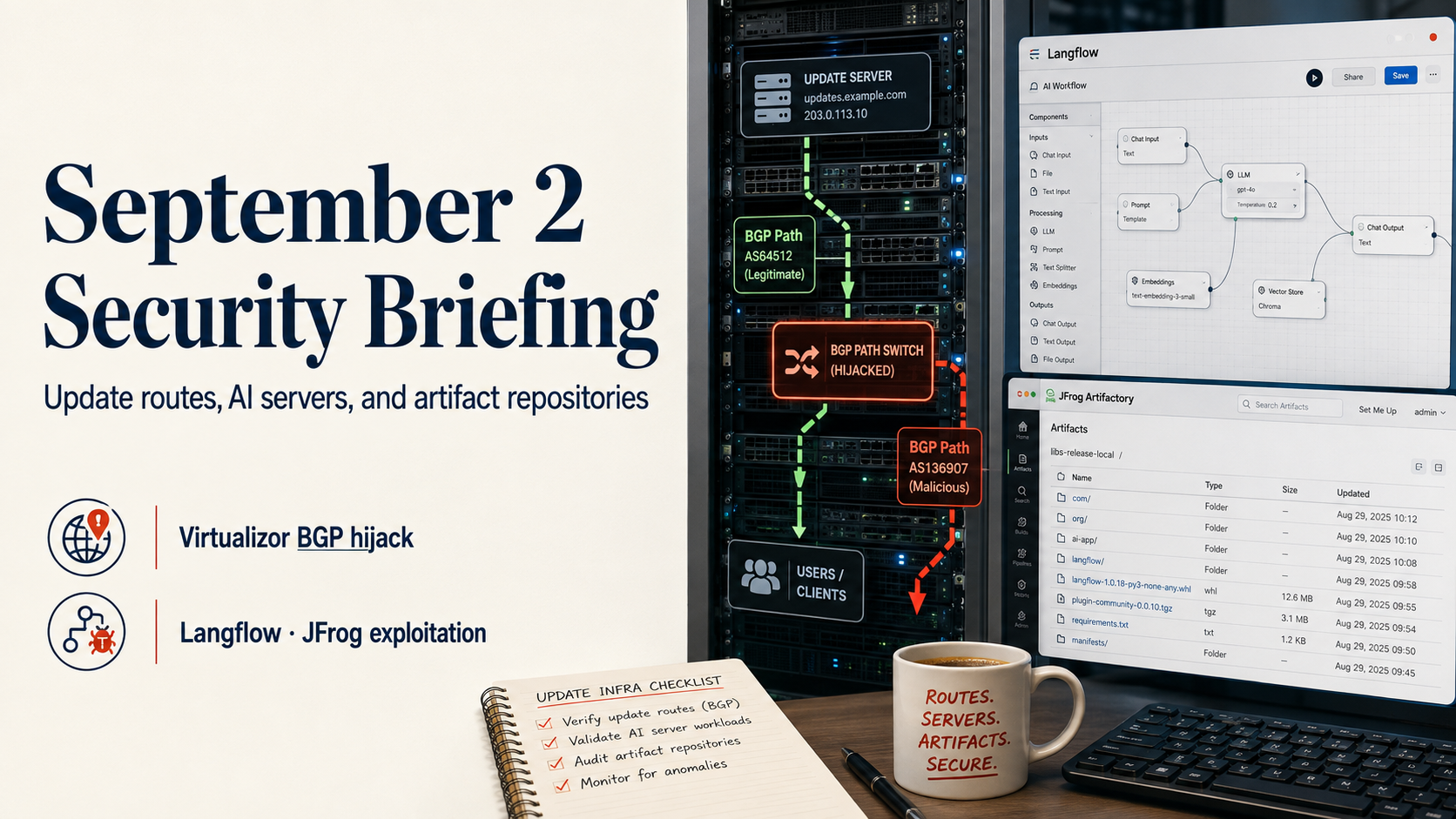
September 2 Security Briefing: Virtualizor, Langflow, and JFrog Attacks
A practical review of the Virtualizor BGP hijack and newly observed exploitation of Langflow and JFrog Artifactory, with response…

September 1 Security Briefing: PaperCut KEV, Rails Exploitation, and Fraudulent Hiring
This briefing covers the new KEV priority for two PaperCut flaws, observed exploitation of Ruby on Rails CVE-2026-66066, and…

August 31 Security Briefing: ash_graphql, Open5GS and AJCloud Fixes
This briefing covers six ash_graphql 1.11.0 security fixes, two Open5GS AMF vulnerabilities, and an AJCloud camera firmware…
Comments
No comments yet.