
August 28 Security Briefing: TeamPCP Arrests, HD Hyundai Findings, and Gitea RCE
This briefing covers the TeamPCP open-source supply-chain case, the confirmed breach path in an HD Hyundai Group investigation, and urgent remediation for Gitea CVE-2026-60004.

Today’s Security Picture
Today’s three developments begin in different places but converge on the same operational question: how far can trust travel from a software component, a management server, or a self-hosted development platform? The TeamPCP case shows how a compromised open-source component can move through ordinary development workflows. The HD Hyundai Group findings show how an exposed management server and an unnecessary internal network path can become one breach chain. KISA’s Gitea advisory shows why service-account privileges and development secrets must be considered when triaging a code-execution flaw.
The immediate priorities are to trace component provenance, review file-upload and network trust boundaries, identify affected Gitea versions, and preserve evidence before rotating credentials. Patching one host is not enough when the host connects build systems, internal records, repositories, and automation secrets.
Issues at a Glance
- TeamPCP case: Australian authorities charged two men and alleged malicious modification of open-source components used across many organizations.
- HD Hyundai findings: an upload flaw, a web shell, and an unnecessary server-to-server path led to access to an internal business system.
- Gitea CVE-2026-60004: self-hosted versions from 1.17 up to but excluding 1.27.1 require the official security update.
Major Incidents
TeamPCP Open-Source Supply-Chain Case
On August 27, the Australian Federal Police announced charges against two Western Australian men alleged to be principal participants in TeamPCP. The operation involved the FBI and Western Australia Police. Authorities allege that malicious code was inserted into open-source components and then adopted by developers as seemingly legitimate dependencies, creating a route into government, academic, and private-sector environments. These statements describe law-enforcement allegations that remain subject to court proceedings.
Authorities estimated potential exposure across more than 1,000 organizations, more than 500,000 credentials, and at least 300GB of data, with remediation costs potentially reaching hundreds of millions of dollars worldwide. Organizations should treat those figures as investigative estimates and determine their own exposure from repository, artifact, and build records.
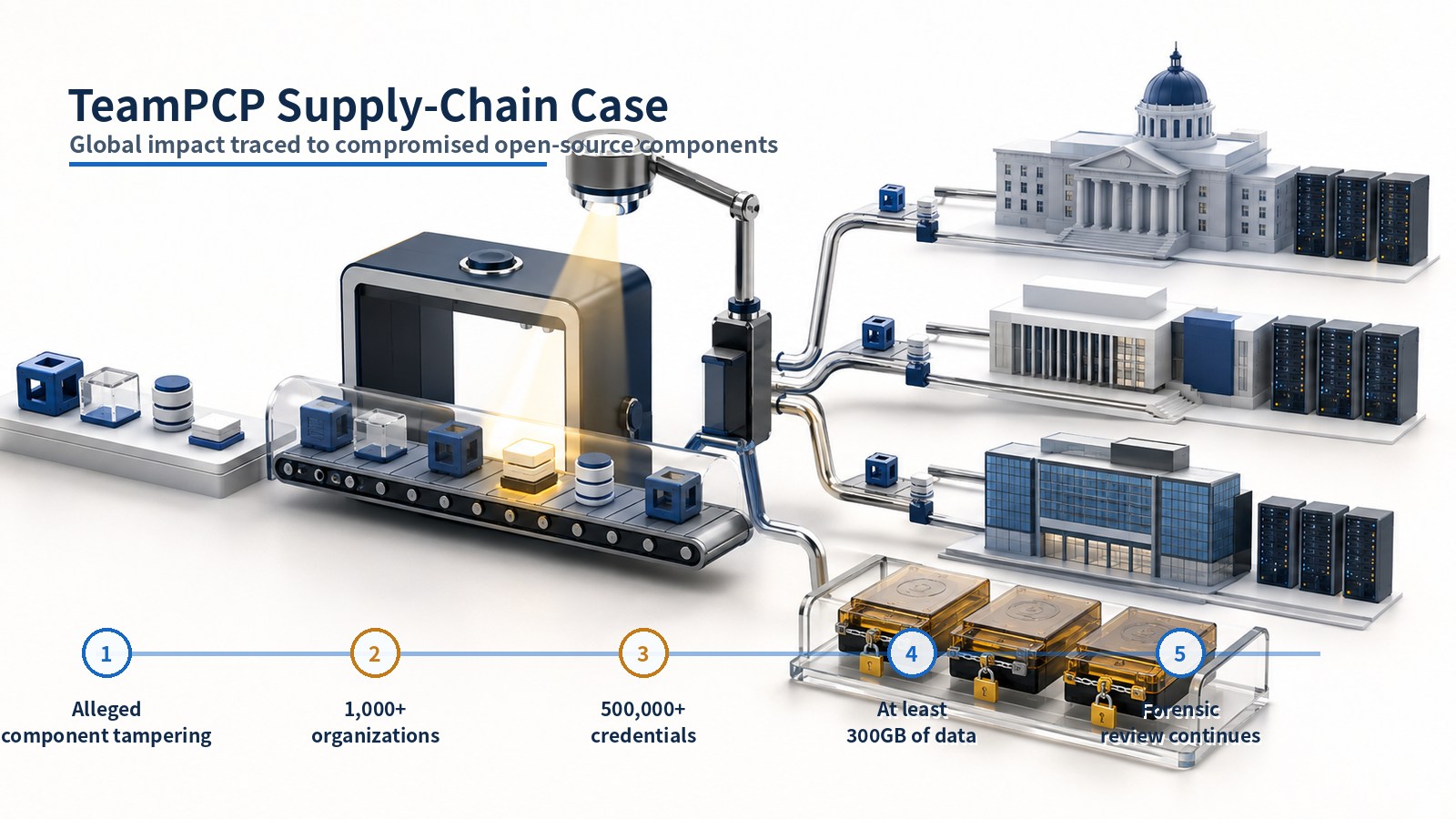
Start by reconciling software bills of materials, lockfiles, internal artifact repositories, and container images. Record the source, signature, hash, and acquisition date for external components. Preserve CI/CD logs and snapshots before rotating build tokens, cloud keys, or repository credentials, then prioritize credentials that were reachable from suspicious jobs or components. Arrests do not remove dependencies already embedded in cached packages, historical images, or deployed releases.
A useful investigation timeline links dependency additions, package-install events, build scripts, repository activity, and unusual outbound connections. The goal is not only to find a named package; it is to establish what a trusted build path could access and what it produced.
HD Hyundai Group Breach Path and Sanctions
South Korea’s Personal Information Protection Commission announced sanctions on August 27 following its investigation of HD Hyundai Construction Equipment and HD Korea Shipbuilding & Offshore Engineering. The investigation found that an attacker exploited a file-upload weakness in a mobile-device-management server in March 2024 and uploaded a web shell. Unnecessary communication between that server and an internal business system then enabled further access. Names, employee numbers, and other personal data relating to 9,503 employees and contractor personnel were exposed.
PIPC imposed a KRW 73.5 million penalty on HD Hyundai Construction Equipment and a KRW 4.8 million administrative fine on HD Korea Shipbuilding & Offshore Engineering. The operational lesson is the combination of two controls: upload handling failed at an internet-facing management server, while an overly broad trust path allowed the compromise to reach internal records.
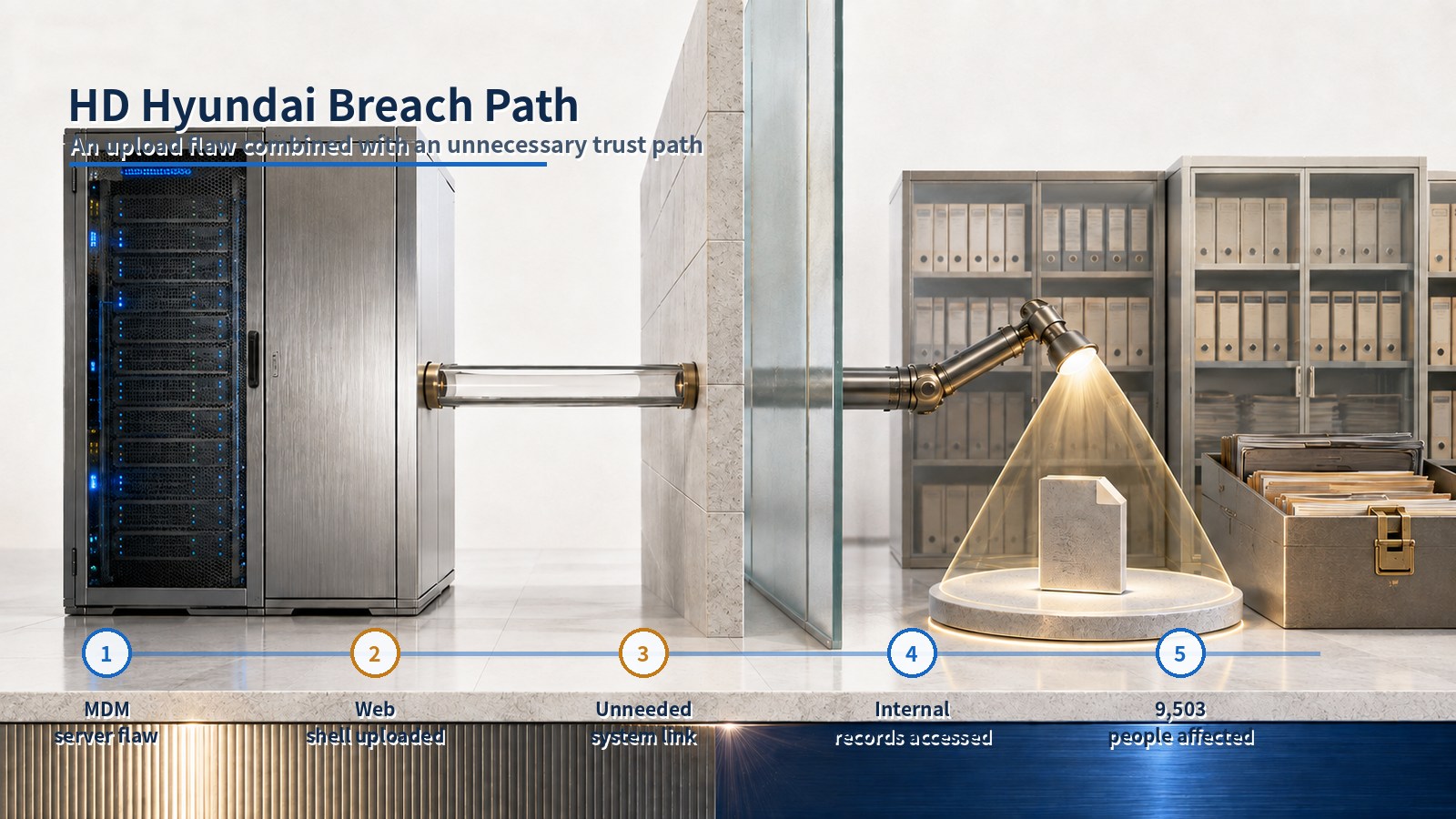
Organizations with similar architectures should inventory MDM, patch-management, file-transfer, and remote-support servers that bridge external and internal networks. For each system, document exposure, upload functions, destinations, ports, and service-account privileges. Uploaded content should be stored outside executable web paths with strict content validation and least-privilege process permissions. Network rules should name exact sources, destinations, ports, and owners rather than rely on broad business-need descriptions.
Preserve web requests, newly created or modified files, process execution, and connections from management servers to internal applications. Then compare record-access and export activity in systems holding employee or contractor data. After remediation, verify that uploaded content cannot execute, that only approved management flows can reach internal systems, and that service accounts can access only the records they need.
New High-Priority CVE
Gitea CVE-2026-60004 Remote Code Execution
KISA published a Gitea security-update advisory on August 27. CVE-2026-60004 is a code-injection issue in the diffpatch API that can lead to Git hook installation and remote command execution as the Gitea service account. Versions 1.17 and later but earlier than 1.27.1 are affected; the issue is fixed in Gitea 1.27.1 and later official releases.
The documented path requires an authenticated user who can create a repository, but open registration can lower that barrier by allowing a visitor to create a regular account. Code execution under the service account can expose repositories, configuration files, environment variables, database credentials, OAuth secrets, and automation tokens. Internet-facing self-hosted instances and multi-team servers should be triaged first.
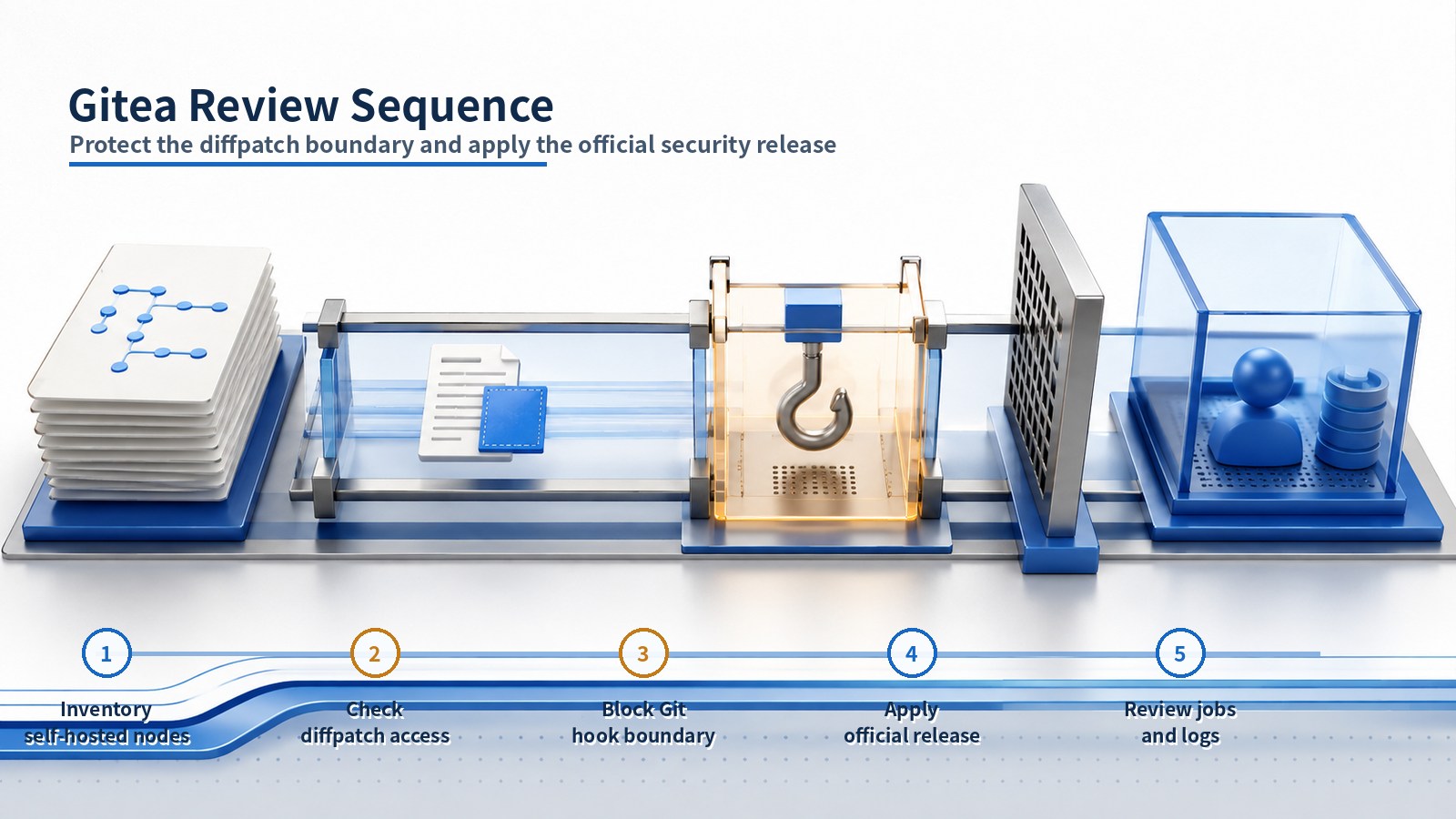
Confirm the deployed version and external exposure of every instance, then apply Gitea 1.27.1 or a later official security release through the normal change process. Restricting open registration or filtering the affected route may reduce pre-patch exposure, but it does not replace the update. Source-built deployments must be checked by the version and commit actually running in production.
After updating, review account and repository creation, unusual diffpatch requests, unexpected Git hooks, automation jobs, and child processes started by the Gitea service. Preserve configuration and repository metadata before rotating secrets reachable by that account. Tighten registration, repository-creation policy, and automation-token scope after the immediate response.
KISA Advisory
KISA’s advisory gives Korean operators a clear affected-version range and fixed release for self-hosted Gitea. Development, infrastructure, and security teams should reconcile one shared instance inventory and record the installed version, update time, and post-update log review. Managed systems operated by vendors should be covered by the same evidence trail.
Operational Priorities
- Assign owners and confirm exposure for software components, management servers, and Gitea instances.
- Map trust paths from external input to internal systems, build workers, and service accounts.
- Preserve repository, web, process, network, and automation logs before changing credentials.
- Apply Gitea 1.27.1 or later and remove unnecessary management-server communication through change control.
- Validate versions, network paths, account permissions, and build-artifact integrity after the change.
Across all three issues, the direction of trust matters more than the size of a single host. Components lead into build systems, management servers lead into internal applications, and Gitea service accounts lead into code and automation secrets. Effective remediation follows that full path. This briefing reflects public information available through 07:59 KST on August 28, 2026.
Sources reviewed
- Two WA men charged following AFP, FBI, WAPF disruption of alleged global cybercrime syndicateAustralian Federal Police release mirror — National Tribune
- 개인정보위, HD현대그룹 개인정보 유출사고 조사 결과 발표개인정보보호위원회 · Official source
- Gitea 제품 보안 업데이트 권고한국인터넷진흥원 · Official source
SECUFOCUS NOW reorganized and analyzed the material above. This article does not replace the original sources.
Related SecuNote articles
September 2 Security Briefing: Virtualizor, Langflow, and JFrog Attacks
A practical review of the Virtualizor BGP hijack and newly observed exploitation of Langflow and JFrog Artifactory, with response…

September 1 Security Briefing: PaperCut KEV, Rails Exploitation, and Fraudulent Hiring
This briefing covers the new KEV priority for two PaperCut flaws, observed exploitation of Ruby on Rails CVE-2026-66066, and…
August 31 Security Briefing: ash_graphql, Open5GS and AJCloud Fixes
This briefing covers six ash_graphql 1.11.0 security fixes, two Open5GS AMF vulnerabilities, and an AJCloud camera firmware…
Comments
No comments yet.