
August 21 Security Briefing: Frauscher FDS, rtMedia, and Flatastic
A practical review of eight Frauscher FDS102 flaws, rtMedia SQL injection, and Flatastic PHP object injection, with affected versions and operational response priorities.

Why these three issues belong in one briefing
The advisories published on August 20 concern very different environments. Frauscher FDS102 supports railway diagnostics and exposes a web management interface, while rtMedia and Flatastic are WordPress components. The operational questions are nevertheless similar: can a management or application endpoint be reached from an unnecessarily broad network, can an unauthenticated or low-privileged request reach a sensitive function, and were old sessions and server artifacts handled after remediation?
CVSS values alone do not express the priority. The FDS102 advisory groups eight flaws ranging from 4.3 to 9.8, but their combination matters. One path can expose plaintext session identifiers in downloadable logs, allow an administrative session to be hijacked, and then reach privileged functions. rtMedia and Flatastic both start from unauthenticated input, but one crosses a database-query boundary while the other crosses a PHP deserialization boundary. They therefore require component-specific checks rather than a generic “update WordPress” action.
Eight Frauscher FDS102 vulnerabilities
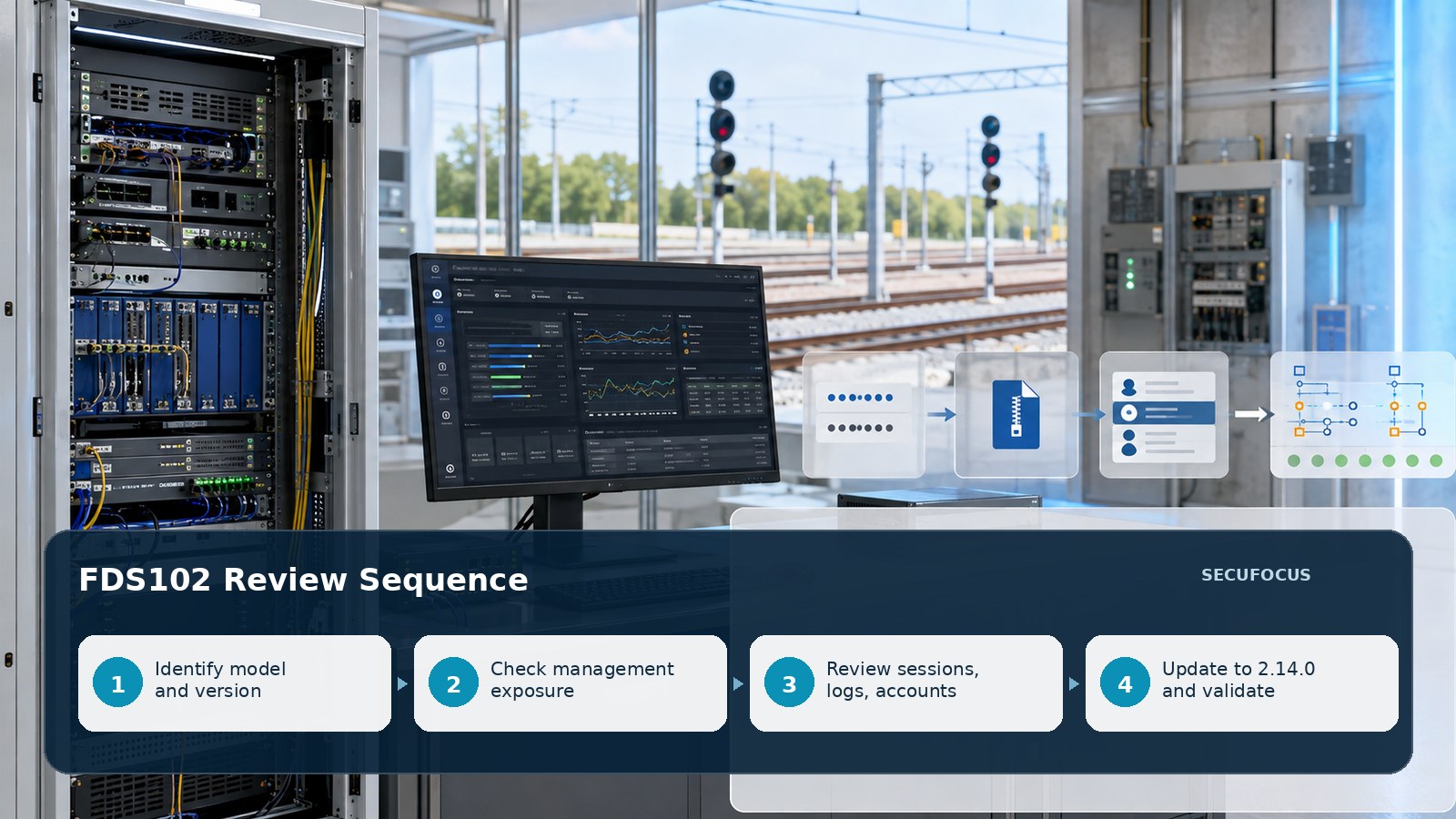
CERT@VDE advisory VDE-2026-078 describes eight flaws in the web interface and file, session, and authorization handling of Frauscher Sensortechnik FDS102 for FAdC/FAdCi R2. Versions 2.0.0 through 2.13.3 are affected, and the official remediation is FDS102 2.14.0. In a railway environment, the issue reaches beyond a conventional admin portal because the system may expose signaling and track-layout data while also affecting the integrity of diagnostic administration.
CVE-2026-14950, scored 9.8, allows an unauthenticated remote party that already possesses a valid session identifier to keep using it after the session should have expired. CVE-2026-14948 makes that condition more concrete: a low-privileged user can extract live plaintext session identifiers for authenticated users from downloadable error-log archives and hijack an active administrative session. Log-download permissions, session lifetime, and session invalidation therefore need to be reviewed together.
CVE-2026-14949 allows a low-privileged user to submit arbitrary role values to the user-creation function and create an account at the highest privilege level. CVE-2026-14953 exposes user enumeration and privilege levels, while CVE-2026-14951 is a CSRF issue that can cause an authenticated user to perform an unintended action through a malicious page. These findings show why server-side authorization and request-origin validation still matter after login.
The file-handling group includes CVE-2026-14946 and CVE-2026-14947. The first permits a high-privileged user to upload a PHP file and request it from the web path, leading to arbitrary code execution. The second uses path traversal in ZIP extraction to write outside the intended directory. Both require high privileges, but they become more consequential when combined with session hijacking or privilege creation. CVE-2026-14952 permits unauthenticated retrieval of backup and download files containing detailed railway signaling and track-layout information.
Response should go beyond a version check. Build an inventory of FDS102 assets and versions, then identify web interfaces reachable from the internet or an unnecessarily broad business network. CERT@VDE recommends limiting access to authorized personnel. Update to 2.14.0, invalidate administrative sessions issued before the change, and recheck access controls on error logs, backups, and download paths. Review user creation and privilege changes, and inspect upload and extraction paths for unexpected PHP files or external writes.
rtMedia SQL injection (CVE-2026-66592)
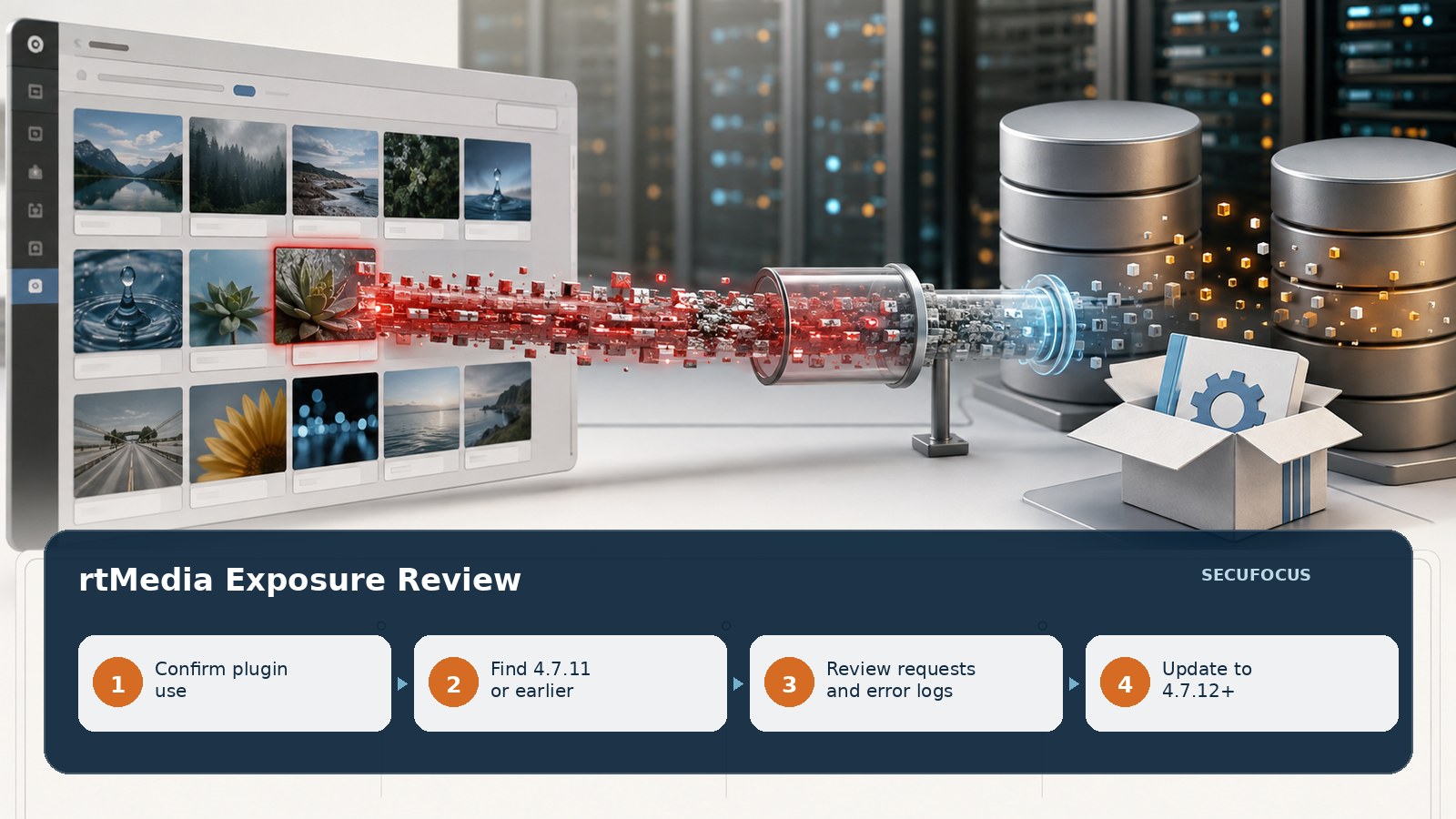
rtMedia for WordPress, BuddyPress and bbPress 4.7.11 and earlier contains an unauthenticated SQL injection flaw reachable through the media shortcode endpoint. The CVE record assigns CVSS 9.3 and CWE-89, and marks 4.7.12 as unaffected. Media-gallery functions are often reachable from public pages, so treating the plugin as an administrator-only component can miss the actual request path.
Check both the WordPress plugin list and deployment manifests for the `buddypress-media` package. Include multisite installations, staging systems, and restored backups. If the component is present, update to 4.7.12 or later and refresh cached scripts and endpoint responses at the CDN or application layer. If the plugin was only disabled, verify that outdated files cannot still be invoked directly from the web root.
For log review, focus on anomalous requests to the affected media endpoint instead of assuming one attack string. Correlate bursts of requests, unusual parameter lengths, database errors, and abnormal response latency across web, WAF, and database logs. After updating, test representative media pages, uploads, and galleries with a normal account. Confirm that the application database account retains only the permissions the site needs; this limits impact even when an injection flaw is reached.
Flatastic PHP object injection (CVE-2026-66672)
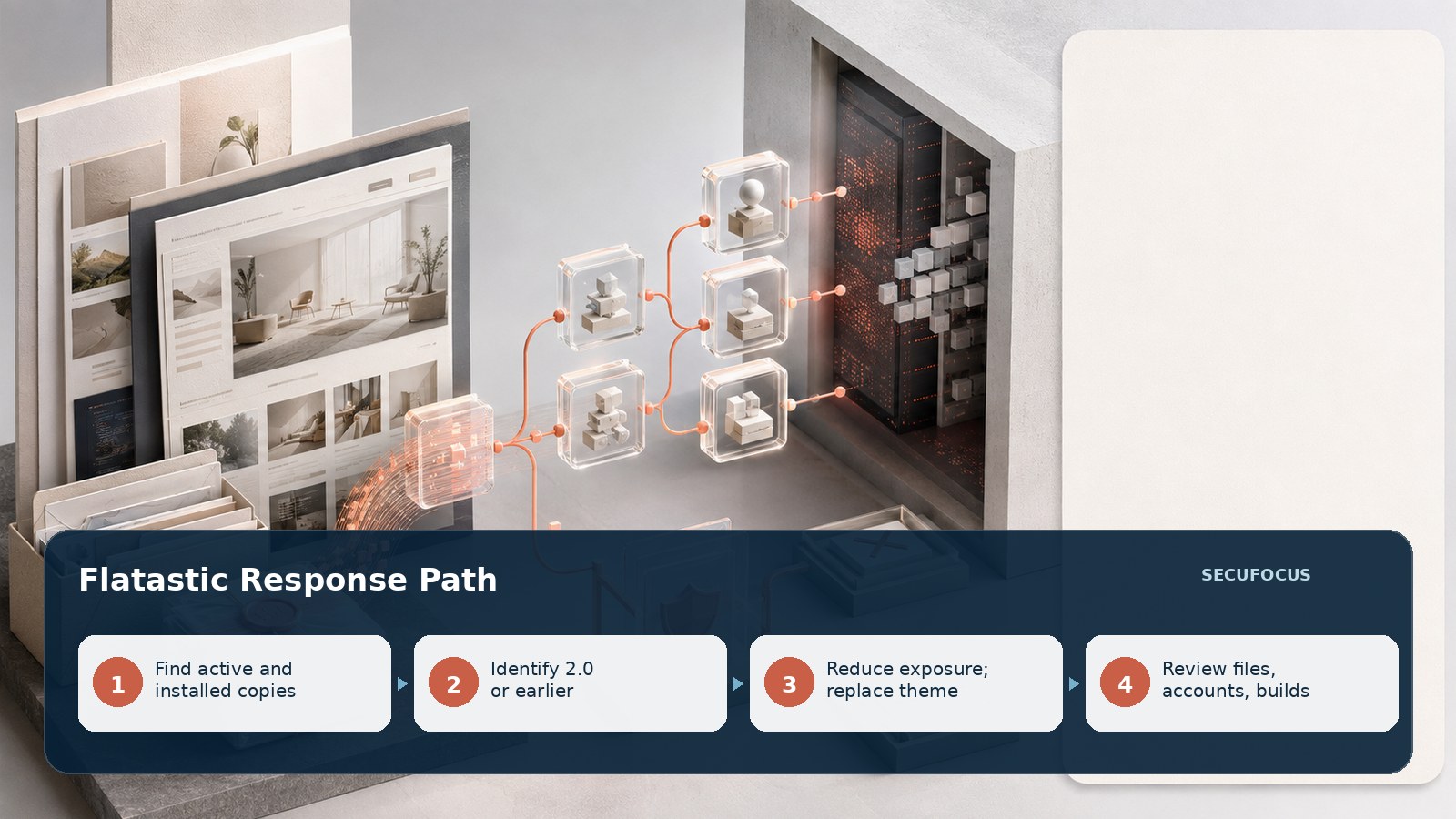
Flatastic theme 2.0 and earlier contains an unauthenticated PHP object injection vulnerability classified as CVSS 9.8 and CWE-502. PHP object injection begins when untrusted serialized data is deserialized. Follow-on impact depends on magic methods and usable POP chains present in the surrounding installation, so reviewing only one theme file does not cover the deployment risk.
Inventory active and inactive themes across production servers, autoscaling images, staging systems, and disaster-recovery copies. On active sites, reduce reachability to the affected processing path and prioritize migration to a verified replacement theme when operationally feasible. For inactive copies, determine whether files remain directly reachable under the web root and remove unnecessary packages.
Review newly created PHP files, recently modified theme files, unexpected administrator accounts, scheduled tasks, autoloaded options, and outbound connections. Align web access logs with file-integrity timestamps to distinguish planned changes from suspicious ones. After replacement, test authentication, forms or commerce flows, caching, and mobile layouts. Update package locks and image-build definitions so the affected theme is not reintroduced during a later deployment.
Operational priority for today
Prioritize by exposure and remediation readiness, not by score alone. If FDS102 is deployed, verify the diagnostic network’s management-interface boundaries and schedule the 2.14.0 update first. Review sessions, logs, users, and file paths as one control set so the eight findings cannot be chained through adjacent weaknesses.
Across WordPress estates, search every site for rtMedia and Flatastic before deciding scope. Combine the rtMedia 4.7.12 update with media-endpoint log review. For Flatastic, find both active and inactive copies, reduce exposure, move to a verified replacement, inspect files, accounts, and scheduled tasks, and correct deployment pipelines. Preserve a rollback point before changes and complete functional testing plus an external-exposure recheck afterward.
Record the asset, prior version, applied version or replacement control, change time, and validation owner. Railway environments may require longer approval and testing cycles, so restrict access paths and log or backup download permissions while the FDS102 update is scheduled. For WordPress, compare the central management inventory with the actual web root and container images. After remediation, watch normal user flows, server error rates, database latency, and new file or account changes together so functional regressions and security anomalies can be separated quickly.
Sources reviewed
- Frauscher: FDS102 for FAdC/FAdCi R2 has multiple vulnerabilitiesCERT@VDE · Official source
- CVE-2026-66592: rtMedia SQL InjectionCVE Program · Official source
- CVE-2026-66672: Flatastic PHP Object InjectionCVE Program · Official source
SECUFOCUS NOW reorganized and analyzed the material above. This article does not replace the original sources.
Related SecuNote articles
August 23 Security Briefing: Fabrik, Mailgun and WS Form Vulnerabilities
This briefing compares an external-input code execution path in Joomla Fabrik, an API request bypass in Mailgun for WordPress, and…

August 17 Security Briefing: Three WordPress Plugin Flaws Affect Uploads, Admin Access, and Booking Data
Three newly published WordPress plugin vulnerabilities affect file-upload validation, administrator account authorization, and…

August 16, 2026 Security Briefing: WordPress, SiYuan, and the Dutch Cybersecurity Act
A practical briefing on the WordPress Profile Builder administrator-authentication bypass, SiYuan’s PDF-annotation code-execution…
Comments
No comments yet.