
RingCentral Breach: Contact Data Tied to 1.6 Million Accounts Published
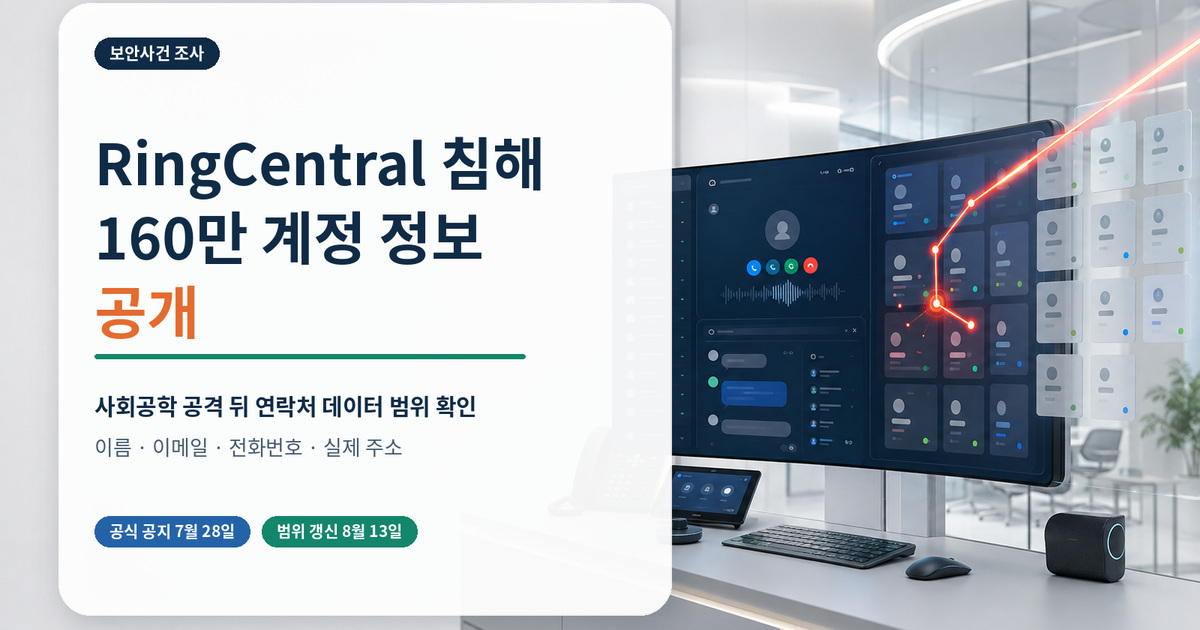
RingCentral disclosed unauthorized activity linked to a sophisticated social-engineering campaign. A material scope update followed when HIBP cataloged about 1.6 million unique email addresses along with names, phone numbers, and physical addresses.
Incident summary
RingCentral, a provider of enterprise calling, messaging, and video services, disclosed that a sophisticated social-engineering campaign led to unauthorized activity involving data tied to a limited portion of customers. The company said it stopped the activity, engaged an outside forensic firm, and began contacting affected customers.
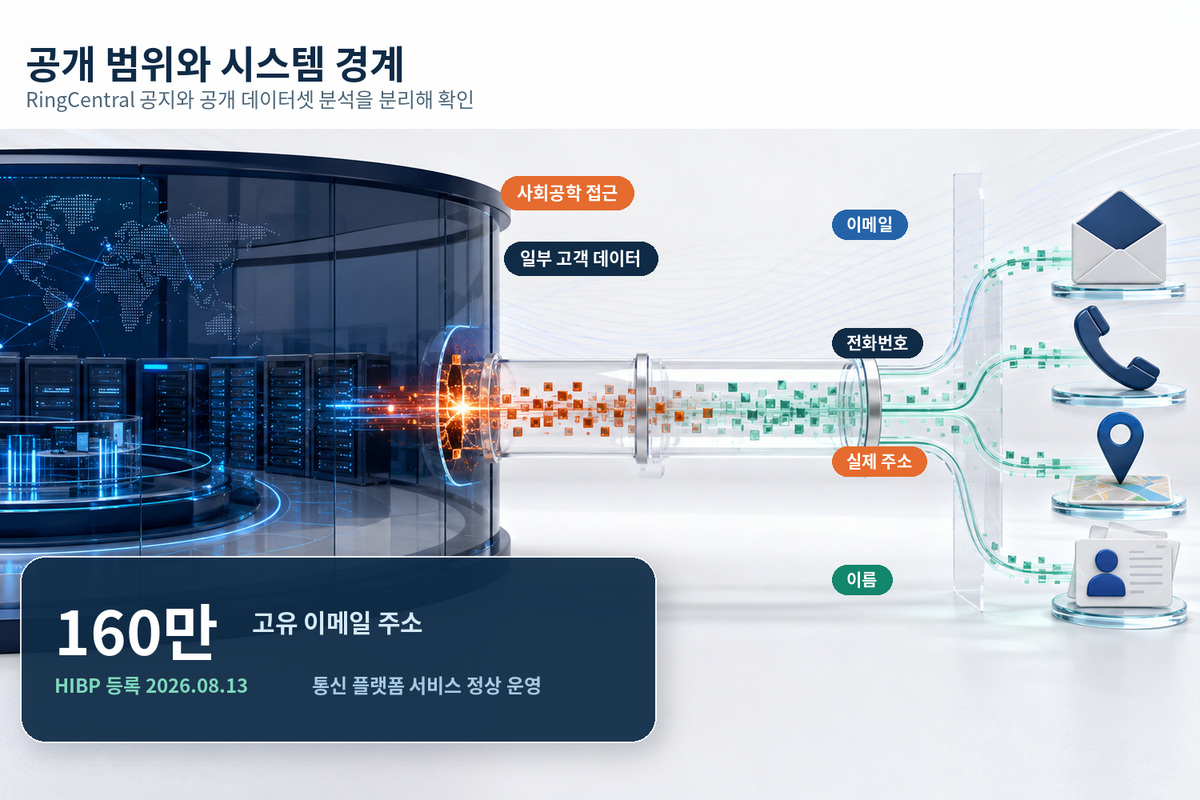
The scope became more concrete on August 13, when Have I Been Pwned added a dataset containing about 1.6 million unique email addresses, together with names, phone numbers, and physical addresses. This is a material scope update rather than a restatement of the original July notice.
RingCentral said its core communications platform remained operational and services continued without disruption. The practical focus is therefore the customer-data boundary, the recipient list for official notifications, and the risk of follow-up impersonation.
Disclosed facts
RingCentral notice
RingCentral described the incident as a sophisticated social-engineering campaign. After detection, it took steps to stop the unauthorized activity and brought in a third-party forensic firm. The company said it had observed no new unauthorized activity after remediation and was communicating directly with affected customers.
The company separated the affected customer data from the availability of its core platform. Calling, messaging, and related services continued to operate, making it important to assess data access and service continuity as different security questions.
The 1.6 million-account update
HIBP added the RingCentral breach on August 13. Its analysis identified roughly 1.6 million unique email addresses, with names, phone numbers, and physical addresses also present. The figure should be read as unique email addresses in the dataset, not automatically as a one-to-one count of individuals.
A combined set of identity and contact details can support convincing impersonation by phone, email, or text. A message may appear to come from RingCentral support, an internal IT desk, a business partner, or a communications administrator while using genuine contact details to establish trust.
Attack and disclosure sequence
The official starting point is social engineering rather than a software vulnerability. Social engineering targets trust and operational procedures to obtain credentials, session approval, one-time codes, or other forms of access. That is the right boundary for customer-side review in this case.
The sequence can be separated into unauthorized access, RingCentral's containment and forensic response, direct customer notification, and HIBP's later analysis of the published dataset. Keeping those stages distinct prevents third-party attribution from being mistaken for a victim-company statement.
HIBP records the incident as connected to a ShinyHunters pay-or-leak campaign. This article treats that label as HIBP's attribution, while using RingCentral's bulletin for the incident, response, and service-status facts. BleepingComputer was used to corroborate the chronology and public-data update.
Recommended checks
Organizations using RingCentral should review more than software versions. Because the disclosed entry point was social engineering, customer notifications, administrative access records, identity changes, and support impersonation should be examined together.
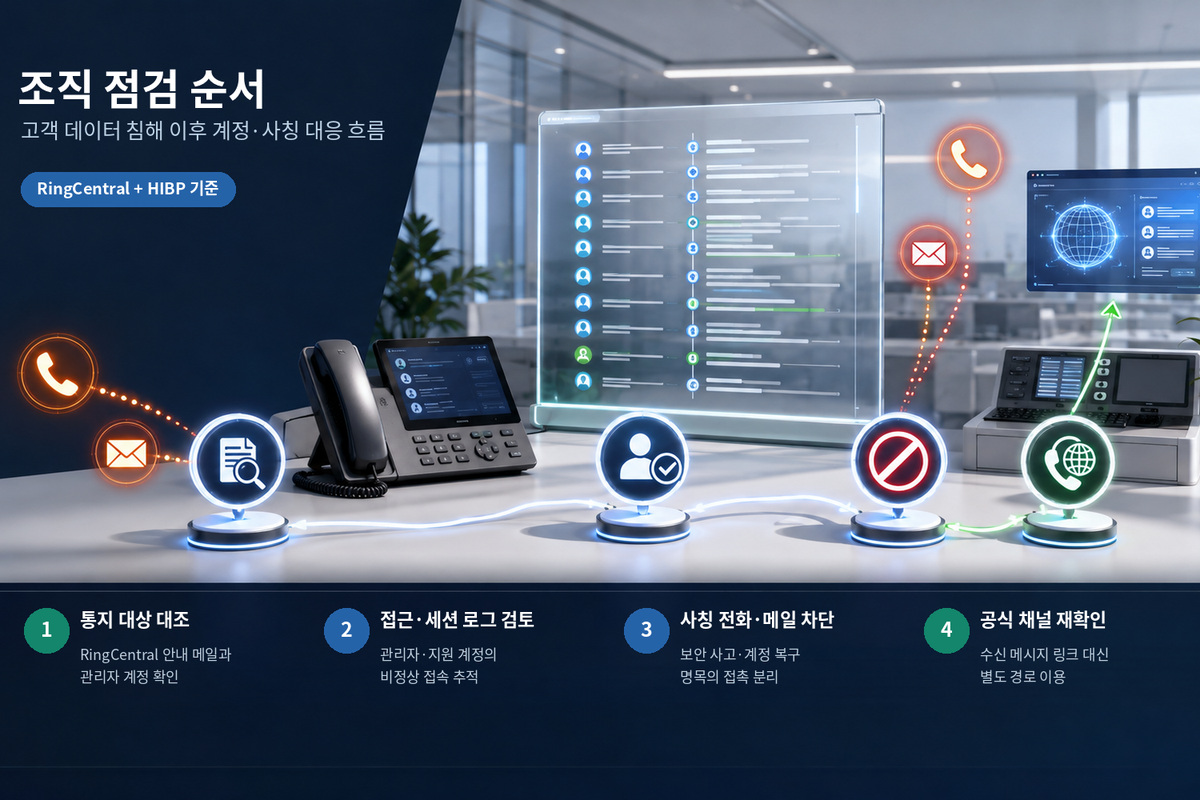
- Notification reconciliation: collect messages sent to security, IT, procurement, contract owners, and RingCentral administrators, then match the tenant and customer account.
- Access and session review: inspect successful administrator logins, new device enrollment, MFA resets, role changes, and newly approved API applications around the incident period.
- Impersonation controls: route calls or messages requesting passwords, one-time codes, recovery codes, or remote-control software into the security reporting process.
- Independent verification: avoid links and reply addresses in unsolicited messages and instead use a previously known administrator portal or contract contact.
Customer notices and account scope
RingCentral notifications should be reconciled with the accounts the organization actually operates. Procurement may own the contract while another team controls the tenant, so a notice can remain in one mailbox unless the contract number, tenant name, and administrator domain are mapped together.
Verified domain owners can use HIBP's domain-search service to assess company email addresses, while individual users can check their own address. Results should be reviewed alongside RingCentral's official customer communications and never through sites that request passwords, MFA codes, or recovery phrases.
Identity and access records
Social-engineering intrusions can use legitimate accounts, making successful logins more important than failure counts alone. Review location, device, time, MFA enrollment changes, administrator grants, and new integrations. Any reactivated support or dormant administrator account should be matched to an approved change record.
If suspicious sessions are found, contain them in a controlled order: terminate sessions, reset passwords, re-enroll MFA, revoke tokens, and remove unnecessary application grants. Validate the result by confirming that subsequent access returns to expected devices, locations, and roles.
Follow-up impersonation
Phone numbers and physical addresses in the dataset mean email filtering is only one part of the response. Attackers can combine genuine details with a supposed security follow-up, account recovery request, equipment replacement, or address confirmation to make a pretext more credible.
Any caller claiming to represent RingCentral or an internal IT desk and requesting a password, one-time code, recovery code, or remote-control installation should be disconnected and verified through a separately initiated official channel. Email teams should also review sender authentication and redirect destinations for voicemail or meeting-themed messages.
Impact
The confirmed impact is concentrated in customer data described by RingCentral and the contact records cataloged by HIBP. Service availability was maintained, but the combination of name, email, phone number, and physical address can increase the credibility of targeted phishing and voice-phishing attempts.
Organizations in any country that use a RingCentral tenant, including multinational operations, can apply the same decision points: official notification, verified-domain search results, and administrator logs. Overseas subsidiaries and headquarters should use a shared incident identifier so that the same account or contact record is not investigated twice.
The incident also shows why service uptime and customer-data access require separate monitoring. Customer-support accounts, CRM connections, administrator portals, and outsourced support channels should have their own inventories, logging requirements, and verification procedures.
Sources
[RingCentral Security Bulletin|General Advisory Notice, July 28, 2026]
https://www.ringcentral.com/trust-center/security-bulletin.html
[Have I Been Pwned|RingCentral Data Breach, August 13, 2026]
https://haveibeenpwned.com/Breach/RingCentral
[BleepingComputer|RingCentral data breach exposed info of 1.6 million accounts, August 14, 2026]
https://www.bleepingcomputer.com/news/security/ringcentral-data-breach-exposed-info-of-16-million-accounts/
Verification cutoff: August 16, 2026, 18:40 KST. RingCentral's bulletin was compared with HIBP's listing and specialist reporting.
For more cybersecurity incident analysis and response guidance, visit secufocusnow.com.
https://secufocusnow.com
Sources reviewed
- General Advisory Notice — RingCentral ResponseRingCentral · Official source
- RingCentral Data BreachHave I Been Pwned
- RingCentral data breach exposed info of 1.6 million accountsBleepingComputer
SECUFOCUS NOW reorganized and analyzed the material above. This article does not replace the original sources.
Comments
No comments yet.