
Four PAX Q80 Zero-Day CVEs Expose Installer and Service Trust Boundaries
Four vulnerabilities in the PAX Q80 payment terminal affect signature verification, file handling, and service authentication. No direct South Korean impact is confirmed; operators should assess the exact firmware and adjacent network exposure.
Today’s Main Security Issue
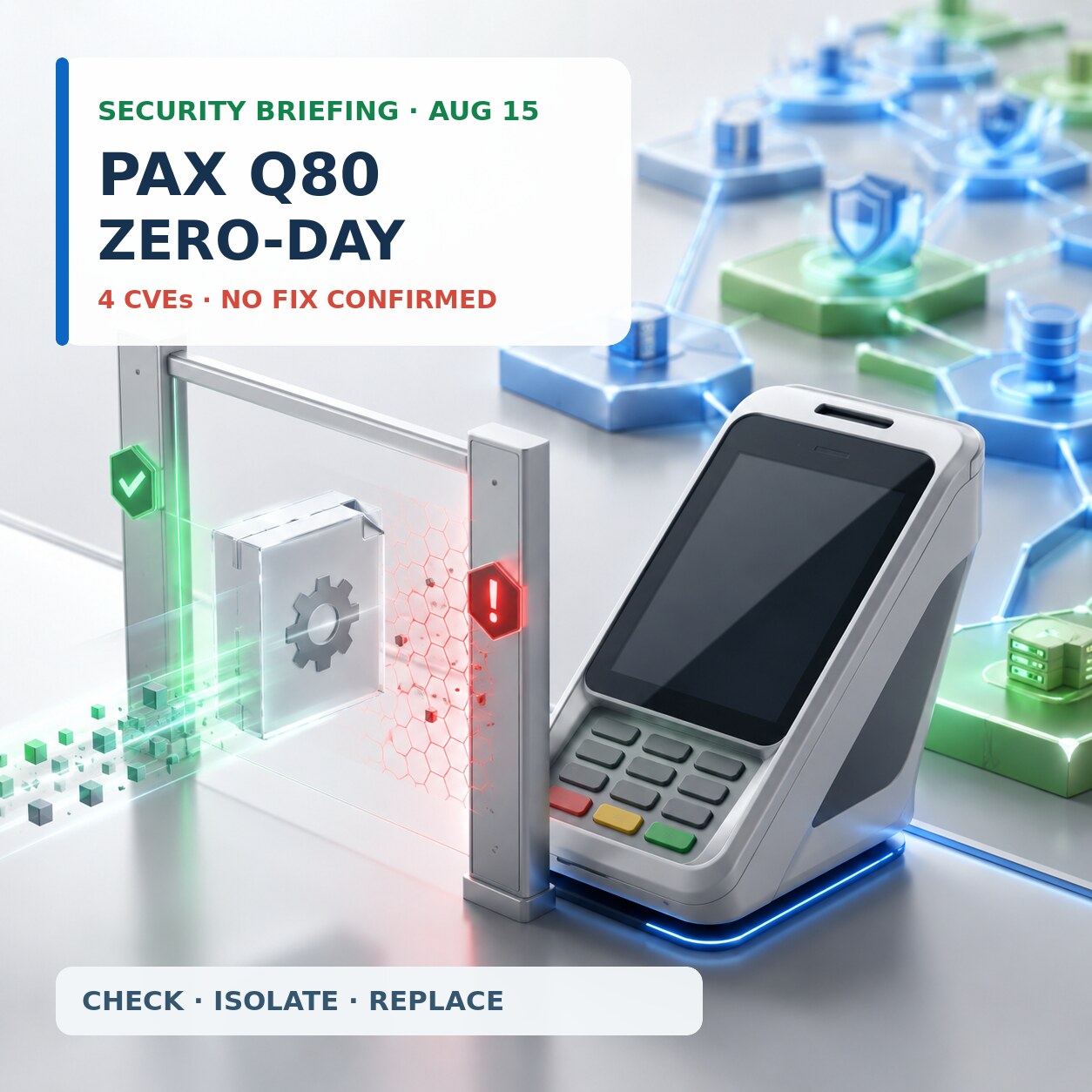
This August 15 briefing covers four vulnerabilities disclosed in the PAX Technology Q80 payment terminal. The Zero Day Initiative published CVE-2026-19910 and CVE-2026-19911 on August 14 and updated its earlier advisories for CVE-2026-19908 and CVE-2026-19909 on the same day. The findings span several trust boundaries: application-package signature checks, AIP file handling, and authentication around the XCB service.
ZDI says CVE-2026-19910 and CVE-2026-19911 are reachable by an unauthenticated, network-adjacent attacker and may be chained with other flaws to execute code as root. CVE-2026-19909 can enable an arbitrary file write through unsafe symbolic-link handling, while CVE-2026-19908 allows an adjacent attacker to access sensitive information or alter device configuration because the XCB daemon does not authenticate requests. None of these statements means every Q80 can be taken over directly from the public internet.
No public evidence currently confirms affected deployments or victims in South Korea. Relevance is therefore indirect and environment-dependent: it turns on whether a Q80 is deployed, which firmware it runs, and who can reach its management services. PAX told ZDI that the reported firmware was end of life, but the public advisories do not settle whether supported releases are also affected. Operators should not declare all Q80 units vulnerable, or dismiss the issue solely because the reported build is unsupported.
At a Glance
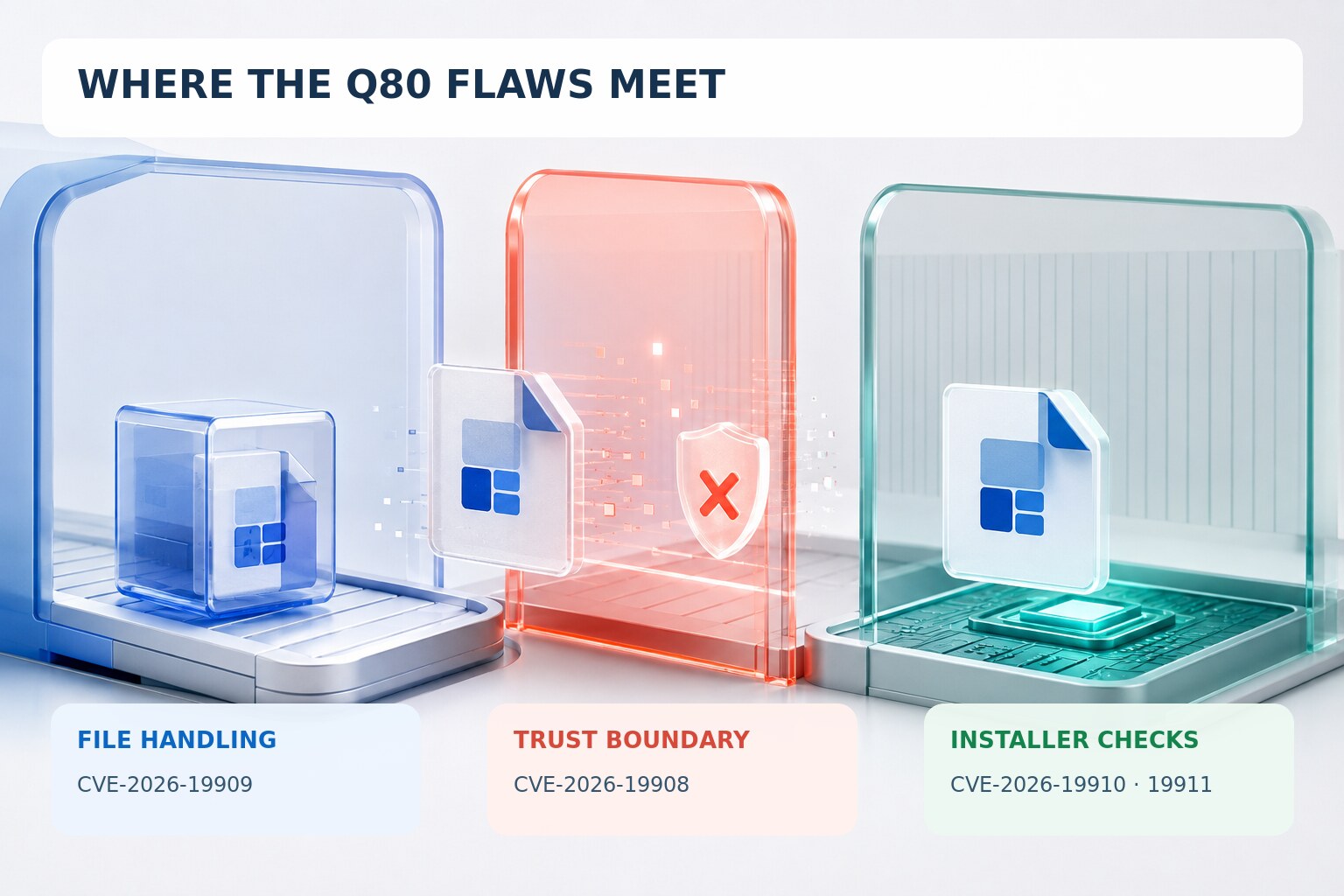
- CVE-2026-19910 and CVE-2026-19911: weaknesses in signature verification during Q80 application installation. ZDI assigns a CVSS score of 7.5.
- CVE-2026-19909: unsafe symbolic-link handling while processing AIP files can lead to an arbitrary file write and may become part of a privilege-escalation chain.
- CVE-2026-19908: missing authentication in the XCB daemon can let a network-adjacent attacker obtain sensitive information or modify device settings.
- The advisories provide no confirmed exploitation, South Korean victim reports, or actionable IOCs. Here, zero-day refers to disclosure without a confirmed remedy for the reported environment, not proof of an active campaign.
Indicator Update
The reviewed advisories do not publish new IP addresses, domains, file hashes, or other directly actionable indicators of compromise. Inventory, firmware identification, and reduction of management-plane access should take priority over IOC blocking.
Major Incidents
No confirmed incident or South Korean victim case tied to these Q80 vulnerabilities was identified in the reviewed primary material. A vulnerability disclosure should not be presented as evidence that a breach has already occurred.
Newly Disclosed CVEs
CVE-2026-19910 and CVE-2026-19911 concern signature verification in the Q80 application installation workflow. ZDI describes the path as accessible to an unauthenticated attacker with network-adjacent access and notes that the flaws can be combined with other weaknesses to reach root-context code execution. This is a chaining scenario with access prerequisites, not a claim of immediate root compromise from anywhere on the internet.
CVE-2026-19909 affects the handling of AIP files. A crafted file can abuse symbolic links and cause a write to an attacker-selected location. The outcome depends on where data is written and how the resulting file is used. Operators should review who can introduce installation or update files, where those files come from, and whether the delivery path is protected against unauthorized changes.
CVE-2026-19908 is an authentication failure in the XCB daemon. An attacker who can reach the service from an adjacent network may obtain sensitive information or alter configuration without authenticating. A terminal connected broadly to office, wireless, or maintenance networks can reduce the practical difficulty of meeting that prerequisite. Checking only for direct internet exposure is insufficient.
The affected-version boundary remains uncertain. PAX said the reported firmware was end of life, while the published advisories indicate that the scope for supported releases was not resolved before disclosure. Because a clear fix for the reported environment was not available in the public material, operators should obtain written confirmation from the vendor or supplier covering the exact model, firmware build, support status, and available upgrade or replacement path.
KISA Notice Check
As of this review, no new KISA notice directly covering these four PAX Q80 vulnerabilities was identified. Any later Korean advisory should be compared against the exact affected products and recommended actions.
Operational Notes
Start by reconciling the asset register, payment-service provider records, and maintenance contracts to determine whether Q80 terminals are present. Record the firmware build, application-management components, XCB usage, update path, and maintenance owner. Use existing management tooling and vendor procedures for read-only identification; do not install test packages or restart services merely to check exposure.
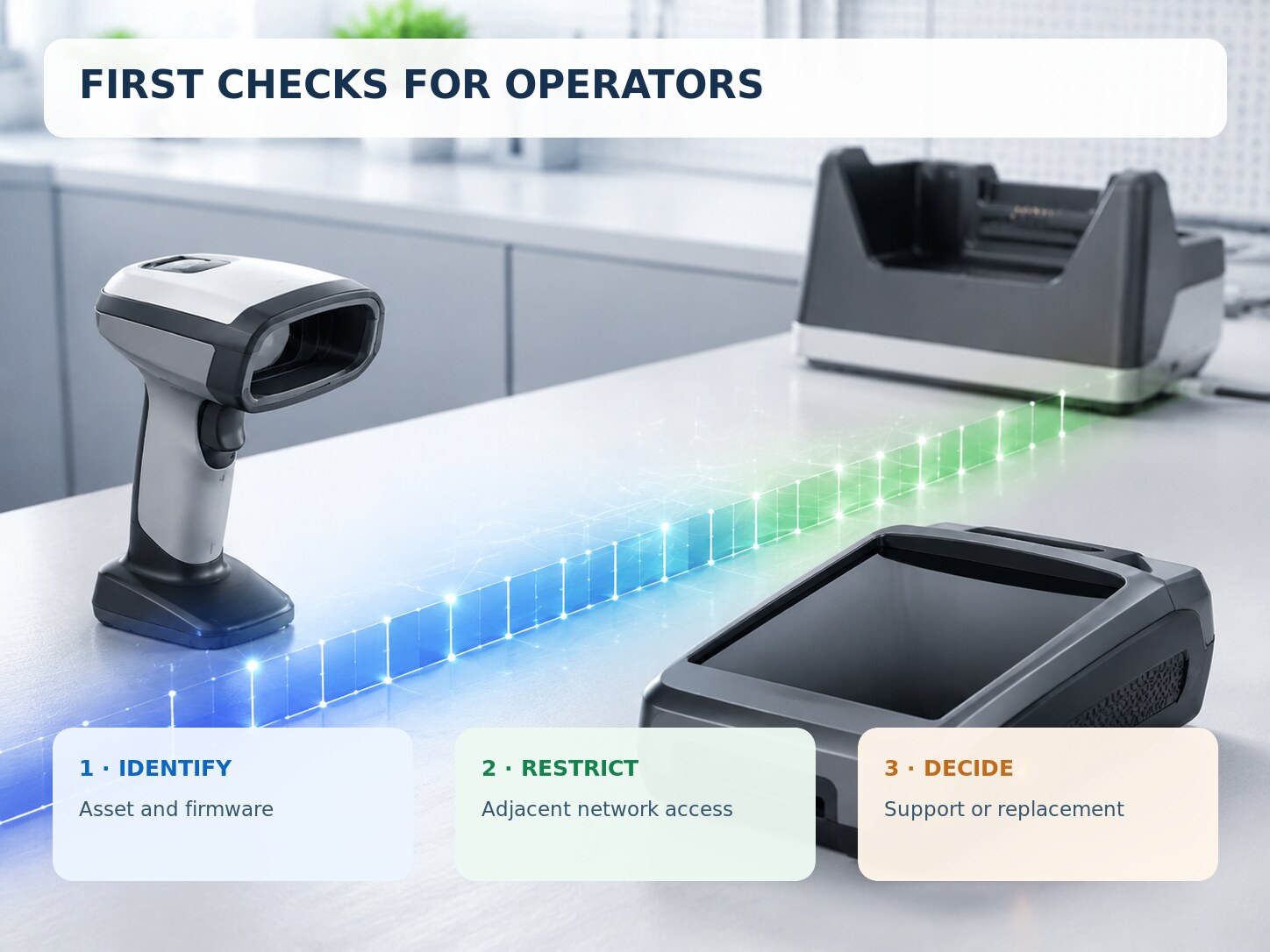
- Identify: record every Q80 asset, firmware build, update route, and responsible supplier.
- Restrict: permit management services only from approved management servers or maintenance segments, and separate payment traffic from administrative access.
- Control changes: accept AIP files and application packages only through approved repositories and delivery channels.
- Confirm support: ask the vendor or supplier whether the exact firmware is affected and what supported update or replacement path is available. If the answer is unclear, tighten isolation and raise replacement priority.
- Observe: look for unexpected configuration changes, new file writes, altered installation history, and unusual management-plane access. Since no official IOC set is available, compare activity against the terminal’s normal baseline.
This briefing is based on three ZDI advisories available on August 15, 2026. No evidence of active exploitation or direct South Korean impact was identified. Decisions should be based on the deployed firmware and reachable network boundaries, not on the product name alone.
Sources reviewed
- PAX Technology Q80 Application Installer Signature Verification VulnerabilitiesZero Day Initiative
- PAX Technology Q80 AIP File Symbolic Link Arbitrary File Write VulnerabilityZero Day Initiative
- PAX Technology Q80 XCB Daemon Missing Authentication VulnerabilityZero Day Initiative
SECUFOCUS NOW reorganized and analyzed the material above. This article does not replace the original sources.