
PAX Q80 CVEs: Four Trust-Boundary Failures and What Operators Should Do
Four PAX Q80 vulnerabilities affect application-signature checks, AIP file-path handling, and XCB service authentication. This analysis separates the prerequisites of each flaw, explains why chaining matters, and gives operators a defensible way to assess exposure while patch availability remains unclear.
Why four CVEs should not be treated as one flaw
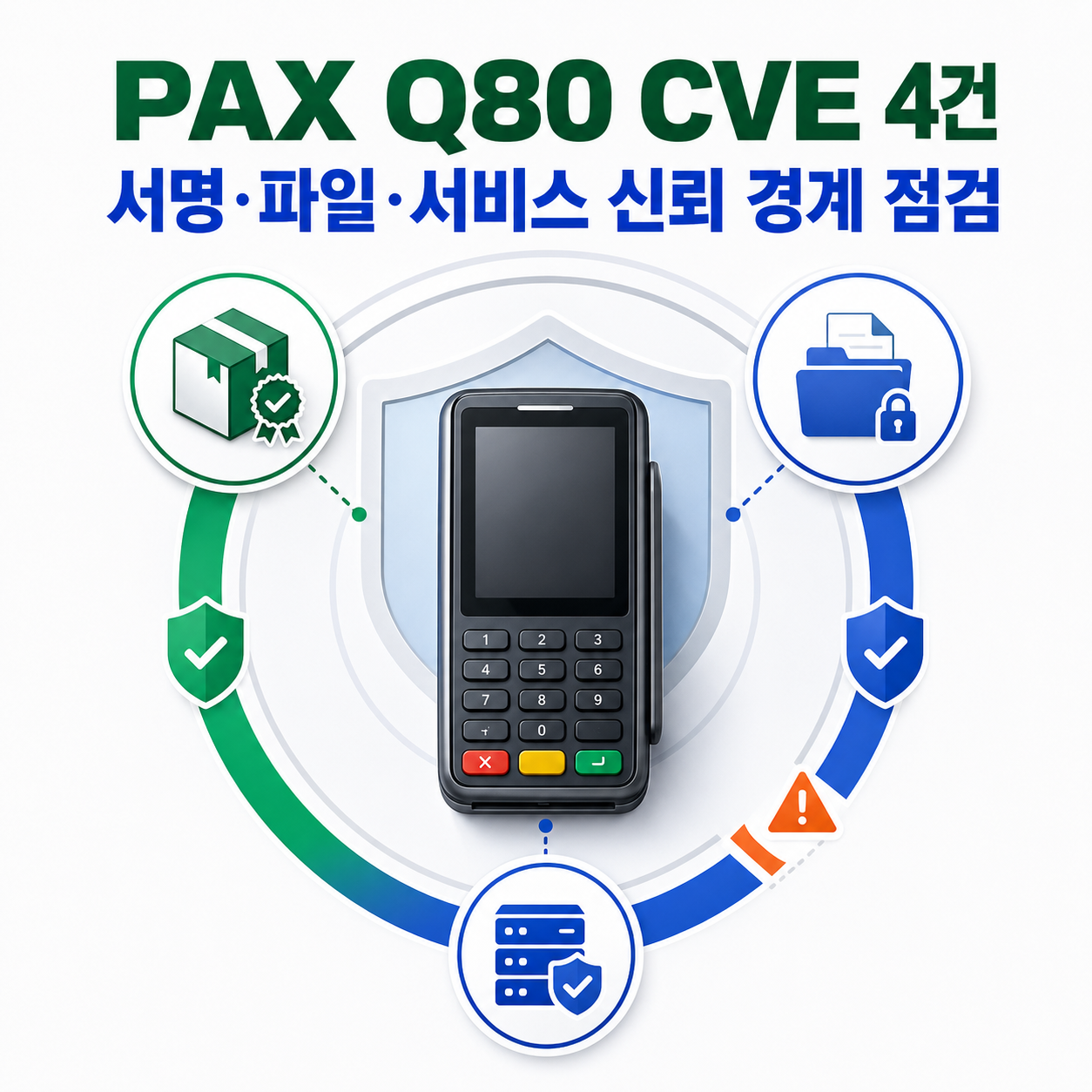
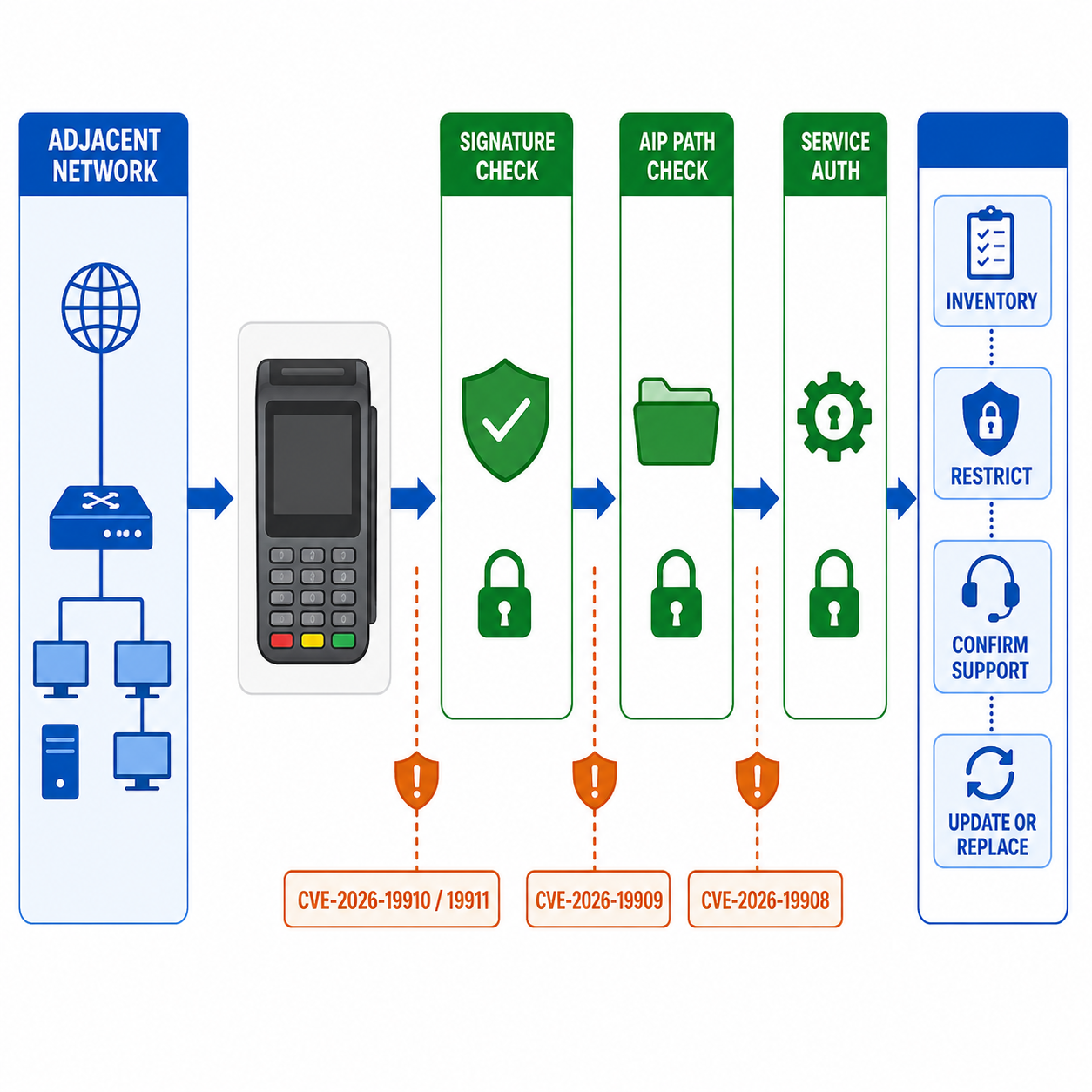
CVE-2026-19908, CVE-2026-19909, CVE-2026-19910, and CVE-2026-19911 all concern the PAX Technology Q80 payment terminal, but they affect different controls. One advisory concerns cryptographic-signature verification during application installation, another concerns where an AIP file can cause the installer to write, and a third concerns authentication in the XCB daemon. The shared product name is less useful for risk decisions than the three trust boundaries involved.
The Zero Day Initiative (ZDI) describes all four as adjacent-network issues. That does not mean an attacker anywhere on the internet can immediately compromise a terminal. The attacker needs a path from the same network segment, a maintenance network, or another system that can reach the exposed service. A flat store network or broadly accessible support network can nevertheless make that prerequisite easier to satisfy than the label suggests.
CVE-2026-19910 and CVE-2026-19911: trust in the application installer
ZDI groups CVE-2026-19910 and CVE-2026-19911 in a single advisory. The Q80 application installer may proceed without properly verifying a cryptographic signature before installing an application. ZDI assigns a CVSS 3.x score of 7.5 with vector AV:A/AC:H/PR:N/UI:N/S:U/C:H/I:H/A:H. The assessment requires adjacent-network access and high attack complexity, but no prior privileges or user interaction.
The advisory does not say that this condition alone guarantees root-level execution on every Q80 deployment. It says the flaw can be combined with other vulnerabilities to execute code as root. Operators therefore need to examine the entire software-delivery chain: where packages originate, which server distributes them, who can approve installation, whether a failed signature check is visible, and whether installation events are centrally retained.
CVE-2026-19909: escaping the intended AIP file boundary
CVE-2026-19909 is a link-following weakness in AIP file parsing. By creating a symbolic link, an attacker may abuse the installer process to write an arbitrary file. ZDI scores the issue at 7.5 with the same adjacent-network, high-complexity vector used for the installer-signature advisory. Arbitrary file write is not automatically equivalent to code execution; the outcome depends on the chosen path, the target file, and the privilege of the process performing the write.
The operational questions are concrete: who can submit an AIP file, where incoming files are stored, what privileges the installer has, and whether an unapproved file can enter the deployment path. If another flaw supplies access to the installation flow, CVE-2026-19909 may become an intermediate step in a privilege-escalation chain.
CVE-2026-19908: an unauthenticated XCB service boundary
CVE-2026-19908 affects authentication in the XCB daemon. ZDI says an adjacent-network attacker may access functionality without authentication, disclose sensitive information, or modify device configuration. The CVSS 3.x score is 7.1 with vector AV:A/AC:L/PR:N/UI:N/S:U/C:H/I:L/A:N. Unlike the other advisories, attack complexity is rated low, while the direct impact emphasizes confidentiality and limited integrity loss.
Unauthenticated configuration access can also help establish the conditions needed for another weakness. Blocking direct internet exposure is therefore only one control. Operators must identify every internal segment, support appliance, remote-maintenance route, and management host that can reach the XCB service.
Four questions that determine practical exposure
- Is the device actually a Q80, and does it run the reported firmware family or a release that the supplier identifies as affected?
- Can a store LAN, corporate wireless network, maintenance segment, or remote-support appliance reach the terminal's management services?
- Do AIP files and application packages travel only through approved repositories and distribution servers, with signature failures and installation events retained centrally?
- If the XCB service is enabled, are its possible callers constrained by network policy, and can configuration changes be compared with a known-good baseline?
A product-name match without a firmware and feature check can generate both false positives and dangerous exclusions. Likewise, treating adjacent-network access as a minor prerequisite can hide exposure created by poor segmentation or a compromised maintenance account. Inventory and reachability should be established before assessing package and service controls.
How to interpret the vendor-impact dispute
ZDI's disclosure timeline records two facts that matter to operators. PAX described the reported firmware as end-of-life, and the parties disagreed about the impact on supported releases. The vendor stated on April 23, 2026 that the reported firmware was no longer supported and confirmed the issue on that firmware on July 21. ZDI argued that affected users could not simply move to a newer firmware, while the vendor disputed the stated impact on supported releases.
Those entries do not establish that every Q80 is vulnerable, nor do they justify assuming that every supported release is safe. Operators should send the exact model, firmware build, regional supplier, and maintenance entitlement to PAX or the authorized supplier and request a written determination for each CVE. A useful response should name the evaluated release and feature conditions, the fixed version if one exists, the end-of-support date, and the approved replacement path.
Controls to apply before a definitive fix
- Reconcile the asset register with field data and record the Q80 model, firmware build, installed management components, and whether the XCB service is used.
- Permit management ports and services only from approved administration servers and maintenance segments. Separate payment traffic from device-management traffic.
- Distribute AIP files and application packages only through approved repositories. Do not test an untrusted file on a production payment terminal.
- Compare installation history, unexpected file creation, configuration changes, and new management connections with a known-good baseline. The ZDI advisories do not provide IP addresses, domains, or file hashes that can serve as direct blocking indicators.
- When a safe vendor update is available, apply it through change control with a recovery plan. If no corrected release exists or support has ended, strengthen isolation and set a replacement date.
Begin with read-only inventory and network-path validation. Testing the weakness by introducing a file or changing service settings on a live terminal can harm the integrity or availability of a payment environment. Any technical validation should follow vendor procedures and use an authorized test device, not a production terminal.
A defensible prioritization model
An organization with no Q80 assets can document a not-applicable decision based on its inventory. A Q80 deployment with tightly separated management access and controlled package delivery should preserve those controls while obtaining a vendor determination. A deployment with broad internal reachability, unknown firmware support, or an untraceable package path should be treated as higher priority, with access restriction and supplier escalation performed in parallel.
The published ZDI material does not cite active exploitation, victim organizations, or campaign indicators. The immediate task is therefore exposure management, not threat-campaign hunting. Assess each CVE separately, then account for the possibility that a weakness at one trust boundary could lower the prerequisites for another.
Sources reviewed
- PAX Technology Q80 Application Installer Signature Verification Bypass Remote Code Execution VulnerabilityZero Day Initiative · Official source
- PAX Technology Q80 AIP File Parsing Link Following Remote Code Execution VulnerabilityZero Day Initiative · Official source
- PAX Technology Q80 XCB Daemon Missing Authentication VulnerabilityZero Day Initiative · Official source
SECUFOCUS NOW reorganized and analyzed the material above. This article does not replace the original sources.