
August 17 Consumer Security Briefing: Impersonation Calls, Customer Data, and Debt-Relief Scams
A local-office callback request, a customer-data incident, and a government-style tax-debt offer look different, but the first safe step is the same: leave the message behind and verify through an independently found official channel.
Cutoff: August 17, 2026 at 4:00 p.m. KST. This briefing focuses on three consumer-security situations that require a decision by the recipient: a callback request using what appears to be a local government number, a company notice about customer data, and an official-looking offer to resolve tax debt. Each uses a familiar trust signal before directing the recipient into a phone number, link, or process chosen by the sender.
A displayed caller ID, a real company name, or a formal letterhead is not independent verification. The safest first step is to leave the channel: end the call, close the message, and locate the organization through an official website or a contact already known to be genuine.
Callback request using a local-office number
KISA warned on August 11 that callers had spoofed real local community-center numbers, posed as public officials, and provided another number said to belong to the Korea Credit Information Services. People who called back were asked to complete identity verification and provide personal information. Calling a number supplied by the original caller does not make the second call independent.
KISA says the Korea Credit Information Services does not ask for identity verification or personal information by phone or KakaoTalk. If a caller requests an app installation, a URL visit, or remote assistance, end the interaction. Look up the public office through its official page, and report spoofed caller IDs or seek guidance through KISA's published channels.
Handling a customer-data notice
RingCentral said in a July 28 advisory that it had been targeted by a sophisticated social-engineering campaign. The company stopped the unauthorized activity, began an investigation with an outside forensic firm, and said data belonging to a limited portion of customers was affected. It is contacting affected customers directly and stated that the core platform and service availability were not impacted.
Recipients should verify whether they actually received a company notice and then sign in through a normal bookmark, an official app, or a manually entered address rather than a link in an unexpected message. A breach notice and an account takeover are not the same event, but directly contacted customers should review recent account activity, replace reused passwords, and enable multifactor authentication where available.
Government-style tax-debt offers
The U.S. Federal Trade Commission described a nearly $10 million settlement involving American Tax Service. According to the FTC, the company sent letters impersonating government agencies, imposed a deadline, warned of possible property seizure, and used advertising to drive people into sales calls containing false promises of tax-debt relief.
This enforcement action concerns the U.S. tax system and should not be treated as a description of Korean tax procedures. The verification lesson is broader: a private company cannot establish a taxpayer's eligibility or guarantee an outcome simply by using official-looking language. Verify the program and responsible agency through a government website, and be cautious when a seller promises large reductions, demands full payment upfront, or creates an immediate deadline.
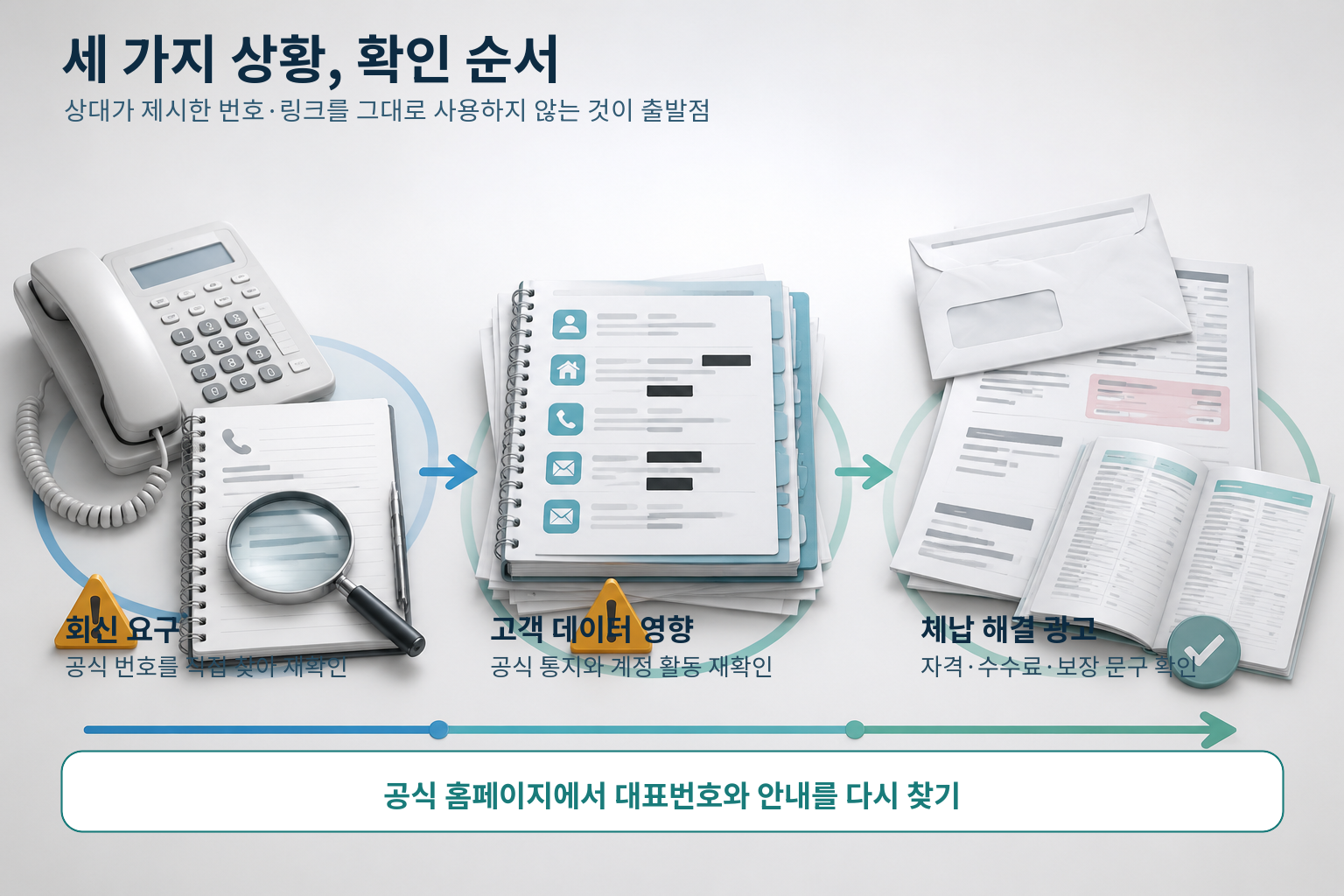
A repeatable verification sequence
- End any call that claims to be from a public office but directs you to a different callback number.
- Do not share verification codes, passwords, bank credentials, or identity documents, and do not install remote-access apps on request.
- Open a company's security notice and account page through a known official route, not through an unexpected email or text.
- Write down the program name and responsible agency in a debt-relief offer, then check both on an official government site.
- Treat guarantees, steep reductions, full upfront fees, and same-day deadlines as reasons to pause and verify independently.
- If money or credentials were already provided, contact the relevant bank, service provider, and public reporting channel without delay.
The common control across all three situations is channel separation. Do not use the number, link, or account supplied by the party asking for trust. Find the organization again through an official source and confirm the request before providing information, installing software, or making a payment.
Sources reviewed
- 주민센터 전화번호를 사칭한 회신유도 보이스피싱 주의KISA 보호나라&KrCERT/CC · Official source
- RingCentral Security Bulletins - General Advisory NoticeRingCentral · Official source
- Struggling with tax debt? Here's what to knowU.S. Federal Trade Commission · Official source
SECUFOCUS NOW reorganized and analyzed the material above. This article does not replace the original sources.
Comments
No comments yet.