
Cl0p’s Windchill and FlexPLM Campaign: What Is Confirmed Behind the Claims of Nearly 50 Victims
Cl0p claims it stole data from nearly 50 organizations through vulnerable PTC Windchill and FlexPLM systems. This report separates confirmed disclosures from attacker claims and outlines what operators should examine now.

Incident Overview
Disclosures published on August 13, 2026 linked Cl0p’s data-theft operation to PTC Windchill and FlexPLM environments. The extortion group claims it obtained data from nearly 50 organizations across manufacturing, energy, medical technology, and financial services. No victim organization, regulator, or law-enforcement body has validated the claimed victim count or the alleged volume as one uniform breach.
Several named companies did acknowledge that they made separate public statements about events involving the affected product family. Philips said an internal server was targeted but found no evidence that customer data was affected. Shell said it had identified a security event and engaged outside security specialists. Fiserv said it had found no evidence that customer or operational data was compromised, while GE activated its cyber-response process. Those statements represent different levels of confirmation and should not be collapsed into one definitive victim count.
What Has Been Disclosed
The shared technical issue is CVE-2026-12569. NIST describes it as an unsafe-deserialization flaw in Windchill PDMLink and FlexPLM that can allow an unauthenticated remote attacker to execute code over the network. CISA added the vulnerability to its Known Exploited Vulnerabilities catalog on June 25 and set a June 28 remediation deadline for U.S. federal agencies.
PTC began publishing indicators and response guidance in June. Its advisory identifies persistent JSP web shells placed under the Windchill login directory, attacker-controlled IP addresses, an abnormal X-windchill-req header, and suspicious POST activity. PTC warned on June 25 that heightened threat activity was continuing, announced patches for multiple supported releases on July 14, and expanded its indicator list again on July 27.
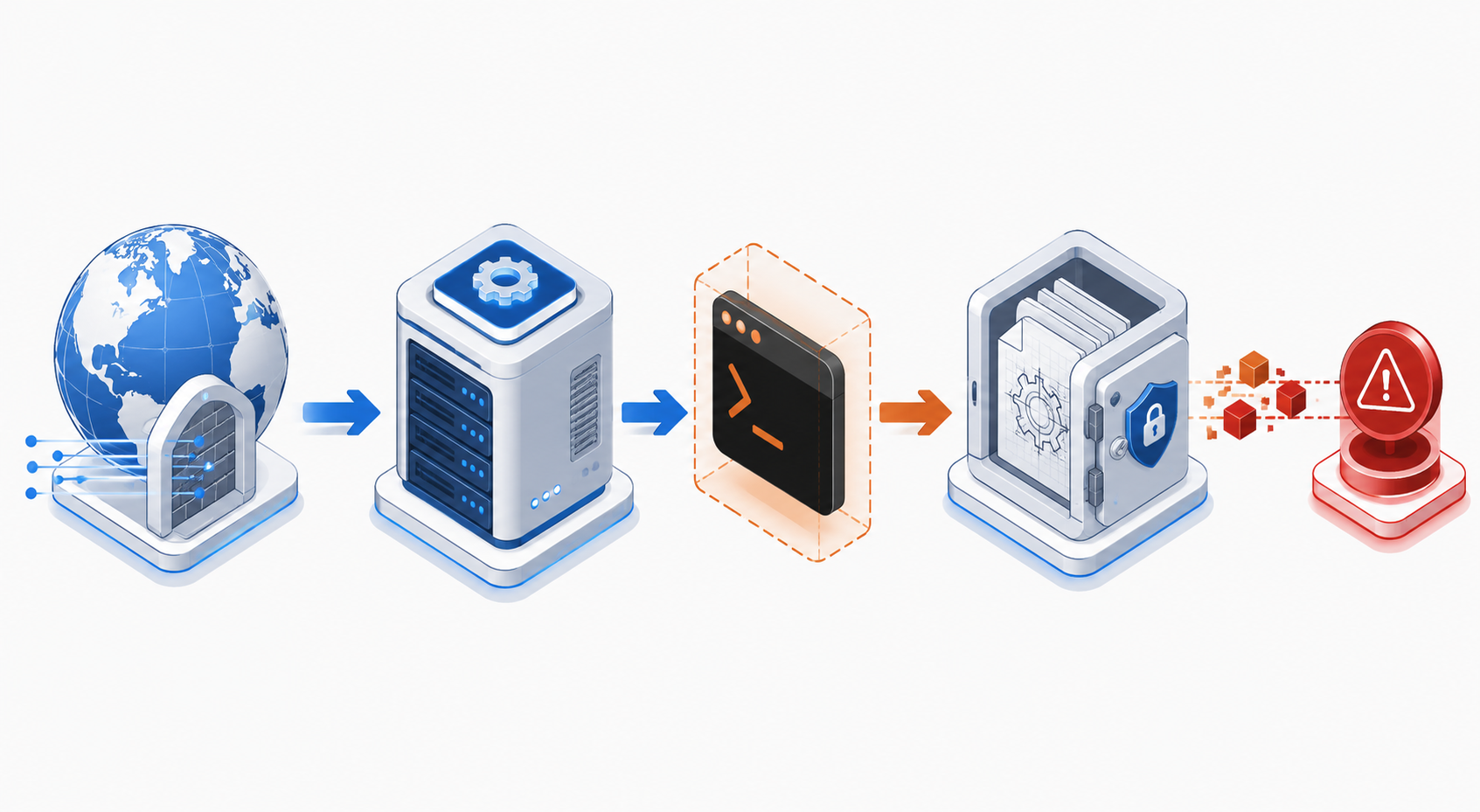
The public evidence describes a chain in which a malicious request reaches a vulnerable application, code execution is gained, and a JSP web shell is left behind for continued command and file access. PTC recommends looking for six- or sixteen-character hexadecimal JSP names, dpr_-style names, POST requests to the login directory, the X-windchill-req header, and unusually large responses from JSP resources. These indicators are leads rather than an exhaustive list.
Evidence Boundaries
- The full list of claimed victims, the amount of data taken from each organization, and whether every listed organization was actually compromised.
- The final findings and notification scope for Philips, Shell, Fiserv, GE, and other companies named by the extortion group.
- Whether CVE-2026-12569 was the only entry route or whether other vulnerabilities and stolen credentials were also used.
- Any direct impact on Korean organizations or Korean users; the assessed first-party public records contain no announcement of such impact.
Names and file counts posted by an extortion site should be treated as claims until a victim organization, regulator, or law-enforcement body validates them. Internal incident records should preserve the same distinction: attacker assertions in one column, evidence confirmed from the organization’s own telemetry in another.
Response Priorities
- Inventory every Windchill PDMLink, FlexPLM, and related CPS component, noting whether each instance is internet-facing, partner-accessible, self-hosted, or PTC-hosted.
- Compare the installed build and mitigation state with PTC’s current advisory and support article CS473270. Environments that relied on an earlier workaround should confirm that the July patch set and later advisory changes are covered.
- Hunt across web, proxy, WAF, EDR, and file-integrity data for POST requests to JSP files under /Windchill/login/, hexadecimal and dpr_ file-name patterns, the X-windchill-req header, and abnormally large JSP responses.
- If suspicious artifacts are present, isolate the system and preserve volatile data and logs before deleting a web shell or rebooting. Premature cleanup can remove evidence needed to establish the entry path and scope.
- Examine connected service accounts, API keys, SSO tokens, and administrative credentials. Check for abnormal access to engineering drawings, bills of materials, supplier documents, and bulk downloads from the PLM repository.

Patching and incident analysis solve different problems. A patch reduces the chance of another exploit, while evidence collection determines whether a system was already compromised and what the intruder reached. Internet-exposed systems need both workstreams, followed by restoration from a known-clean image or backup whose creation date has been verified.
Impact Assessment
The assessed first-party sources do not identify a direct Korean victim. The relevance to Korean organizations is indirect but practical: manufacturers, automotive and electronics suppliers, aerospace companies, and retailers often use PLM systems to centralize designs, bills of materials, supplier records, and release plans. A Korean operator does not need a business relationship with a named overseas victim to share the same product exposure.
A compromised PLM repository can expose intellectual property, cost and supply-chain information, and provide a foothold for movement into other internal systems. At the same time, the current evidence does not support a claim that every named company lost customer data. Product inventory, exposure records, logs, and forensic artifacts—not the extortion group’s list—should drive each organization’s conclusion.
Sources
- PTC Trust Center — Windchill and FlexPLM remote-code-execution advisory, patches, indicators, and change history
- NIST National Vulnerability Database — CVE-2026-12569 description, affected versions, severity, and KEV status
- CISA Known Exploited Vulnerabilities Catalog — confirmation of exploitation and required action
- Reuters, August 13, 2026 — Cl0p’s claims and individual responses from Philips, Shell, Fiserv, and GE
Sources reviewed
- Hacking group claims mass data theft from Shell, Philips, GE, Fiserv and dozens of othersReuters
- Customer & Partner Updates: Remote Code Execution Vulnerability in PTC’s Windchill and FlexPLM SolutionsPTC · Official source
- CVE-2026-12569 DetailNIST National Vulnerability Database · Official source
- Known Exploited Vulnerabilities CatalogU.S. Cybersecurity and Infrastructure Security Agency · Official source
SECUFOCUS NOW reorganized and analyzed the material above. This article does not replace the original sources.